
The University is reshaping its role in national defense—an evolution decades in the making and now formalized under a single, determined office. With this year’s launch of National Defense Initiatives (NDI), KU is uniting military-focused research, education and service in a way that few public institutions have dared. Leading the charge is Mike Denning, a retired Marine colonel as adept at coordinating helicopter squadrons as he is at fine-tuning the University’s support for the nation’s defense community.
Denning, c’83, assistant vice chancellor for national defense initiatives, leads NDI with a mandate that’s both strategic and personal.
“Jayhawks Rising, the University’s strategic plan, was the driving force behind the new office,” Denning says. “We came together to conceive how the office can better support the University’s strategic priorities. Now we have the structure to better support these priorities while advancing our support to the military.”
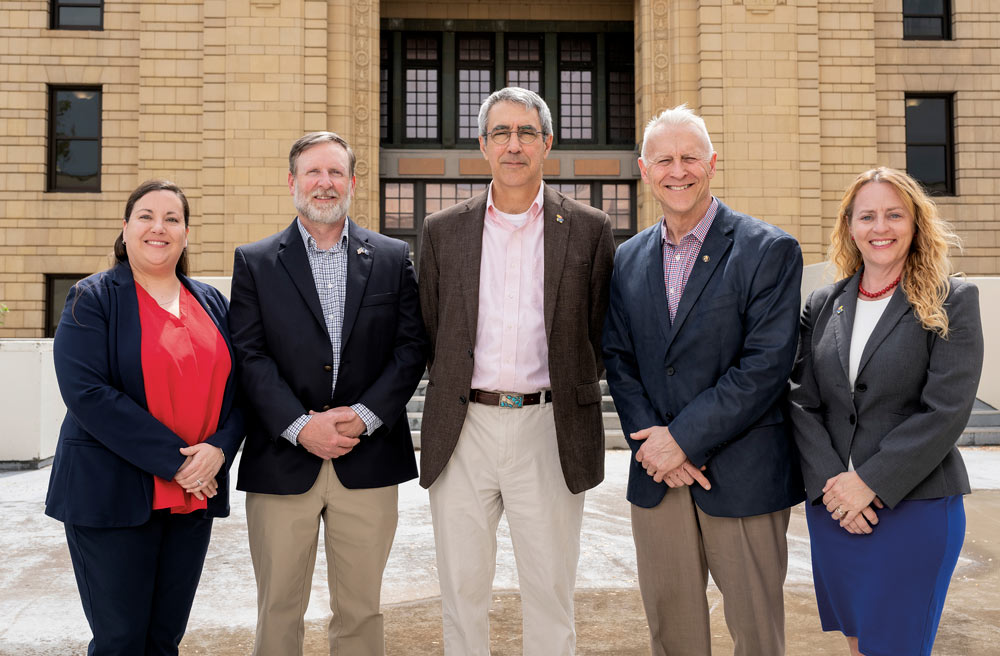
Formed by consolidating Denning’s former KU office, Graduate Military Programs, with KU’s Army, Navy and Air Force ROTC departments, NDI resides within the Office of Academic Affairs. The move is more than a bureaucratic realignment—it’s KU’s declaration that national security education and research are vital.
“This restructuring, which includes bringing KU ROTC programs under NDI, creates a powerful synergy and a single point of contact for the Department of Defense,” says Senior Vice Provost for Academic Affairs Jen Roberts.
It also sends a message: KU is not simply participating in defense education; KU is helping define it for the next generation.
Denning’s own journey makes him an ideal steward of that mission. A retired Marine colonel who joined KU in 2011, Denning brings decades of command experience and a strategic mind shaped by both war and academia.
He flew AH-1 Cobra attack helicopters and led the Marine Corps’ V-22 Osprey training program. He also holds a degree from the Naval War College and completed a national security fellowship at Harvard University’s Kennedy School of Government, and his experience as a military officer informs his sense of purpose in higher education.
“Developing future officers who are educated, fit, and men and women of character isn’t a bonus—it’s mission-essential,” Denning says. “When I was a squadron commander on a 48-hour deployment tether, every ounce of readiness mattered. That kind of readiness starts long before someone dons the uniform.”
The new office’s scope is intentionally broad. It facilitates undergraduate and graduate programs for ROTC cadets, active-duty officers and veterans alike. It supports online learners stationed around the globe—including those taking KU’s popular Homeland Security course from active combat zones.
At Fort Leavenworth, KU offers seven graduate degree programs—up from just two when Denning arrived. Meanwhile, the Intelligence Community Center for Academic Excellence, launched in 2017 under his leadership, continues to flourish. The consortium includes four regional community colleges and five degree programs at KU’s Edwards Campus, with emphases ranging from cybersecurity and information technology to criminal justice and health sciences.
“We’re not just filling seats,” Denning says. “We’re preparing the next generation of intelligence professionals and officers with the depth and breadth they’ll need to meet tomorrow’s threats.”
NDI isn’t only about education. A key pillar is research, and Denning in 2024 enlisted Kurt Preston, a 20-year veteran of the Department of Defense research enterprise, to elevate KU’s national profile.
Since Preston’s hiring as director of National Defense Research Initiatives, KU has hosted multiple Pentagon research leaders and sent faculty to DOD labs across the country. The office also signed a memorandum of understanding with U.S. Cyber Command, leveraging KU’s growing strength in radar and cybersecurity.
“Every discipline has a role to play in Department of Defense research,” Denning says. “Most people don’t realize the DOD is one of the largest funders of medical research, including cancer and autism studies. Our job is to connect KU’s research excellence with DOD priorities.”
For Denning, who also serves as president of KU Alumni’s Veterans Alumni Network, NDI isn’t about dollars or prestige. It’s about service.
“Yes, there’s funding involved, but the bigger story is our obligation to the nation,” he says. “We’re a public institution. We have an obligation to contribute to national security through education, research and service. That’s integral to our identity.”
Chris Lazzarino, j’86, is associate editor of Crimson & Blue.