
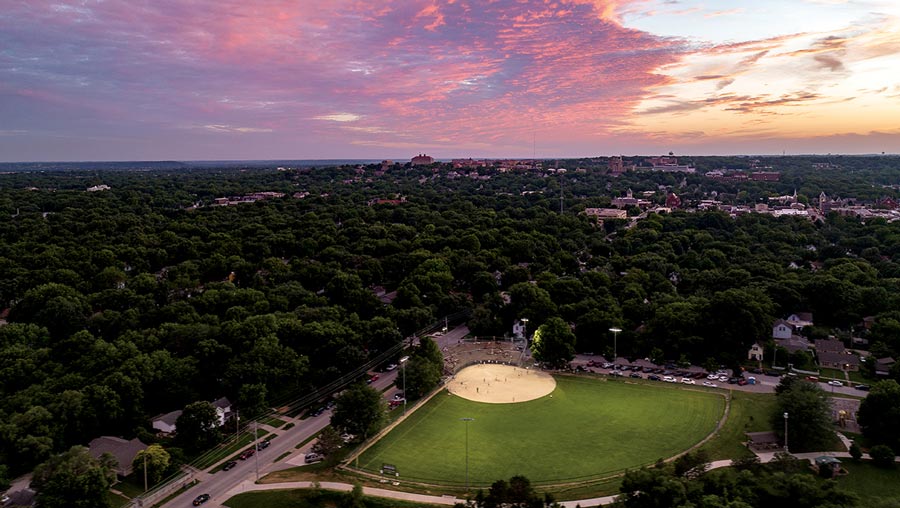
On a mild night in August, the day after KU football’s season opener and first game in the reimagined David Booth Kansas Memorial Stadium, two more local teams face off under stadium lights just a mile east. Though Monday morning looms, the atmosphere at Municipal Stadium at Hobbs Park is festive, the grandstand abuzz with spectators who’ve gathered for the 9:30 p.m. showdown. On the field, a spirited competition unfolds for the next hour and a half, the action turning on the resounding thunk of a rubber ball booted into the cool air.
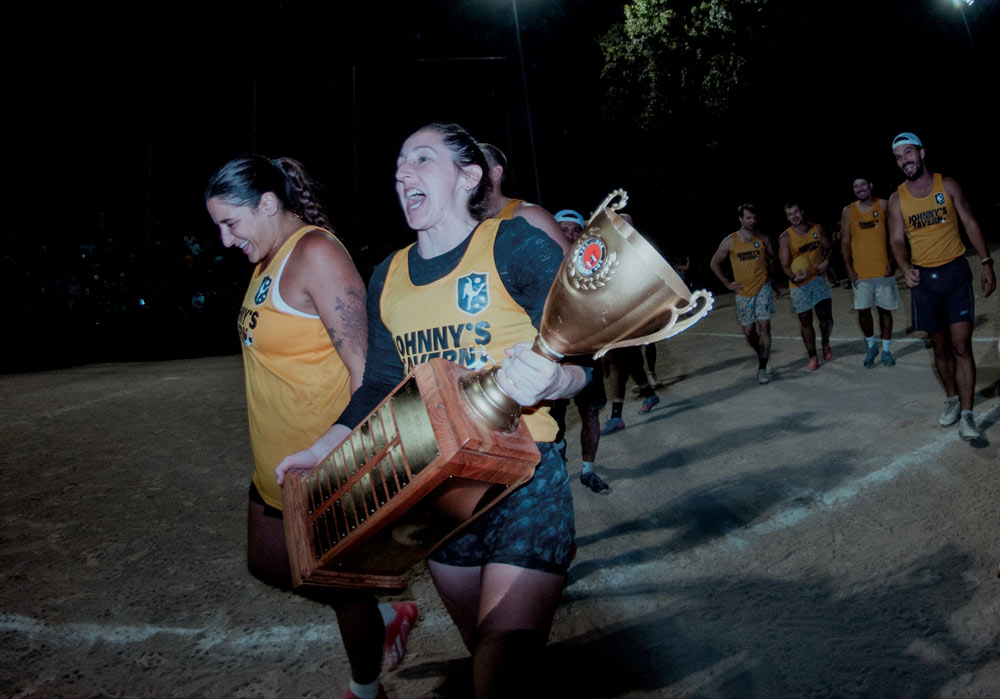
It’s the Kaw Valley Kickball League’s 2025 Cup Championship, the culmination of 13 Sundays of play for the co-ed league’s 36 teams. Throughout the day, teams have claimed trophies at three levels of tournament play, and now, the last squads standing are contending for the Cup, KVKL’s top prize. A double play in the top of the ninth inning decides the game, 10-7.
As many in the league—which naturally attracts hundreds of KU alumni—would attest, however, the final numbers on the scoreboard don’t reflect the full reach and rewards of the KVKL experience.
“In one sense, it’s the cheesiest thing ever,” Nick Lerner, c’03, says of Lawrence’s grassroots kickball league for adults, which began in 2002. “And in another sense, to me, it’s been one of the most important things in my life.”
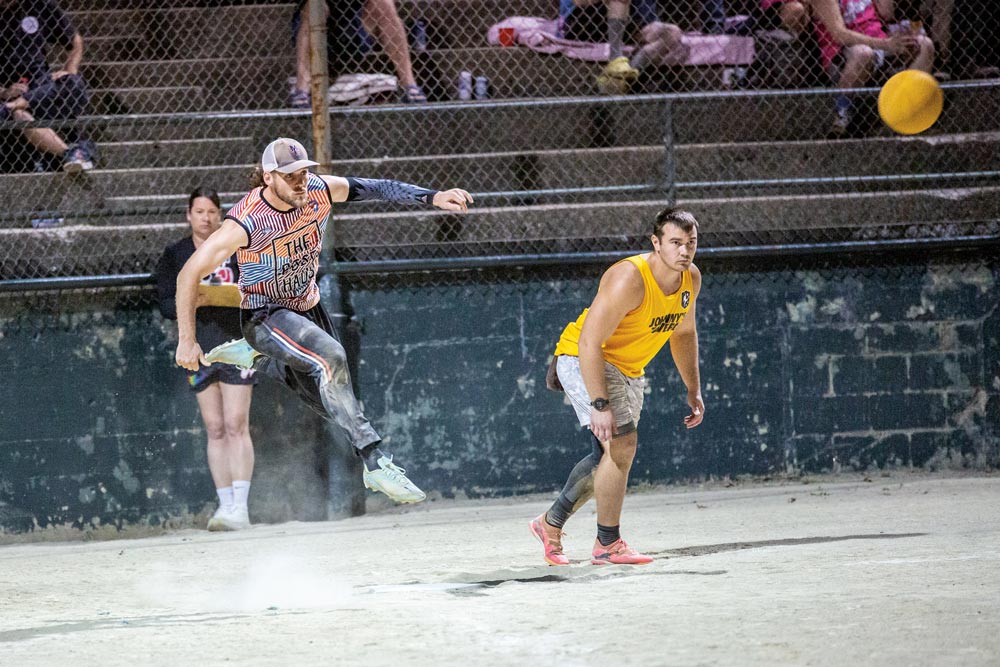
Lerner met his wife in KVKL in 2005, and as an early member of its board of directors, he has watched the league evolve from a group of Lawrence restaurant and bar employees who convened for a handful of informal kickball matches into a local institution that now boasts more than 600 players and stages more than 200 games every summer. Thanks to kickball’s accessibility and wide appeal—it’s played like baseball—KVKL draws participants of diverse ages, backgrounds and professions, and, in turn, fosters connections among residents whose paths may otherwise never cross.
“There are people from so many different walks of life who get together because of kickball,” Lerner says, “and it’s not just about the games.”
In its 23 years, the league has also emerged as a powerhouse in giving back to and enriching Lawrence.
“When I saw kickball, it was this organic world of people who were engaged in their community, so it just made sense to tie it into some of our local nonprofits,” says Jacki Becker, c’92, who has played in KVKL since 2004 and led the establishment of its charitable component in 2009. To date, the league has raised more than $130,000 for local nonprofit organizations, including Just Food, the Bert Nash Community Mental Health Center and the Lawrence Humane Society.
“I think KVKL lifts Lawrence up as a community—for health, for charity, for building relationships,” says Becker, who muses on the league’s offbeat charm: “A crowd cheering in a stadium for adults playing a kids’ sport on a Sunday night—it’s uniquely Lawrence, and it just fits.”
Humble beginnings
In summer 2002, during the relatively slow stretch between Commencement and the start of fall classes, employees of several downtown Lawrence establishments, looking for a novel social outlet, formed what would become the Kaw Valley Kickball League. Lerner, then a manager at the Cheese Shoppe inside Round Corner Drug on Massachusetts Street, says the league was the brainchild of a fellow downtown employee, Natalie Winn, c’05, who circulated flyers at businesses inviting staff to play kickball after their Sunday shifts. Eight teams competed in KVKL’s inaugural season.
“It was ironic—it was a bunch of kids who were not athletic and had no idea what they were doing,” Lerner says of the first year. “It was just a fun way to get together.” He describes early KVKL as a “rogue” league, with games played in open park space without permits or refined rules. “There were no refs, and if there was a close call, we’d have do-overs,” he laughs. “That was the feel of the league.”
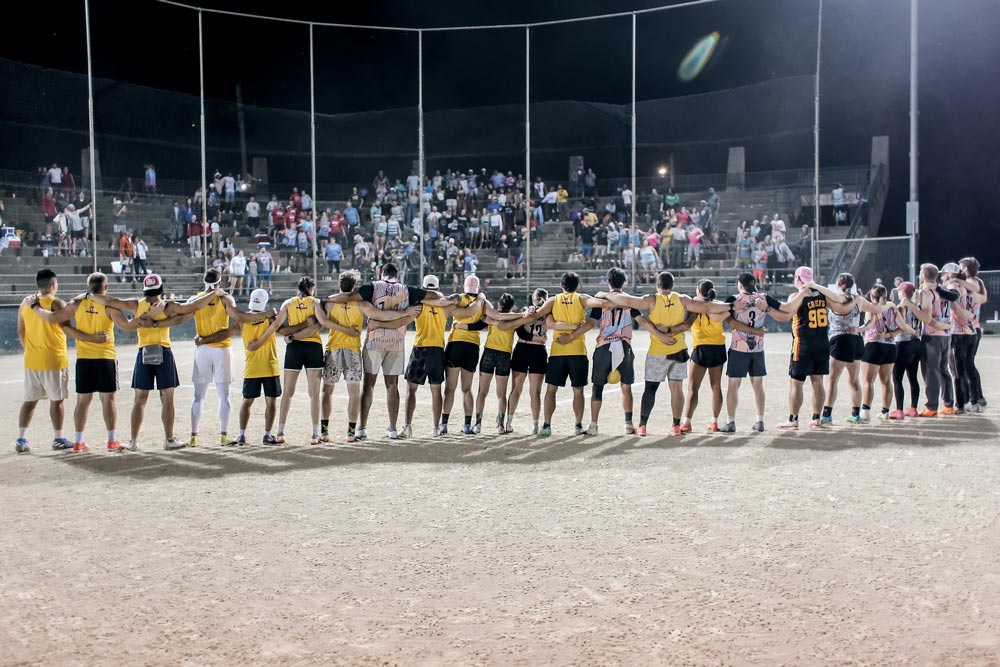
Word spread, and by summer 2003, KVKL had expanded to 20 teams. Kelly Corcoran, j’98, took the helm as commissioner during the league’s fledgling phase, and says the unifying quality of organized kickball quickly stood out.
“It was really a community rallying point, and that sense of community was why the league became such the talk of the town,” says Corcoran, who worked at Love Garden Sounds on Mass Street in the early aughts and today co-owns the record store. “It was our thing, and people found a lot of camaraderie in it. It was just a blast.”
Corcoran guided KVKL for two seasons, but says his greatest contribution was shifting administration of the league from a single person to a board of directors. “I ran the league like a basement punk venue,” Corcoran says. “The board was able to run it like a real organization. They got the permits for the fields and brought some legitimacy. Different hands and personalities came on deck and shaped it into this amazing thing.”
Becker, who served on the board for four years, says game days gradually gained luster. “KJHK came out and did a play-by-play. There were food trucks, and people started to come watch the games,” she says. “It started to become an event.”
Both she and Corcoran cite the league’s first game at Municipal Stadium at Hobbs Park, the 2006 championship, as a turning point. “I remember thinking, ‘This is incredible,’” Becker says. “The stadium lights were on, and it was so special. I knew then that this was something we could run with.” In 2007, the league instated Game of the Week, a featured contest in the historic stadium that caps every Sunday’s slate of kickball matches.
“Those early days were fascinating,” Lerner, a board member from 2007 to 2013, says of witnessing the league’s progression. “We all knew it was something special, and a lot of us wanted to do what we could to continue to make it happen. We weren’t thinking about it lasting 23 years; we were just passionate about it.”
Their instincts proved ahead of a trend: “Now there are kickball leagues all over the nation, and there are people who travel to play in kickball tournaments. Now it’s a legit sport,” Lerner says. “But it wasn’t back then. And that was part of what was fun about it—the reaction of, ‘You’re playing kickball?’”
‘A labor of love’
Today’s KVKL retains much of the whimsy and self-governing spirit it was founded on, but with a formalized infrastructure and streamlined operations. The league is now a 501(c)(3) nonprofit, and it has documented rules and a code of conduct for players. The volunteer board of directors handles the logistics, setting game schedules, renting the fields through Lawrence Parks & Recreation, and overseeing the league’s charitable initiatives.
Elizabeth Karr, b’15, g’21, a current board member, says a culture of cooperation and pitching in defines KVKL. “One of the things that makes this a well-oiled machine is that to be a team in the league, you have responsibilities to the league,” she says. Teams’ duties include providing referees, scoreboard managers and postgame cleanup. Karr notes, however, that many in the KVKL world lend their time and talents beyond what’s required, volunteering for the league’s charity events or for administrative tasks like website maintenance. “There are people who don’t play anymore who still want to be involved and be around kickball,” Karr says. “The league is a labor of love for a lot of people.”
For Karr, who has played in the league since 2016, serving on the board is an opportunity to give back to something that has significantly shaped her life. “KVKL gave me a family in town, and I’m so grateful for that,” says Karr, who came to KU from rural Lyon County. “It helped me feel like I belong in Lawrence.”
When she met Jimmy Bormolini, b’17, c’17, at a friend’s birthday party in 2017, they not only connected over KVKL, but discovered their teams would be playing each other the next day. “We ended up losing to them pretty bad, like 24-2,” Karr says, remembering the game fondly despite its outcome. She and Bormolini married in 2023.
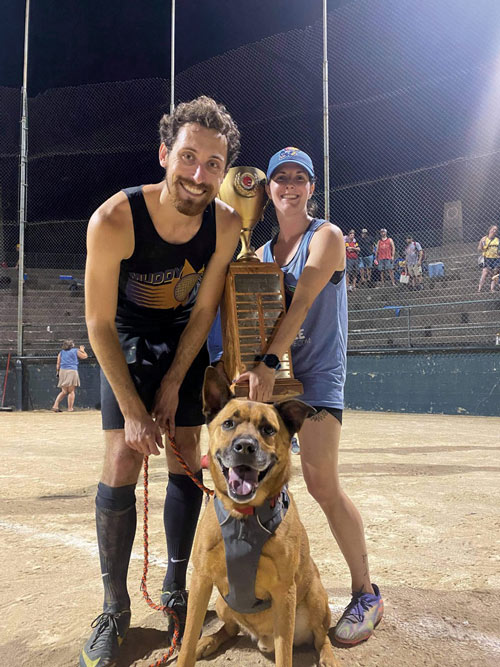
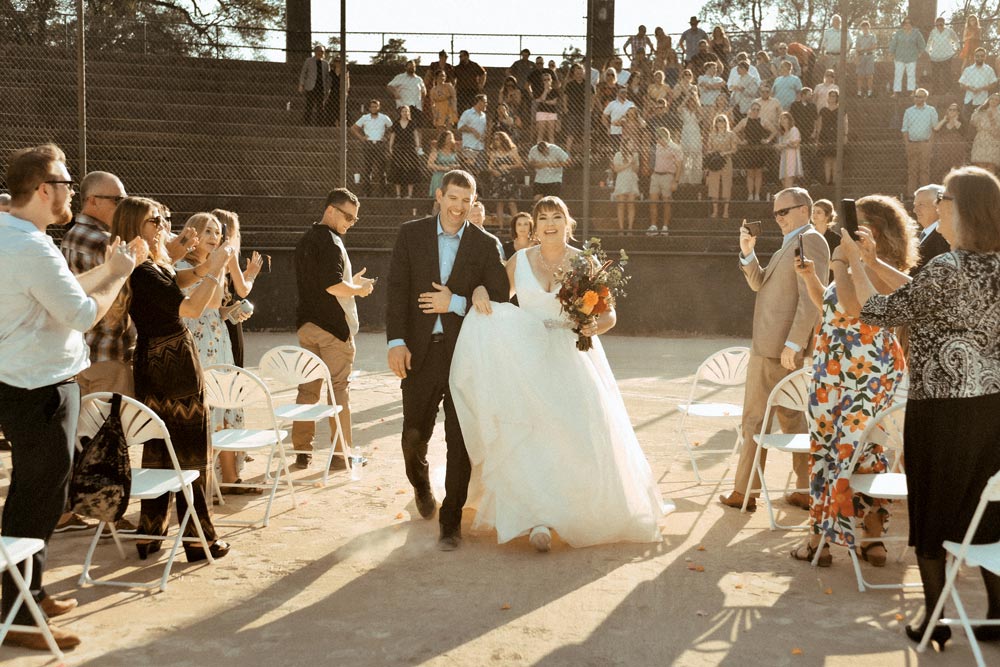
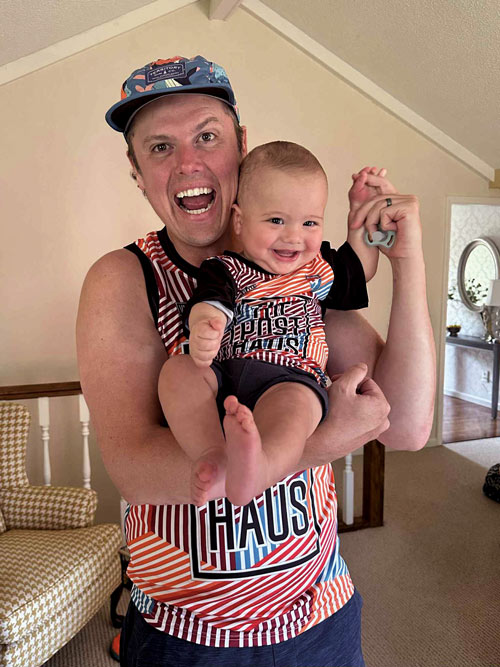
During her tenure on the board, Jacki Becker championed incorporating charitable efforts into the KVKL enterprise, a concept that has become a cornerstone of the league. Every season, KVKL chooses one or two local nonprofits to receive the proceeds from its variety of fundraising activities, which include a preseason kickball tournament, raffles at Game of the Week and a postseason auction at Liberty Hall.
“This is about people being willing to give $10 or $20 every year—to give what they can,” Becker says of the fundraising approach. “That adds up, and it can really make a difference in our community.”
In 2024, the league donated $16,000 to the Douglas County Special Olympics and $1,100 to Toys for Tots.
Becker was also an early advocate for gender inclusivity in the league, a value now enshrined in its rules: For a 10-player roster, teams may field no more than seven men or seven women.
“Women were kind of sidelined in the early years,” Becker says. “One of my goals was to get what were mostly male teams at the time to truly notice that women can be competitive and can be critical pieces of the game. Today, you can’t win a tournament without having incredible women on your team.”
A former KU swimmer, Becker says KVKL has been a gift in her life. “Kickball got me healthy, active and well with myself, and I’m grateful to KVKL for that,” she says. “Swimming isn’t really a team sport, and KVKL gave me the ability to be a team athlete that I didn’t know I could be. It has been amazing to have that experience.”
She reflects proudly on KVKL’s evolution into the philanthropic, more inclusive organization it is today. “So many of the things that were important to me in those early years are just standard for the league now,” Becker says, “and that means a lot to me.”
Kickball for all
When he arrived in Lawrence in 2010, Farai Rusinga, PhD’17, had never heard of kickball. An accomplished athlete, Rusinga had played soccer for Grinnell College in Iowa, but a kicking-driven game set on a baseball field was unfamiliar turf for the Zimbabwe native.
“I had never played diamond sports before,” says Rusinga, who earned his doctorate in chemistry at KU. “I think I stepped into a baseball field in Zimbabwe for one or two innings when I was 8 years old, so that was what I knew of even baseball or softball.”
Kickball, it turned out, suited him perfectly.
“I always loved playing soccer, but kickball felt like it was a good pace for me now,” says Rusinga, a KVKL player since 2019. “In soccer, once the game starts, there’s no stopping. You’re running all the time. The pace with kickball is more stop-and-go, so there’s a lot more time to talk to people, time to watch my teammates and cheer them on.”
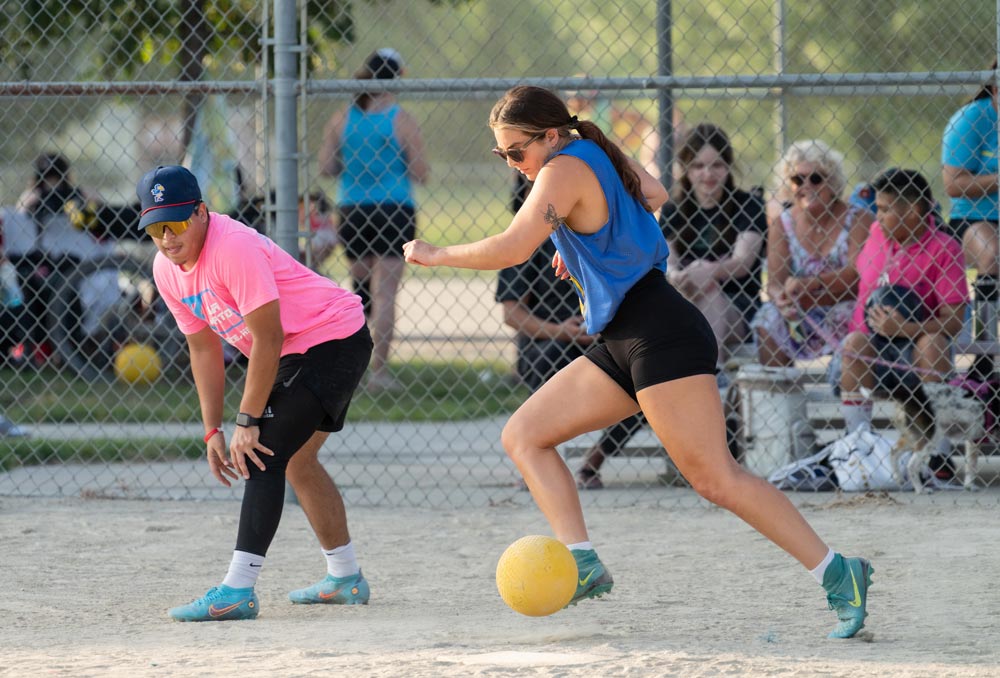
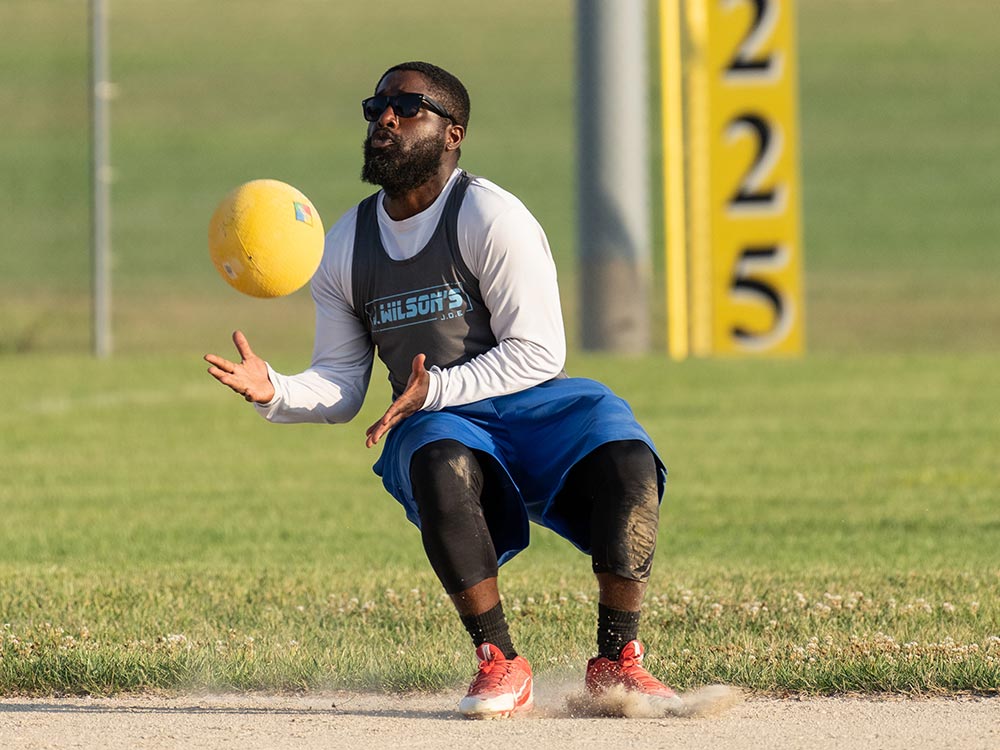
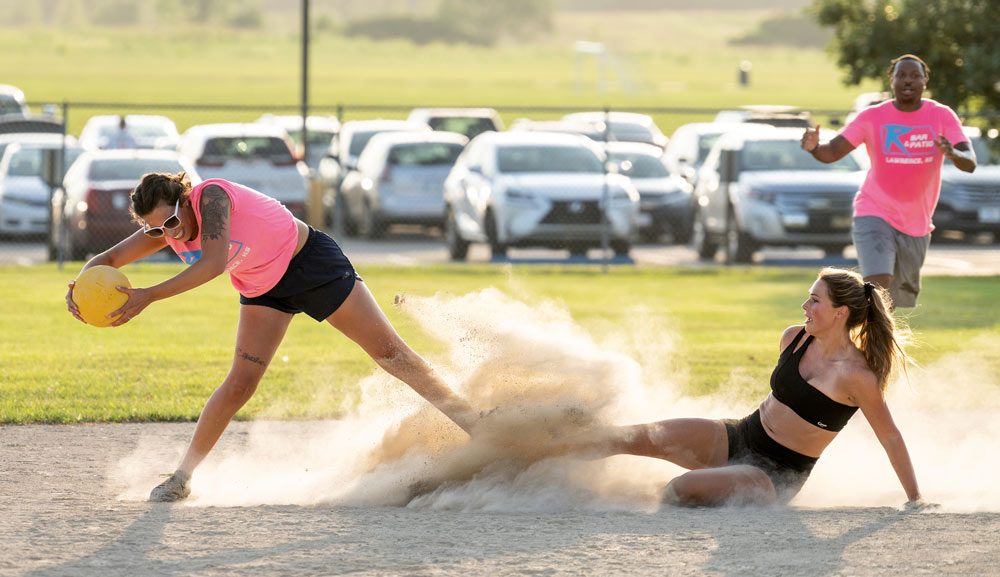
Rusinga says he enjoys the strategy of kickball too, and plans to be part of KVKL well into the future, adding that the people are what he appreciates most. “A lot of my friends in the league are people I never even imagined that I would come across, and they’ve welcomed me,” he says. “They’re my people; it’s my community.”
Kickball as an accessible, lifetime sport is a notion at the heart of KVKL. The league invites all skill levels, and teams’ competitiveness runs the gamut from the tenacious to the laid-back. The four tiers built into the season-wrapping tournament ensure that teams of different competitive stripes can make a bid for a title. In addition to the Cup, KVKL awards the Twain (a bust of Mark Twain, for ninth place), the Plate (a Princess Diana commemorative plate, for 17th place) and the Boot (a gold-painted cleat, for 33rd place), each trophy an item formerly plucked from a kickballer’s personal possessions.
In its customary hospitable fashion, KVKL offers resources for those who’d like to improve their kickball skills. All are welcome at Wednesday evening open practices—held during the season at Municipal Stadium—which provide a no-pressure environment where less experienced players can get instruction from veteran players. Kristin Colahan-Sederstrom, c’05, first organized the midweek sessions more than a decade ago, and says a skill she acquired at Wednesday practices spawned her favorite kickball memory.
She recalls being up to kick at Game of the Week, two outs, bases loaded, and needing to kick the ball behind first base. “It didn’t go so well, and after that I decided I wanted to become ‘ambi-kick-strous,’” she laughs, “because kicking to right field is easier with your left foot. So I spent one season of Wednesday nights just learning how to kick with my left foot. The next year, we played in Game of the Week again, and the exact same scenario came up: bases loaded; I was up to kick. I kicked it right where I needed to, scored my runner and got on base. I still kind of get goosebumps from it.”
Since 2012, KVKL has also hosted “Kickball Is for All,” an annual community outreach event that offers an inclusive, supportive space where kickball newcomers can spend an afternoon learning the basics. The league holds the clinic especially for women, transgender and nonbinary players.
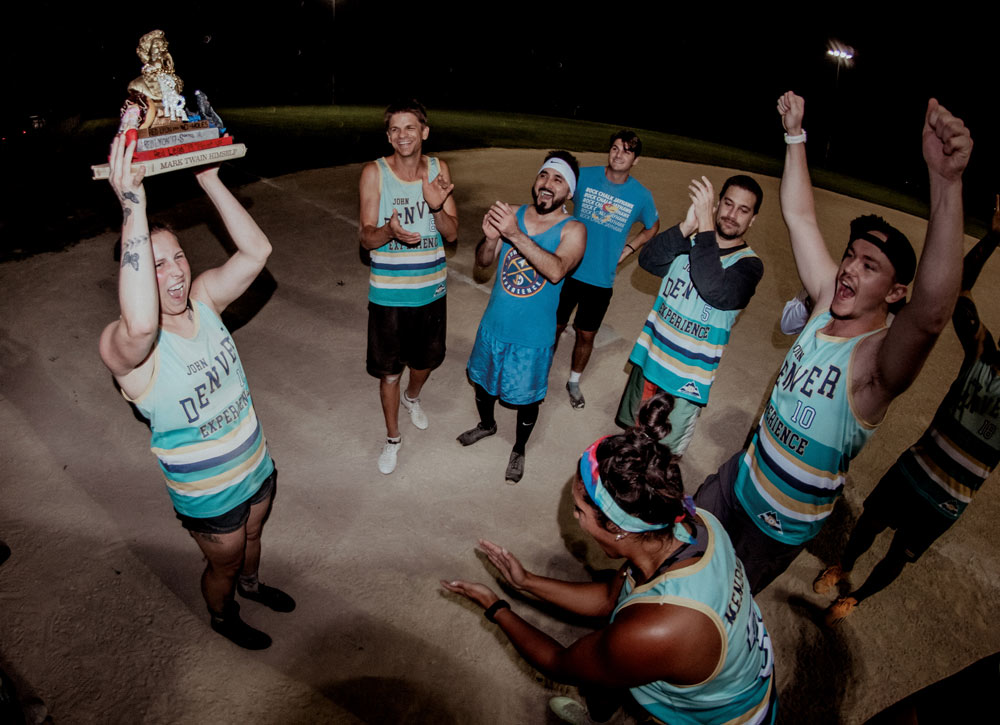
Colahan-Sederstrom says “Kickball Is for All” and Wednesday practices can be good trial runs for folks curious about joining KVKL, and the relaxed occasions are among the many ways the league unites simply by breaking the ice.
“Making friends as an adult is so hard,” Colahan-Sederstrom says. “And especially in a college town, it can feel like a revolving door of people who graduate and move all over the country.” KVKL provides the type of casual, consistent setting in which connections can spark and grow, and for Colahan-Sederstrom, who has played in the league for 14 years, kickball kindled some of her closest friendships. “I can’t imagine my day-to-day life now without people I’ve met through KVKL,” she says. “The people I see and touch base with every week, the people who know my pets and we go to the dog park together—all of those relationships formed from KVKL. It’s enriched my life tenfold.”
Common ground
Sociologist Ray Oldenburg coined the term “third places” in his 1989 book, The Great Good Place, to refer to public spaces that “host the regular, voluntary, informal, and happily anticipated gatherings of individuals beyond the realms of home and work.” Oldenburg proposed that these places, which encourage conversation, relaxation and diverse company, are central to community vitality and individual well-being.
The welcoming, recreational setting furnished by KVKL can serve as just such a venue, and, to Seth Sanchez, c’10, kickball answers a growing need for affordable opportunities to socialize.
“It can be difficult to get out and just interact with other people without having to spend a fortune,” says Sanchez, who has played in KVKL since 2008. “Kickball is a free or minimal-cost activity, and when you go out on Sunday, there are hundreds of people you can talk to about a common interest. Right away, you have a touchpoint.”
In addition to being a thread that knits together an eclectic patchwork of locals—players are teachers, attorneys, bartenders, financial planners, personal trainers, firefighters—Sanchez says KVKL is a tie that binds former residents to Lawrence, with games occasionally featuring cameos from past players who’ve moved away but never kicked their affinity for Sunday kickball. Even iconic Jayhawks have been known to make an appearance: At a 2024 Game of the Week, KU women’s basketball legend Lynette Woodard, c’81, rolled out the first pitch.
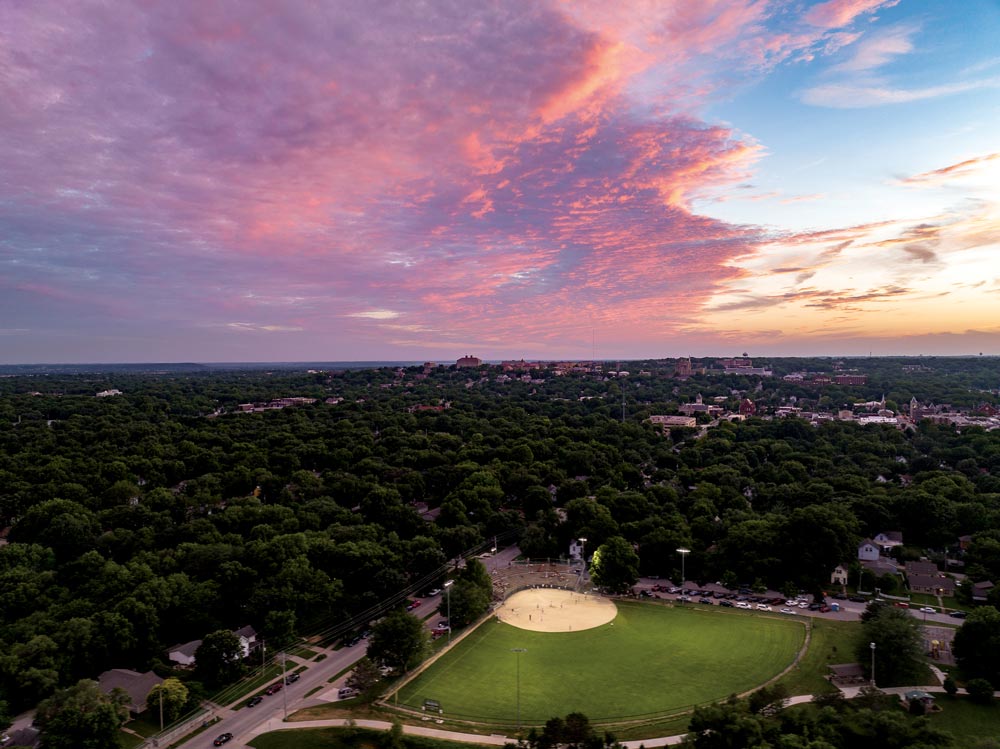
Sanchez says the league’s many affiliated ventures, which include a weekly podcast during the season, further expand the range of folks who can excel and belong in KVKL. “There is such an infrastructure that has been built up over the league’s 20-plus years that is administrative, legal, fundraising, artistic. It makes it a community that allows a lot of people opportunities to showcase skills that are not just athletics, not just who can kick the ball the farthest,” Sanchez says. “Everyone who’s a part of KVKL loves it for a different reason, and everyone can contribute to the league growing and moving forward.”
For Nick Lerner, a self-professed KVKL “old-timer” who has played in every season since the league’s inception, the vibrant, big-hearted world of KVKL is a glittering testament to the vibrant, big-hearted city it calls home, and to the university whose students and alumni help steward it.
“I think the Kaw Valley Kickball League is a representation of what Lawrence is,” Lerner says. “Lawrence is this cool, quirky community, and inside that is this group of quirky people who play kickball. It’s an embodiment of what Lawrence and KU are about—about embracing people, doing things that are different.” Adds Lerner: “At KU, we’re proud of our sports, and I’m also really proud of this kickball league.”
Preserving a Lawrence landmark
In its nearly 80 years as a pillar of the East Lawrence neighborhood, Municipal Stadium at 11th and Delaware streets has hosted generations of youth athletes, adult baseball and softball teams, and, since 2007, the Kaw Valley Kickball League’s summer tradition, Game of the Week.
In fall 1946, a petition signed by 1,014 Lawrence residents requesting a modern baseball facility went before the city council. The new baseball field was dedicated on July 9, 1947, and construction of the 1,200-seat grandstand was completed the following year.
According to an article in the Lawrence Daily Journal-World, about 2,000 people packed Municipal Stadium to watch the Lawrence Colts, the city’s semipro baseball team, take on the Kansas City Monarchs on Aug. 6, 1949. The Pittsburgh Pirates came to town to hold a tryout camp at the ballpark in 1967, and before he was a KU football and NFL star, John Hadl, d’68, played youth baseball at Municipal Stadium.
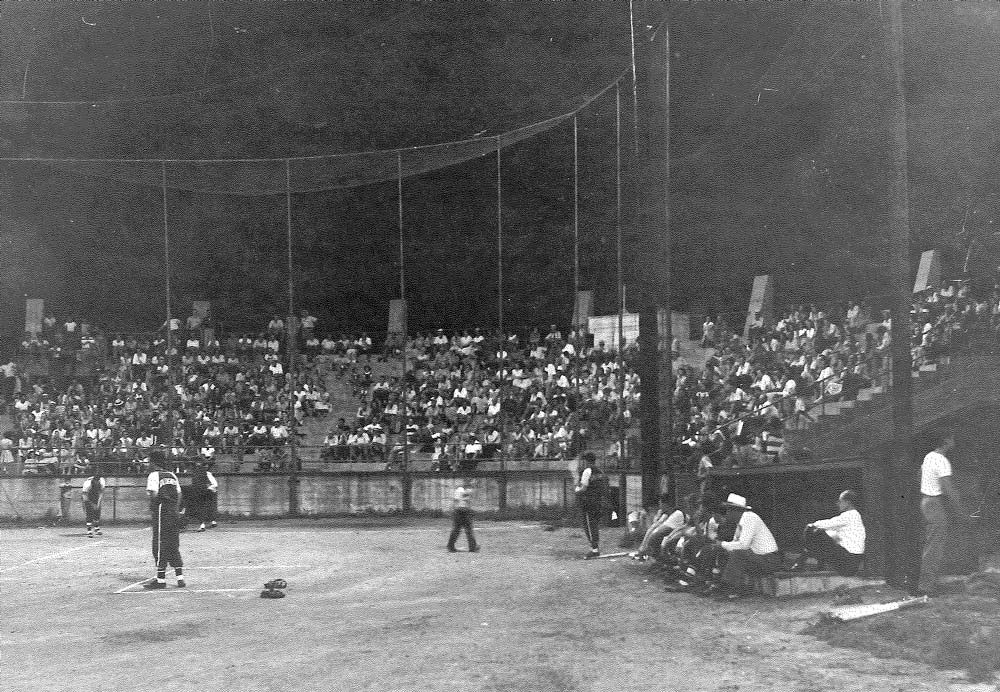
To address time’s toll on the site—cracks and water damage threaten the concrete grandstand’s structural integrity—a group of local organizations in 2024 partnered to launch the Municipal Stadium at Hobbs Park Legacy Project, an effort to revitalize and preserve the historic venue and the larger park in which it’s located. KVKL is among the partners, alongside the East Lawrence Neighborhood Association, Lawrence Preservation Alliance, Watkins Museum of History, Lawrence Parks & Recreation, Hernly Associates and the Shelley Miller Charitable Trust.
“The stadium is a reflection of American history, a place to play and a source of pride for the community,” says Erin Adams, a longtime KVKL player and one of the volunteers shepherding the Legacy Project. “It needs to be celebrated, and the best way to do that is to preserve it.”
Adams, who grew up in East Lawrence, says the Legacy Project’s first phase is to raise money to cover the cost of research and other legwork necessary to nominate Municipal Stadium to be listed on the National Register of Historic Places. The designation would unlock access to grants and tax credits to go toward the restoration.
The Legacy Project held its most recent fundraiser, a screening of the movie “Field of Dreams,” at Liberty Hall on Oct. 26. Adams says the group plans to host more community events to benefit the project in the months ahead.
Megan Hirt, c’08, j’08, is managing editor of Crimson & Blue.