

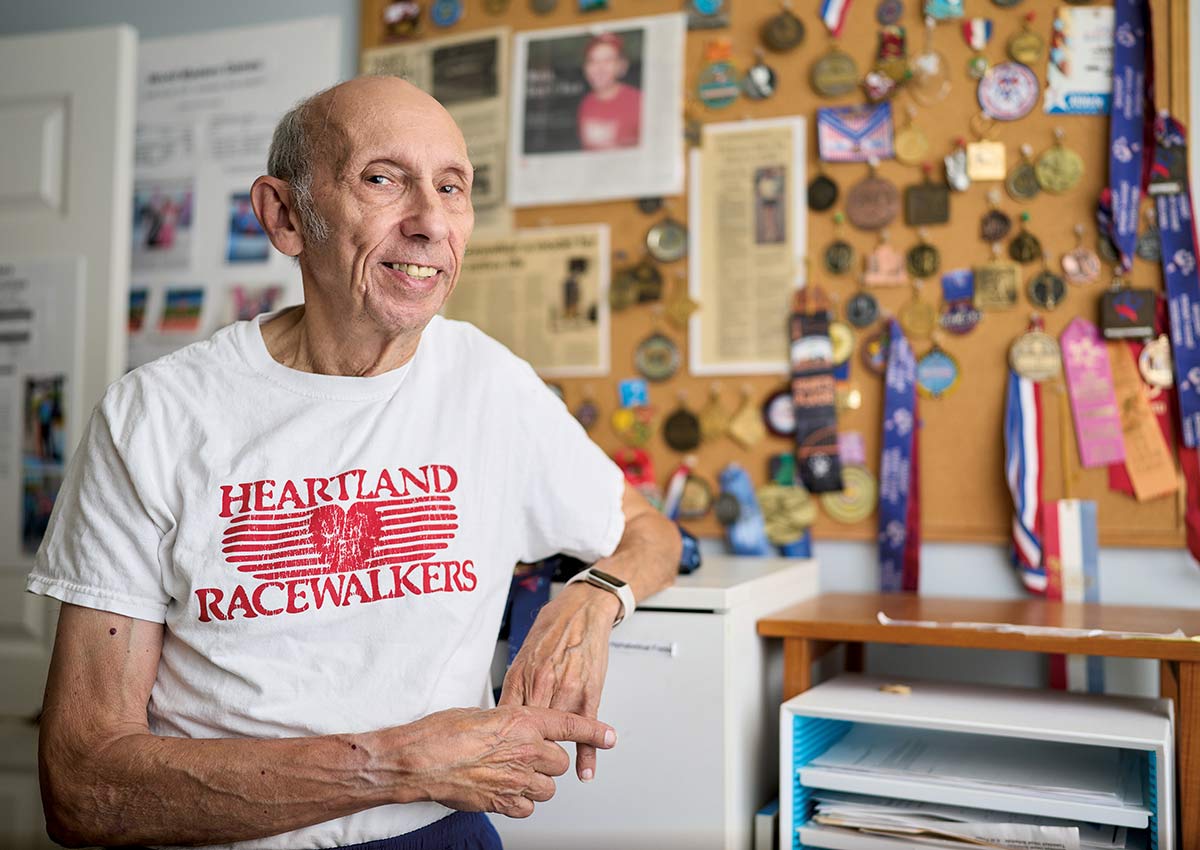
As a physician and a professor of pharmacology at KU Medical Center from 1968 to 2001, Alan Poisner devoted his career to understanding the human body at a microscopic level.
“You might call it basic cellular endocrinology,” Poisner, m’60, says of his research focus. “An advantage of the MD degree is I could go in different directions, whereas PhDs usually focus on one area for their whole career. I worked on all levels of investigation from subcellular to molecular to tissue to whole animal—the whole spectrum.”
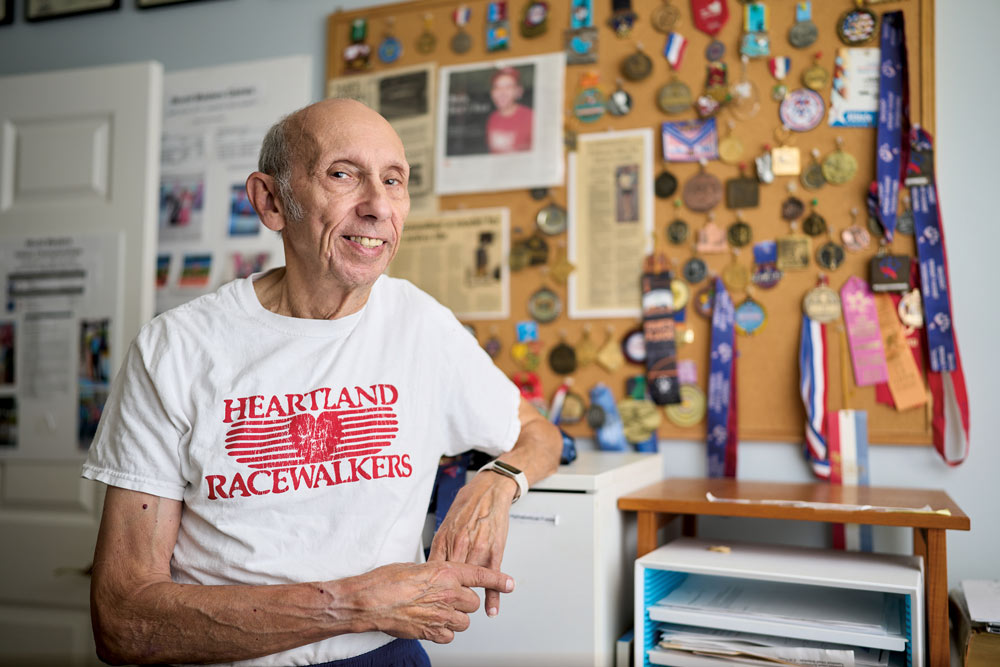
Poisner’s research continued even after retirement, and it isn’t over yet. But his life outside the lab has yielded some similarly long-term insights into the human body’s capabilities on a more macro level: For the past four decades, Poisner has been a competitive racewalker, setting records and winning medals in events sanctioned by state, national and international athletic organizations. And now, the 91-year-old Overland Park professor emeritus is often outpacing younger athletes.
Racewalking, which grew out of a British tradition of long-distance competitive walking, was among the original events in the first English Amateur Athletics Association meet in 1888, and it was introduced as an Olympic sport in 1908. Typical distances range from 3000 meters (1.9 miles) to 100 kilometers (62.1 miles). The only two rules are that competitors must maintain foot contact with the ground at all times and that the leading leg must remain straightened from the point of contact with the ground until the walker’s body passes over it.
The technique takes time to master, because it’s not a natural gait for humans.
“What a lot of people don’t appreciate is the walkers are moving their legs just as fast as the runners,” Poisner notes. “The elite guys now go 200 steps a minute, and that’s just as fast as the runners go. So why is it that the runners get ahead? Their stride is so much longer.”
At the National Senior Games in Iowa in July, Poisner won four medals and set records for the 90-94 age bracket, the fourth age division in which he holds an NSG record. In his first event of the meet—a 5K road race in which he was the only racewalker in a field of more than 300 runners—he took silver in his bracket (finishing behind a runner who set the all-time record) and finished ahead of two dozen younger competitors. A day later, he won gold in the 90-94 bracket in the “Mile for the Ages” run, racewalking the mile in 11:52, again posting a faster time than many runners in lower age brackets. The following week, he added medals in 1500-meter and 5K racewalks.
Those triumphs followed a gold-medal performance in the 3000-meter walk at the World Masters Athletics Indoor Championships in Florida in March.
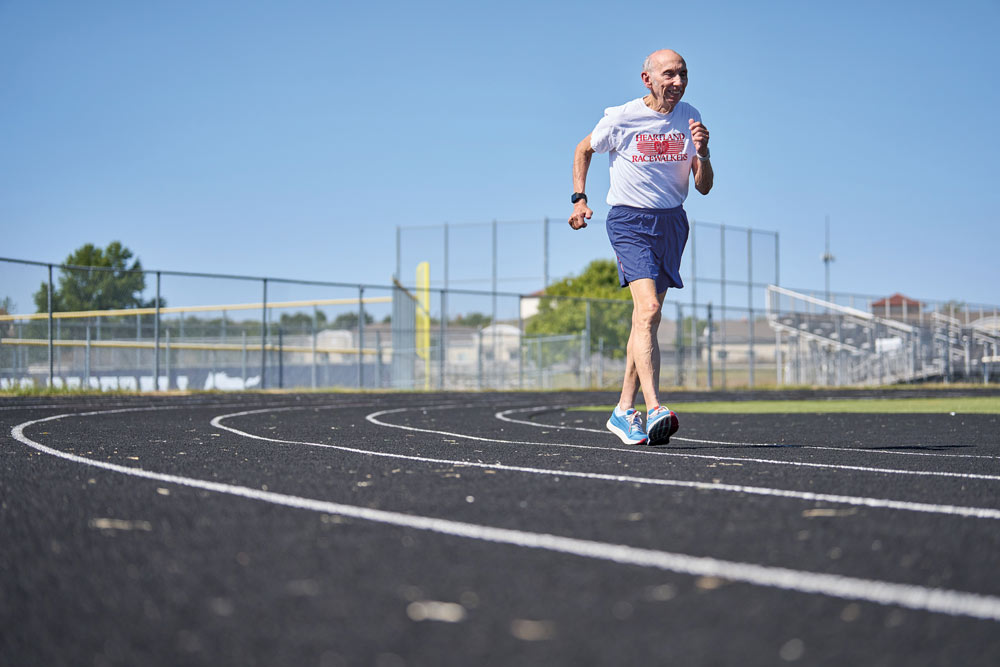
Medals and records, while nice, aren’t the only (or even the most important) benefit of racewalking for Poisner, who also helps introduce others to the sport through the Heartland Racewalkers, a Kansas City club he helped found in 1989.
“He’s a natural-born teacher,” says his wife, Sharon Lowenstein Poisner, PhD’83. “He doesn’t lecture; he leads by example, just by being who he is. And he likes giving back.”
Poisner started racewalking at 52. He had played tennis competitively for many years, then got into running in his 40s but sustained an injury that led to a recommendation for back surgery. To avoid surgery, he stopped running “cold turkey,” and the injury healed. He turned to racewalking after Debbi Lawrence, an Olympic racewalker, started a racewalking club in Kansas City. Poisner credits Lawrence and her trainer husband, Don, as well as the club’s “older” walkers—they were then in their 70s and 80s—for helping him learn the sport. A key influence was Jean Brunnenkant, who began racewalking at 75 and was still competing at 95. “She’s my role model,” Poisner told The New York Times for a story that appeared in The Athletic in July. “She lived to 103.”
Now it’s his turn to be a role model.
“I enjoy it. What I tell everybody when they start, the first thing is don’t hurt yourself. But the second thing I tell people is have fun. If it’s not fun, you’re not going to keep it up. If it’s something where you’re having fun and it helps your body physically and mentally, that’s terrific.”
Citing the growing research consensus that having a strong social network is as important as a healthy diet and an active lifestyle for aging well, Poisner extols the benefits of the relationships he has built through the sport, from the regulars he sees weekly at Heartland Racewalkers to the competitors he’s faced in races across the globe.
“I’ve got friends all over the country and even around the world. Some I’ve known for 20 years. I’m not going to stop now.”
Steven Hill is associate editor of Crimson & Blue.