

KU’s iconic Campanile, the 120-foot limestone bell tower that crowns the Hill as both landmark and memorial, this summer and fall was once again tended by busy stonemasons rising to the sky in lift buckets securely affixed to long hydraulic booms. This year, though, the work extended far beyond recent emergency repairs that removed chunks of stone in danger of sloughing from high overhead.
“We’ve had lifts there once a year for several years,” University Architect Mark Reiske, a’86, said in a September interview, “but we just removed loose stone so it wouldn’t fall on people. We never had the resources to actually fund the work that’s going on now.”
Reiske said the latest renovations—the most extensive Campanile repairs since its 1996 overhaul—involved “a lot of stone replacement” and complete tuckpointing of every masonry joint, all in an effort to ensure the Campanile stands secure for generations to come.
“We’re cutting out every masonry joint, redoing them, replacing all the damaged stone, doing roof repairs, doing repairs to the steel that holds up the bells, and repainting that steel,” Reiske said. “By the time we hit Veterans Day, we should be cleaned up and out of there.”
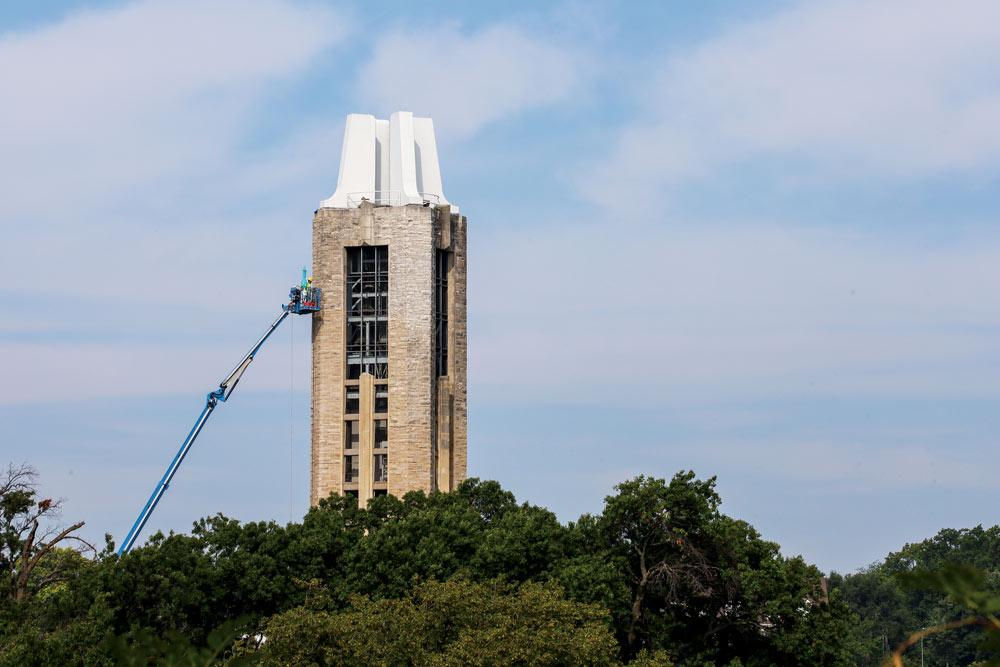
Dedicated in 1951 to honor Jayhawks who died in World War II, the Campanile and its 53-bell carillon have long been a focal point for both celebration and remembrance. Graduates pass through its doors during Commencement, while the chime of its bells marks the hours across Mount Oread.
Years of Kansas weather, however, have taken their toll. The reliance on emergency repairs was rooted in a lack of money, but that changed when rising interest rates boosted KU’s state-held reserves, generating an influx of “180 funds,” a revenue category available only for building projects.
Annual deferred maintenance allotments, typically about $25 million, can only be spent on “mission-critical” teaching and research buildings. “I can’t spend that money on the Campanile,” Reiske explained. While 180 funds, like deferred maintenance dollars, are used on building repair, they are not limited in project scope.
“We got around $7 million last year in 180 funds, compared to about $500,000 that we’d get in a low-interest period,” he said, “so we started doing work on buildings that we can’t spend other state money on. The Campanile was one of them.”
Contractors are replacing roughly 300 square feet of damaged stone, along with the bells’ steel structural supports. Once repairs are complete, the entire tower will be washed and sealed, and the School of Music will refurbish the carillon keyboard and bell cables—a sparkling restoration from base to belfry. The work, Reiske explained, is intricate and painstaking. “The guys are doing incredible work,” he said, “but it takes time.”
KU on Aug. 29 dedicated its new World War I Memorial Plaza, adjacent to the reimagined David Booth Kansas Memorial Stadium. The alignment of those two sites—the World War I memorial at the base of Campanile Hill and the World War II memorial at its crest—forms what Reiske called “a powerful connection.”
“If you think about the power of having the memorial at the bottom of Campanile Hill, and the memorial on top of Campanile Hill, it’s pretty cool,” he said. “You can stand on the World War I Memorial Plaza and look up to the Campanile—it’s pretty powerful.”
The Campanile, Reiske emphasized, is more than limestone and bells. “For our alumni, the Campanile is a destination memorial,” he said. “This will ensure it remains that way for future generations.”
Chris Lazzarino, j’86, is associate editor of Crimson & Blue.