
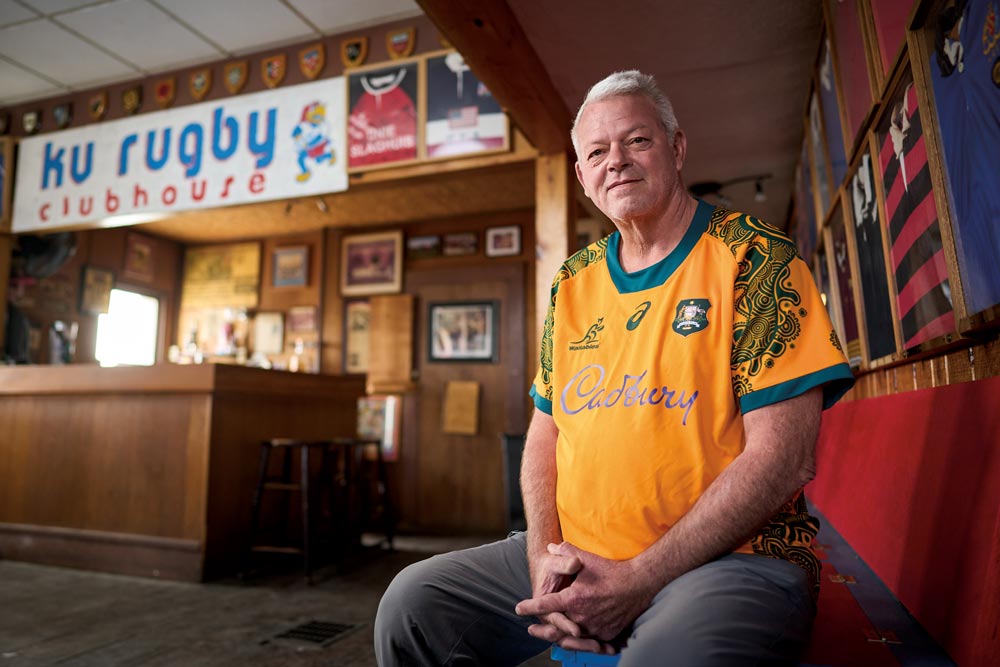
Rick Renfro was 21 years old when he bought Johnny’s Tavern in 1978. The purchase was motivated not by a polished business plan, but by rugby.
Renfro, a football star at Shawnee Mission West High School, in Overland Park, came to KU after a brief, unsatisfying stint playing football at Ottawa University. Here he discovered rugby, which offered a continuation of the athletic life he wanted—physical, fast and unscripted. Owning a bar gave him a way to stay in Lawrence, make a living and keep playing rugby.
Nearly five decades later, Renfro, ’80, is still here. Now the owner of a business that has grown to 14 locations, a member of the Lawrence Business Hall of Fame and one of the driving forces behind the Kansas Jayhawks Rugby Football Club—the alumni and community umbrella organization that supports the University-sanctioned KU men’s rugby club—Renfro knows that staying power isn’t a byproduct of Kansas rugby. It’s the point.
“At that age, you’re figuring out life—meeting people, learning how to live on your own,” Renfro says. “Rugby gives you a family to be part of.”
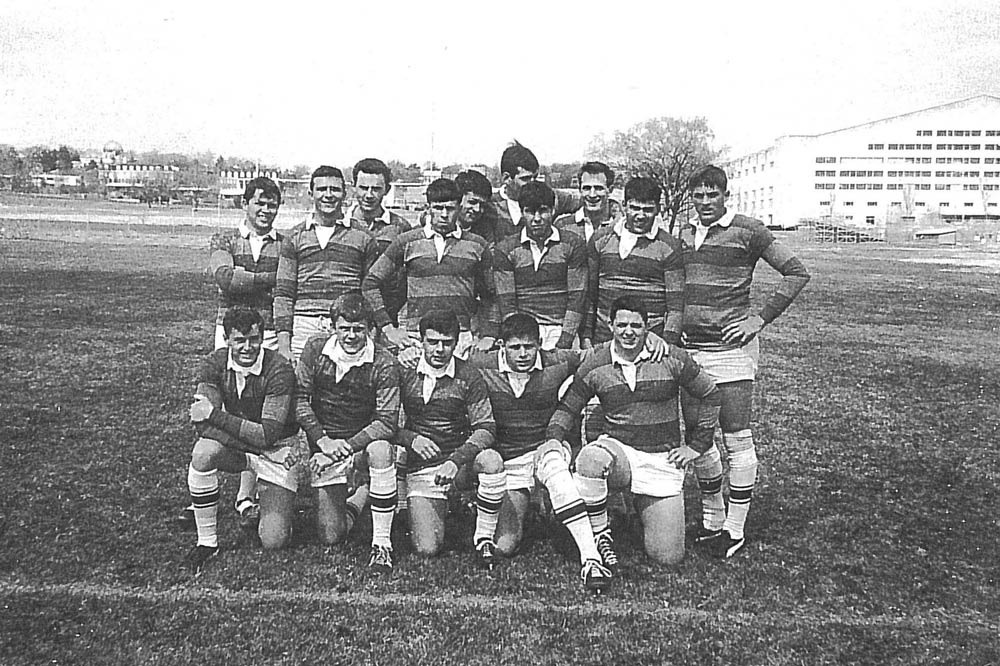
It’s a family that has endured since 1964, when the late George Bunting, a Kansas City native and Dartmouth University graduate, arrived at KU for law school. Eager to keep playing rugby, which he’d discovered at Dartmouth, Bunting was dismayed to learn there was no such club at KU. So he started one.
Bunting, l’67, placed a notice in The University Daily Kansan, and 13 students showed up for KU rugby’s inaugural meeting. Some were experienced in the game, including foreign graduate students who had played overseas. Kansas Athletics supplied old football jerseys, and the University offered access to intramural fields. By the time Bunting graduated, the roster had grown to nearly 40.
What Bunting—an entrepreneurial businessman who died in 2018—envisioned was not just a team, but something that could outlast him. Something that would renew itself year after year. More than 60 years later, it has.
A club sport with a vast community
Today, men’s rugby operates as an official club sport within KU Recreation Services, offering students a level of competition and connection perched between intramurals and varsity athletics.
“We try to find something for everybody on campus,” says Jason Krone, director of KU Recreation Services. “Intramurals works great for a lot of students, but some students want more—more competition, more commitment.”
Rugby provides that. But what makes it stick, Krone says, is what happens beyond the field.
“You spend so much time together—practicing, traveling, competing—that you build a real sense of community,” he says. “And that’s vital. That kind of connection brings students back year to year.”
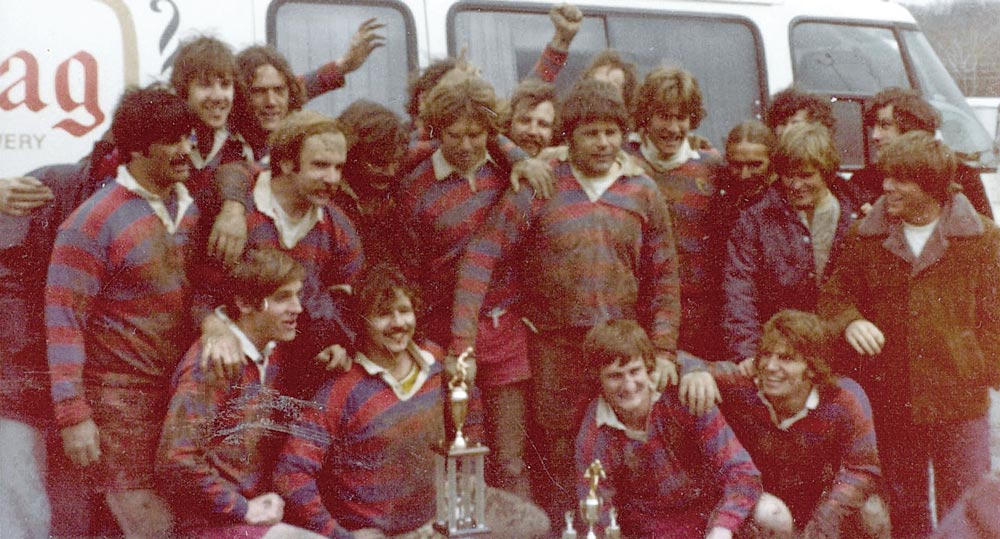
Among KU’s many club sports, rugby stands apart for another reason: its alumni.
Generations of former players remain closely tied to the program, helping fund trips, building facilities and mentoring current athletes. That continuity has created something rare—a club team that operates with the depth and memory of a much older institution.
Former player Trevor Lister felt that the moment he arrived.
Lister, d’24, now a firefighter/EMT with Lawrence-Douglas County Fire Medical, picked up rugby as a high school sophomore after his older brother suggested it. A star offensive lineman at Johnson County’s Blue Valley High, he yearned to finally run with the ball and make tackles. What kept him invested in rugby, though, was something else entirely.
“What made me fall for it was that anybody can do it,” Lister says. “Any size, any position. There’s a lot of freedom.”
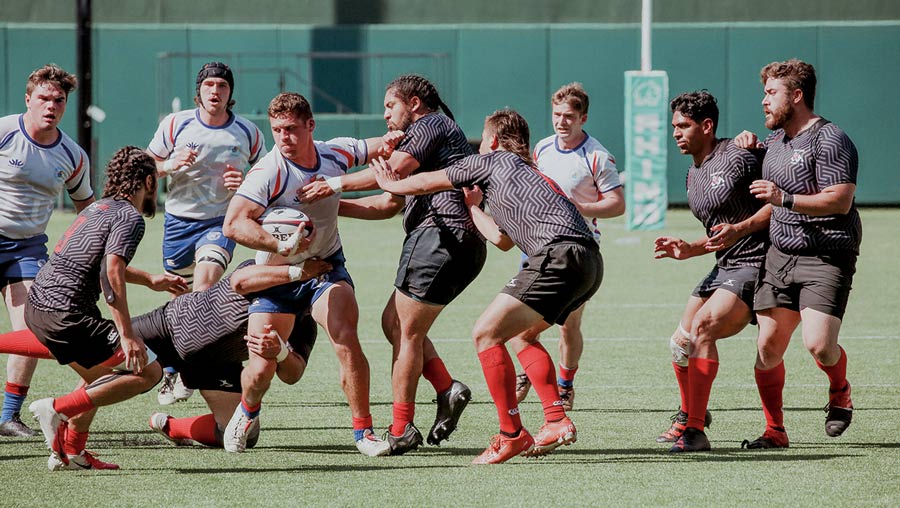
That freedom is central to rugby’s appeal. Unlike football, where every movement is dictated, rugby demands constant decision-making. Play flows, possession shifts, and players must adapt in real time.
“There’s so much autonomy,” Lister says. “You have to read the game and react.”
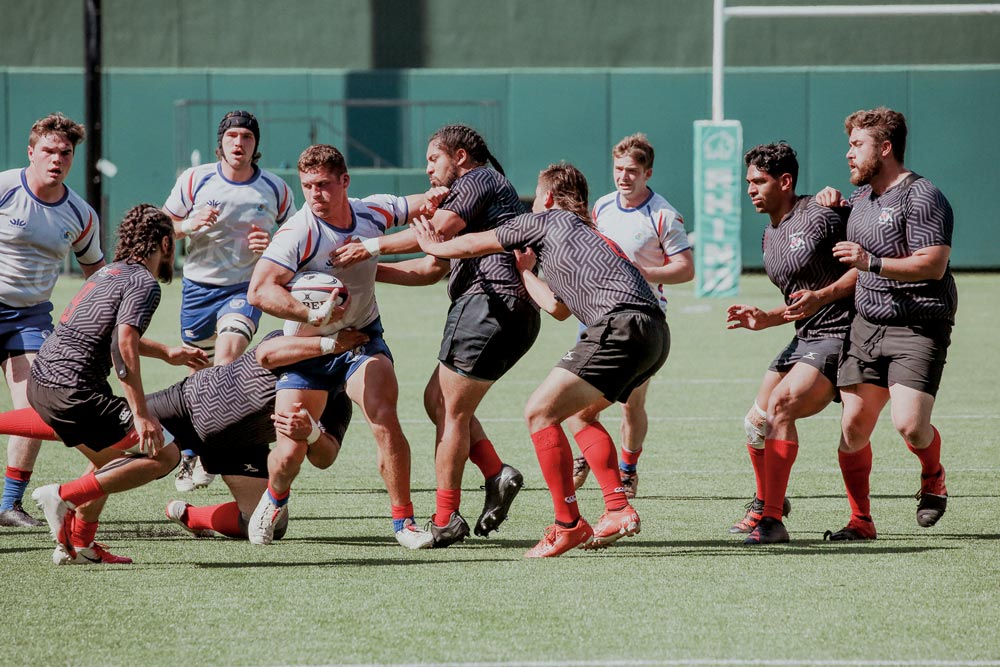
By the time he reached KU, Lister was committed to rugby. He would go on to become a two-time All-American and, in Renfro’s estimation, one of the best players in crimson-and-blue history.
But the accolades aren’t what Lister remembers most.
He remembers the immersion—the way the team became a daily presence in his life. Teammates gathered before matches, after matches, at the clubhouse, at apartments and off-campus houses shared with other rugby players. Newcomers, if they displayed a commitment to the club and a willingness to learn the sport, were quickly absorbed into the group.
“It’s what people are looking for,” Lister says. “A place where you belong. And if you buy into it, you’re part of it fast.”
Here, there, everywhere
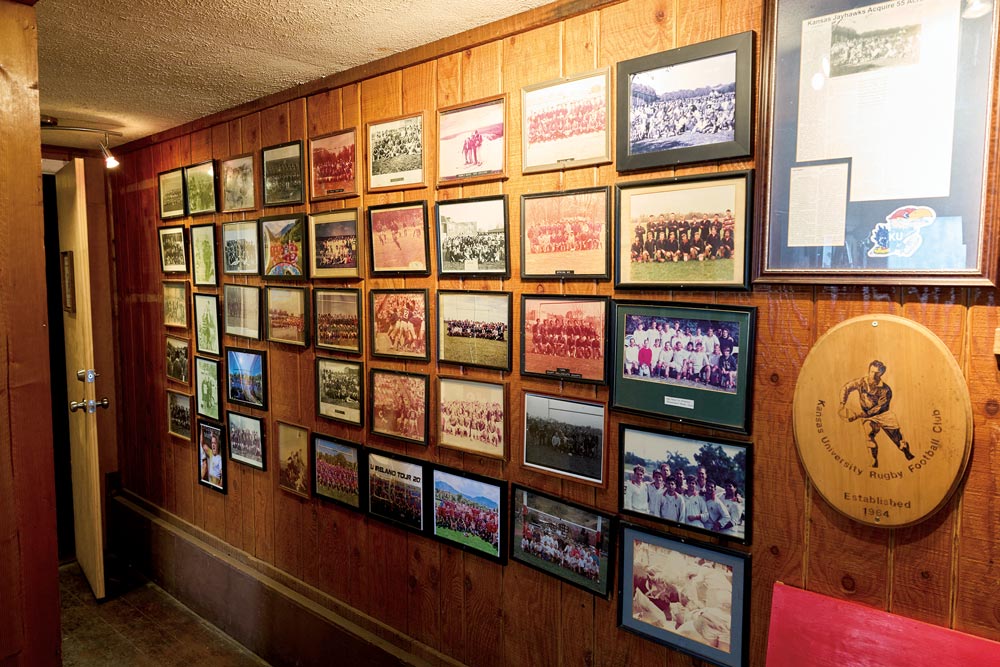
Above Johnny’s Tavern sits the KU rugby clubhouse, established in 1980 as a home for the program’s history—photos, jerseys, trophies and decades of accumulated stories. It’s notable that the club’s largest and most treasured prize is the OSVA Trophy—Optimus Socius Viator Athleta, outstanding social and victorious athlete—awarded after international trips to the Jayhawk who best represented team unity.
For current players, the clubhouse is a reminder of what came before. For alumni, it’s a place to return to, sometimes years later, often with spouses and children.
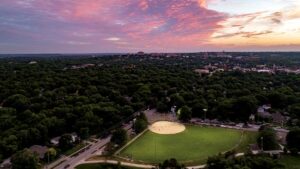
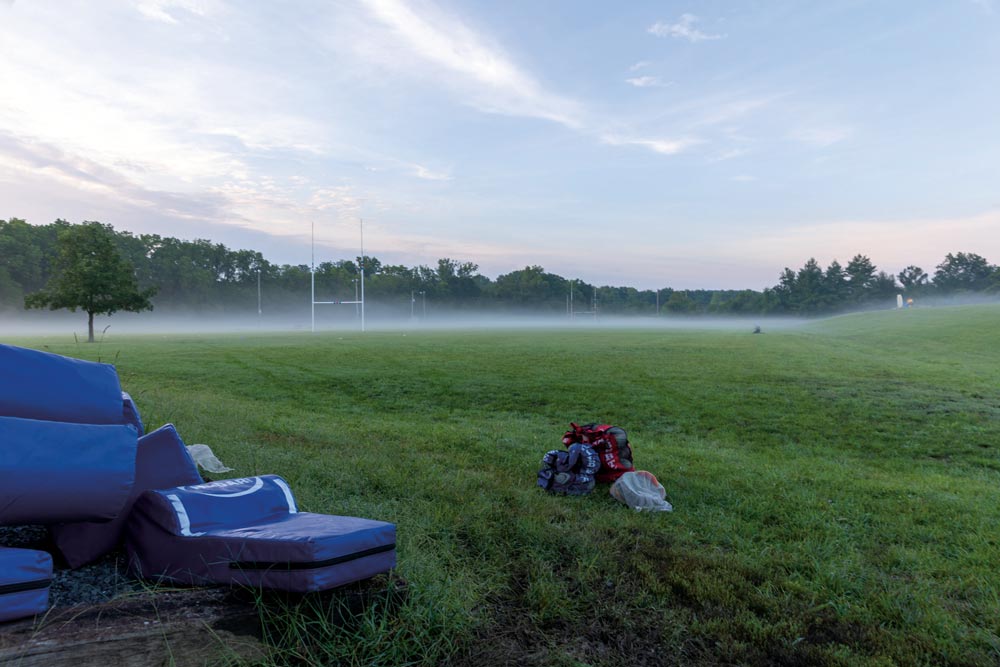
Elsewhere, just south of town, sits the KU rugby complex, Westwick, so named as a cheeky nod to being west of Twickenham Stadium, the home of English rugby. The 35-acre complex features two first-class rugby pitches, a practice field, lights, locker rooms and training space. The site, nestled within 200 acres of club-owned land, came together “like a church project,” in Renfro’s description, built over time through alumni donations and volunteer labor.
“It’s as good as there is in the United States,” Renfro says. “There’s about 15 or 20 permanent facilities dedicated to rugby in the U.S. Most teams either use a city park that isn’t taken care of properly, or a multisport campus field that’s marked up for other sports and is difficult to schedule.”
And then there’s the world beyond Lawrence.
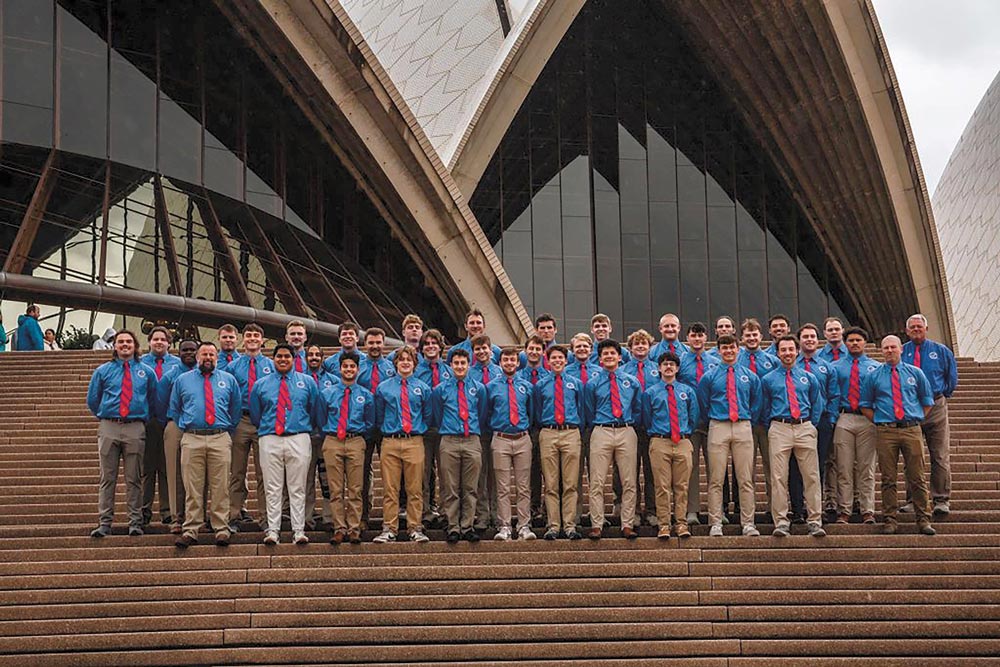
Since 1976, the Jayhawks have toured internationally every two years. This spring, the team traveled to Ireland, continuing a tradition that has taken the Jayhawks to England, Scotland, Wales, France, New Zealand, South Africa, Argentina, Brazil and Australia.
“There’s no other club in the United States—or, hell, worldwide—that tours as much or to as many different places as we do,” Renfro says, adding with a laugh, “That’s why we have Westwick. We saw these little clubhouses that these European clubs had and we said, ‘We’re from America. We can do way better than that!’”
For many players, KU rugby tours are their first time leaving the country. For some, it’s their first time on an airplane.
“They’re not just going to play rugby,” Renfro says. “They’re seeing how people live. They’re meeting families, seeing the culture.”
In rugby-rich countries, that culture runs deep. Clubs are multigenerational, rooted in neighborhoods and families. Matches are followed by meals, speeches and shared time with opponents. The game is competitive, but the community is just as important.
Lister experienced that firsthand when he spent time playing in New Zealand during spring and summer of his junior year.
“Every little town has a rugby club,” he says. “You’d play your match, then everyone would shower, put on a tie, sit down for a full meal, have a beer together. It’s just part of it.”
That tradition—competition paired with connection—is something KU rugby has worked to replicate. After matches, it’s not uncommon for teams to share a meal and a drink, either burgers and brats at Westwick or Johnny’s legendary pizza at the clubhouse.
“You just don’t see that in other sports,” Lister says. “That’s one of the coolest parts.”
Lifelong buy-in
At KU, the camaraderie built by rugby extends across generations. Alumni games, annual banquets, winter golf tournaments at desert resorts, and a network of roughly 450 former players help sustain the program financially and culturally. When the club team made a run to American College Rugby’s 2022 national championship, alumni support helped fund the trip to Arlington, Texas.
The Jayhawks came up just short in a hard-fought final, but the moment reinforced something larger: KU men’s rugby, the club sport for undergraduates, and its mother ship, the alumni- and community-based Kansas Jayhawks Rugby Football Club, endure because people keep investing their time, treasure and passion.
For Krone, the recreation services director, that continuity enhances something already powerful: the opportunity to represent KU.
“There’s only one Jayhawk,” he says. “When our clubs go out and compete with a Jayhawk on their jersey, that means something to the athletes.”
For Renfro, the meaning is transformation.
“Seeing the kids go from 18-year-old knuckleheads to 22-year-old mature adults who will end up being successful in whatever endeavor they end up choosing,” he says, “is the greatest reward.”
Lister is one of those stories. He credits rugby with preparing him physically and mentally for his career as a firefighter/EMT in Lawrence’s high-volume Station 5, directly south of Daisy Hill. The discipline, conditioning and resilience all carried forward.
“As soon as I was done playing rugby, I started firefighting,” Lister says, “and there was zero drop-off. I was ready to go for whatever firefighting would bring me, and that’s thanks to playing rugby. I’m fortunate.”
That success was, in a way, set in motion more than six decades ago, when Bunting created a club that could sustain itself, remain connected to the University and continue drawing in new players. He built the foundation. Others raised its lasting structure.
At KU, rugby is still being passed down—player to player, class to class, generation to generation, raised glass to raised glass. And as with Renfro all those years ago, some never really leave it behind.
Visit the KU Rugby website to find the team’s game schedule, purchase official KU Rugby merch and donate to support the club’s ambitious tours.
Chris Lazzarino, j’86, is associate editor of Crimson & Blue.