
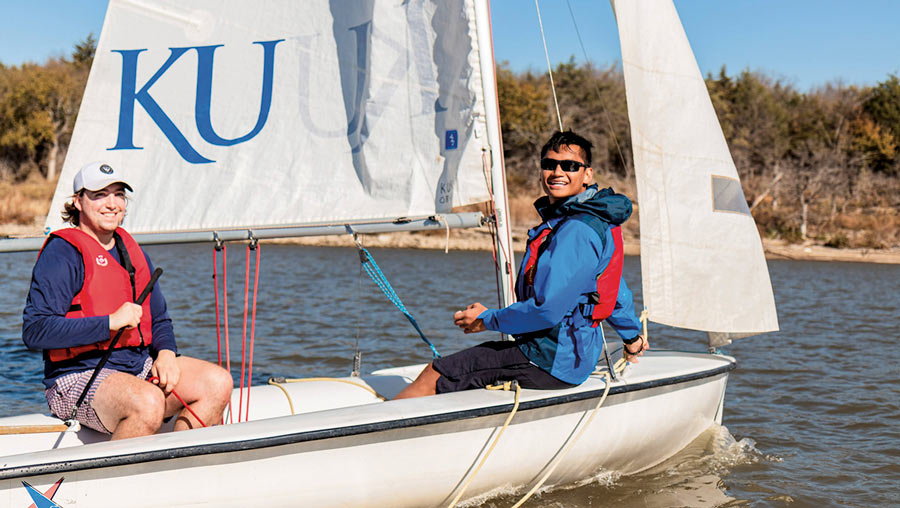
When Emma Russin arrived at KU in 2019, she didn’t know port from starboard. But she knew a good breeze when she felt one—and she felt something promising blowing across Perry Lake.
“I didn’t grow up sailing,” says Russin, e’23, g’25, a Minnesota native and recent master’s graduate in environmental and water resources engineering. “But once I got involved, I realized it was something really special. There’s nothing else quite like being out on the water. It’s kind of a timeless moment.”
KU Sailing Club has existed in one form or another since the 1970s. By the time Russin signed on, it was less of a team and more of a floating friend group—just a few students with access to boats and a willingness to get wet. Russin, along with a few like-minded students, set to work transforming it back into a true student organization, complete with regular practices and a competition schedule, social media presence and dues structure.
Today, KU Sailing is a thriving, competitive club sport with nearly two dozen members, a healthy waitlist and more wind in its sails than ever. And if you’re picturing an elite yacht club with blazers and champagne flutes, think again.
“Most of us had never touched a sailboat before college,” says senior Abe Pankratz, e’25, the club’s outgoing president. A chemical engineering major from Wichita, Pankratz joined the team during his sophomore year. “I played baseball and basketball growing up, and soccer in high school, but sailing clicked in a totally different way. It’s strategic, physical and just plain cool.”
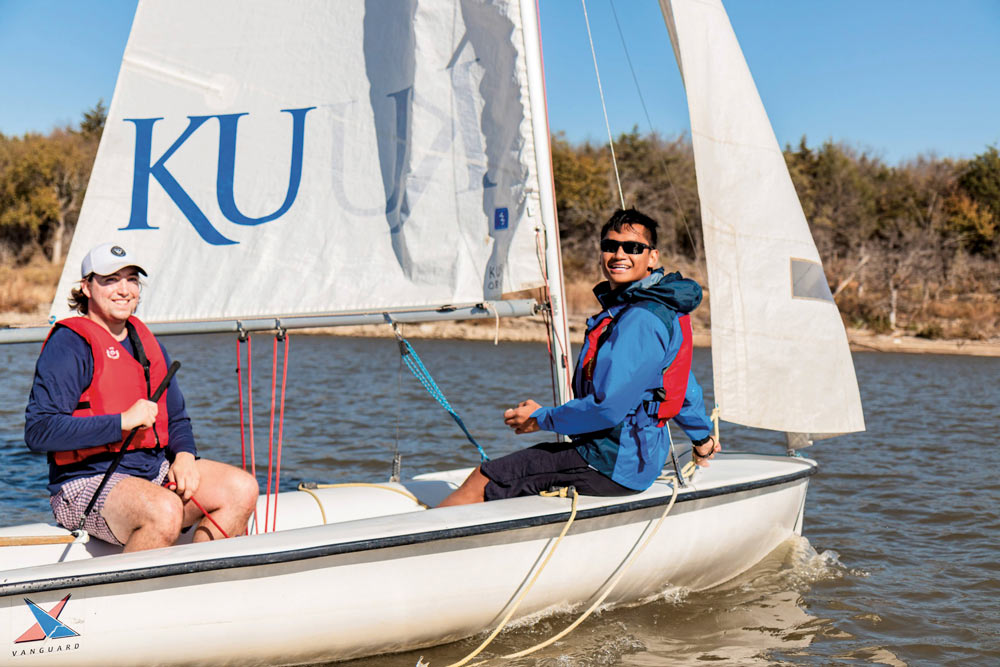
College sailing, it turns out, is designed to be accessible. Teams don’t haul their own boats across state lines—hosts provide them. KU sails in the Collegiate Sailing Association conference, which includes schools from Kansas, Oklahoma, Texas, Louisiana and Mississippi. The boats—typically two-person 420s—are stripped down for simplicity. No spinnakers allowed, just mainsails and jibs, life jackets and quick wits.
“Sailing is physically intensive and there’s a lot of thinking that goes into it,” Pankratz says. “There’s no YouTube tutorial that substitutes for the wind smacking you in the face.”
Practices take place on Saturdays at Perry Lake, northwest of Lawrence. Thanks to partnerships with the Perry Yacht Club and area alumni, KU sailors have access to up to 14 boats, though the club owns and maintains six of its own.
And yes, those boats break.
“Often,” says Russin with a laugh. “That’s what a lot of our dues go toward—maintenance, plus travel costs like rental vans and hotel stays.”
The club also benefits from a dedicated support system. Local sailing advocate and alumnus Ted Lischer, b’89, along with his family, has been instrumental in connecting students with sailing opportunities beyond KU. “He’s like our honorary coach,” says Russin. “He helps with everything from logistics to life lessons.”
Russin herself served as club president before handing the helm to Pankratz. Under their leadership, KU Sailing has again evolved into a serious pastime for students craving breaks from computer screens, although trophies were never the endgame.
“Our goal is to create lifelong sailors,” says Russin. “One of our members rented a boat in Europe and sailed the Mediterranean because of what he learned here. That’s the dream.”
For both Russin and Pankratz, the experience paid off beyond the water. Prospective employers, it turns out, are curious about students who can manage boat fleets, lead teams and balance spreadsheets with sail sheets. “I got more questions in interviews about sailing than anything else on my résumé,” says Russin, who’s heading to Minneapolis to work for the sustainable engineering firm Stantec.
Pankratz, too, is Minneapolis-bound, hoping to launch a career in environmental engineering. And yes, he plans to keep sailing. “But,” he adds, “I don’t really want to do dinghy sailing anymore. It’s fun, but I’m a tall guy, so I’m looking to graduate to a bigger boat.”
As they pass the tiller to a new generation of Jayhawk sailors, both leave the club with gratitude—and confidence.
“The next exec board gets it,” Pankratz says. “They want to build something lasting. That’s what matters.”
Chris Lazzarino, j’86, is associate editor of Crimson & Blue.