

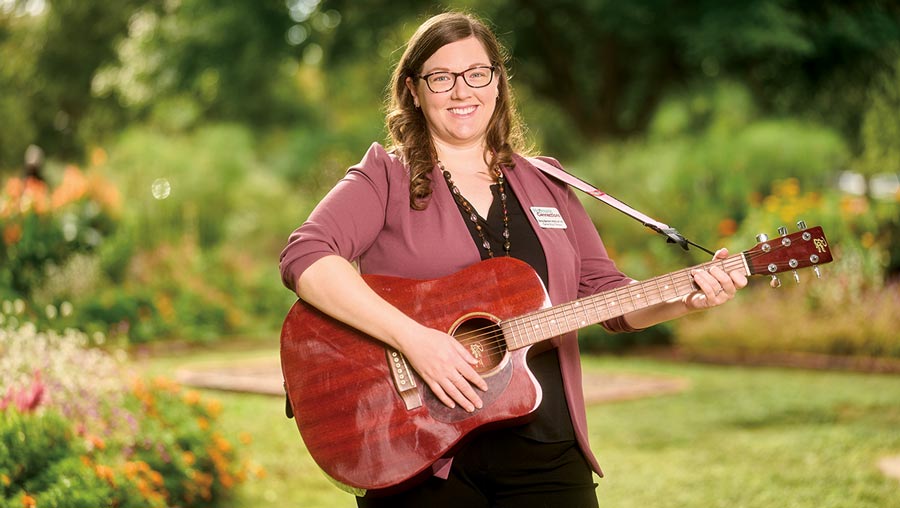
Music, with its sublime power to color mood, conjure memories and channel meaning, seemed to Emily Bachert the perfect subject for her high school psychology paper.
“You could write about any topic of your choosing that was related to psychology,” Bachert, u’14, g’17, recalls of the assignment. “I decided to write about music and the brain, and my mom mentioned, ‘Have you heard of music therapy?’ As a student, I was very interested in sciences, very interested in psychology, and I loved music, so a profession that brought those three together seemed right up my alley. As I was writing, I thought to myself, ‘This is what I’m going to do.’ It was clear as day.”
Today, Bachert brings the enrichment and comfort of music to residents of Lawrence and surrounding areas through her music therapy practice, Harmonic Connections, which she founded in 2017. Her clients range from preschoolers to older adults, and in a single day, her work can take her to a classroom, a nursing home, a client’s living room and a hospice bedside. To Bachert, the ability to adapt to such variation and the heart to meet every interaction with intention and empathy are pillars of her profession.
“Something you learn about as a music therapy student is the ‘iso principle’—meeting the individual where they’re at in that moment, and how validating that can be,” Bachert says. “So the specific goal of a music therapy session will vary depending on who you’re working with. Like a lot of therapy services, the overarching goal is to improve quality of life. In addition, my mission is to provide a service that allows individuals to feel respected, successful, seen, heard, understood.”
Bachert grew up in a family of musicians—her three older brothers are also School of Music alumni—and began piano lessons at age 5. A future in music wasn’t a foregone conclusion for the Lawrence native, however. “At first, I said I wasn’t going to be a musical Bachert,” she laughs. “I was resistant to it when I was younger. And then middle school and high school were when pursuing music really took off for me. It became an important part of expression for me and part of my independence and identity.”
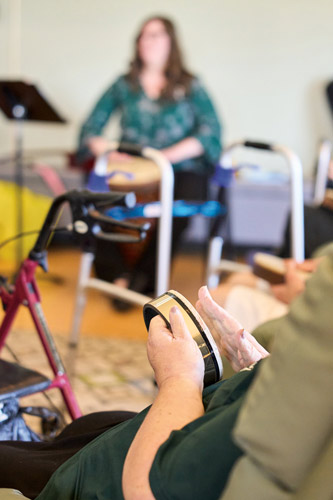
She added clarinet to her repertoire in fourth grade and percussion in sixth, and went on to earn her bachelor’s degree in clarinet performance and her master’s in music therapy at KU. Among her most treasured college experiences was traveling to New York City with the KU Wind Ensemble in 2013 to perform at Carnegie Hall: “We premiered a piece about 9/11 that was written by a New York composer. To this day, I remember what it felt like to step into Carnegie Hall and what it sounded like to play in Carnegie Hall. That is very much imprinted on me.”
Similarly etched in her memory are KU music therapy faculty who modeled the mindfulness and compassion the vocation demands. “I can still hear their words and their advice,” Bachert says. “It will echo through my head sometimes as I’m doing a session, about what the next appropriate step or consideration is for the person I’m working with.”
Alongside ongoing efforts to improve Alzheimer’s detection and treatment, the work of music therapists like Bachert fulfills an essential component of holistic care: providing support and reprieve to those who have been diagnosed and their loved ones.
Bachert recently chatted with Crimson & Blue about the world of music therapy and how the specialty can assist individuals and families impacted by Alzheimer’s disease.
What are some of the effects music has on the brain?
Bachert: What’s special about music as a stimulus is it’s processed throughout the brain. Because of this, if part of the brain is damaged or declining, music can engage other areas of the brain that support memory and cognitive function and can strengthen neural connections. If someone’s left hemisphere is affected by a stroke or brain injury, they may have difficulty speaking or articulating their words. They may not be able to speak a sentence, but they may be able to sing a sentence, as music engages both brain hemispheres.
Music also triggers the “feel-good” brain chemicals serotonin and dopamine, and our bodies physically synchronize to music, a concept called “entrainment.”
Board-certified music therapists are trained to use music in a capacity that maximizes these benefits. Music therapy interventions and strategies can increase coping and regulation skills, improve speech, decrease agitation, increase memory recall, improve gross and fine motor movements, and influence many other areas of well-being.
What role can music therapy play in Alzheimer’s care?
Music therapy can play a variety of roles, but a particularly impactful one I see in my work is providing a sense of normalcy, providing moments of being in the present and moments of clarity, whatever that may look like. And moments for the person to feel like themselves, feel in control and feel connected with those around them.
The changes could be subtle, like the individual at first seems unaware of your presence but later begins to show awareness that you’re right across from them. Or maybe they were agitated, pacing and incoherent at the beginning of the session, and by the end, they’re sitting and singing with me, and they’re articulating sentences. Music therapists watch for and measure those changes—the neutral face to the elated smile; the fidgeting and pacing to the rested arms and relaxed breathing.
As Alzheimer’s progresses, it can be harder for family members to know how to connect with their loved one. The person might not remember you, or they might think you’re someone else, and that can change the relationship. In a music therapy session, I might use a song that was special to the person and their loved one, and that can start to bring about awareness or reminiscence. All of a sudden, there is more eye contact between those two people, or they are singing that song together. The client may not be able to talk to the loved one, and the two of them can’t have a conversation anymore, but by singing something together, they’re able to connect.
So music therapy can be both a means to address some of the behaviors that are affecting connection, like agitation, as well as a means to connect and communicate.
Is there a piece of insight into Alzheimer’s, from your vantage point, that you’d share for people who may not be as familiar with the disease?
I would say, to have the assumption that the person understands more than they can convey. When a client is communicating something to me and it’s incoherent, I assume that in that moment, their communication makes sense to them. They feel and understand what they’re trying to tell me. This—assuming the person understands more than they’re able to express—is true for other diagnoses as well, and it goes toward preserving that person’s sense of dignity and showing respect for them and what they’re experiencing.
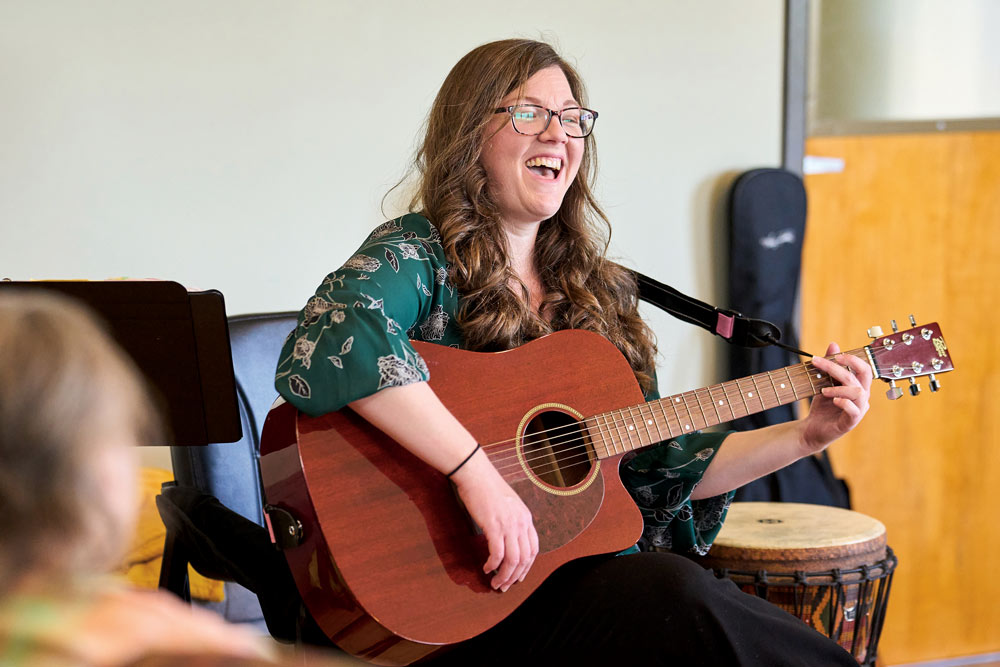
With this disease, as incoherent as a verbalization might become in later stages, it may still have inflection. In linguistics, it’s called “prosody.” For example, the way that we rise in pitch when we ask a question, or when someone is mad about something, how their speech might be more punctual and forceful. Those qualities of the way we communicate may remain.
I’d also add: Don’t underestimate what simple, small things can do. A musical example of this is a simple song like “You Are My Sunshine” and the positive effects it can have for someone.
What does doing this work mean to you?
The word that always comes to mind is “privilege.” It is a privilege to be a part of people’s lives and to be able to provide something meaningful for them. And it’s a privilege to be present in those moments when they can be uninhibited and be themselves.
With clients who have Alzheimer’s, building relationships with their families is also something I really enjoy. I get to learn from them about the person I’m working with—stories and legacies that shouldn’t be lost just because the person is presenting differently now. I will interject pieces of that information about the person—like they worked a particular job—into sessions.
Doing this work, I also witness a lot of vulnerable moments. I’ve been present when an individual with a traumatic brain injury or who has had a stroke has been able to say “I love you” to a loved one, because we’ve worked on that phrase. The emotions that arise in moments like that and just the humanness of it all—it’s incredibly meaningful to me.
What career advice would you most emphasize for current KU students or recent graduates?
Your college education is a foundation. You’ve already learned so much! But going out and working in your field and living life, you will still always be learning. Textbooks can make life and situations seem so straightforward, and especially within a helping profession, you learn that life isn’t so clear-cut. There is so much nuance to people and complexities to situations, and a textbook can’t always tell you what exactly to do.
So have that awareness that you’ll always be learning, and as long as you open yourself up to that, you’ll continue to grow. And have grace with yourself for what you don’t know—it’s more that you don’t know it yet.
Megan Hirt, c’08, j’08, is managing editor of Crimson & Blue.