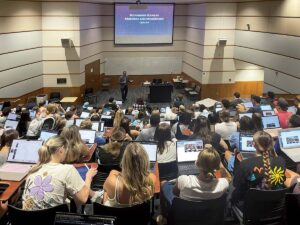

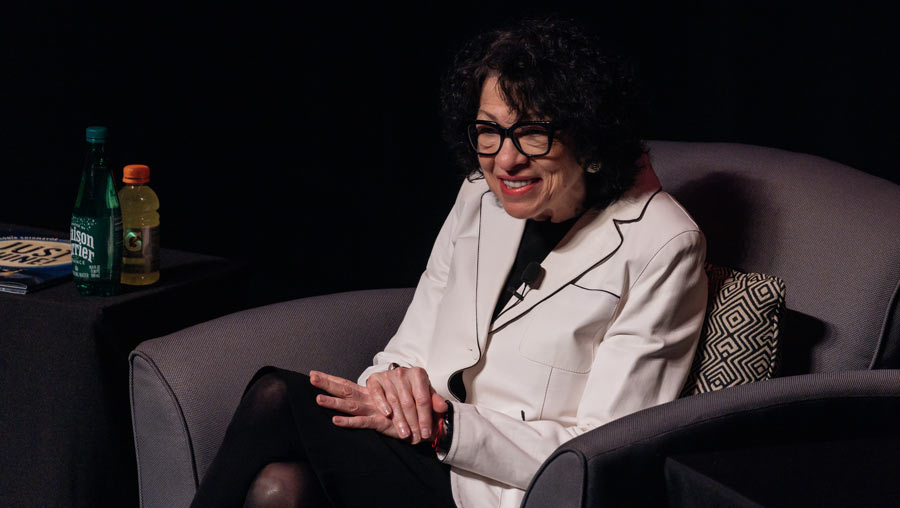
Before U.S. Supreme Court Justice Sonia Sotomayor addressed a crowd of 1,700 at the Lied Center on April 7, she gathered a much smaller audience. At a Lawrence elementary school the previous day, Sotomayor read excerpts from one of her children’s books, Just Shine!, and answered students’ questions about her life and career.
That Sotomayor’s two-day visit to Lawrence this week began with reading to public school children in their library seems no accident. Sotomayor, who is of Puerto Rican descent and grew up in a Bronx housing project, told the Lied Center crowd that she was 10 or 11 when she decided she would go to college and become a lawyer.
That early interest was inspired by the first chapter book that Sotomayor ever read, Nancy Drew. Initially, Sotomayor said she wanted to be a detective like Nancy Drew, but those plans were thwarted following her childhood diagnosis with Type 1 diabetes. A few years after being diagnosed at age 7, she was given a chart at the doctor’s office that had two columns: one listing careers she could do, and the other listing those she couldn’t.
“The ‘can’t do’ started with being a police officer,” she said. “It continued with, you can’t fly a plane, you can’t be a truck driver, you can’t be in the military. There was a whole list of ‘can’t do.’ And the list of ‘can do’ started with doctor, lawyer.”
Sotomayor said when she realized she couldn’t be a detective, her dream was “crushed.” It would be another fictional character, this time TV lawyer Perry Mason, who would reincarnate that dream. She said that for half of each episode of the show, Mason would investigate the crime his client was charged with, then would appear in court in the other half. “He’s playing detective as a lawyer,” she recalled thinking. “Maybe I should become a lawyer.”
“I tell this story to kids because growing up to want to become something doesn’t just happen on its own,” Sotomayor said. “You get struck by something that you’re exposed to. And reading can do a lot of that. For me, Nancy Drew started the process, but television continued it.”
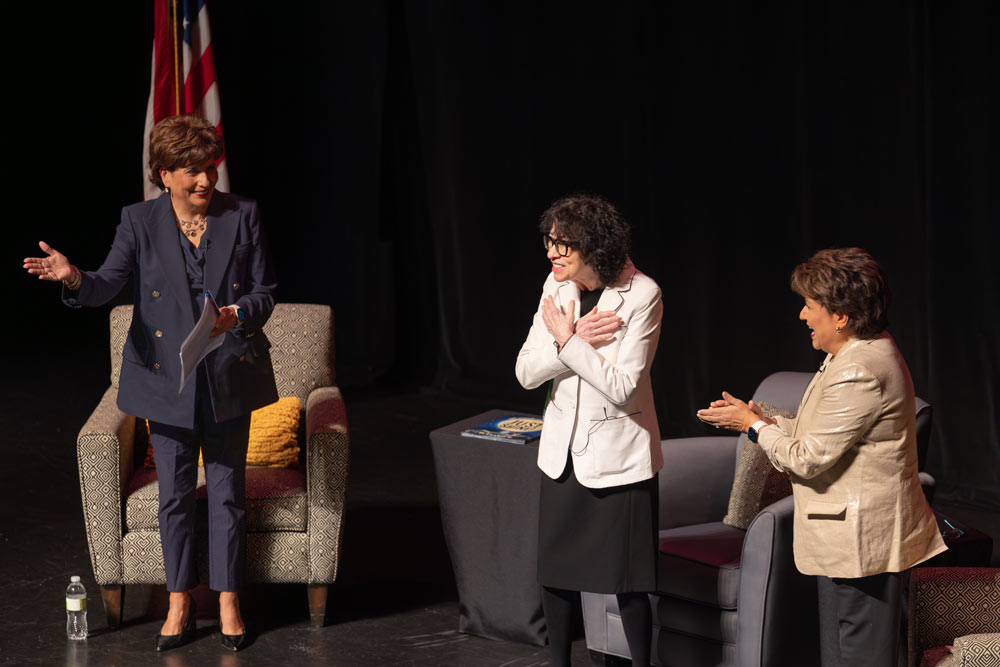
Sotomayor shared that it was watching Perry Mason argue his cases that first gave her the thought of being a judge someday. Though the aspiration was there, she was quick to admit she didn’t really understand what it entailed.
“My neighborhood as a child was a housing project in New York City, in the Bronx,” she said. “There were no doctors, there were no lawyers in the housing project. There were certainly no judges. And I didn’t really know what I was aspiring to be.”
As Sotomayor got older, those fictional characters were replaced with real-life examples. That included civil rights lawyers such as Thurgood Marshall and Constance Baker Motley, who were integrating schools across the nation. She watched as judges in the South, including Frank Johnson, a federal judge in Alabama, issued landmark rulings dismantling segregation. She said this was even though those Southern judges had been educated to believe segregation was the right thing for society.
“These men had crosses burnt on their front yards,” Sotomayor said. “They and their families were threatened. And they so believed in the power of law that they followed it. And they’re the ones that ultimately inspired me to become a lawyer. And it’s their model that I’m trying to follow as a judge—to do what I think the Constitution requires.”
Sotomayor graduated from Princeton University and Yale Law School before later ascending through the courts, from the U.S. District Court for the Southern District of New York to the U.S. Court of Appeals for the 2nd Circuit. But like the column of “can’t do” she faced as a child, Sotomayor met resistance, particularly following her Supreme Court nomination. She said there were “a lot of naysayers.” Those who said she wasn’t smart enough, those who called her “an average judge who would be an average Supreme Court justice” or said she wouldn’t make any contributions to the court. At one point, Sotomayor said she was considering withdrawing from the process.
“It really hurt me,” she said. “I had spent a career working hard at everything I did. I had done pretty well in Princeton and pretty well in Yale, and, you know, getting a District Court judgeship and getting a Court of Appeals appointment was not easy. And I knew that my colleagues respected and liked me, and to be publicly criticized that way—I actually thought about pulling out.”
Ultimately, Sotomayor said it was a conversation with a friend and fellow Latina that renewed her commitment. Sotomayor recalled the friend coming to her and saying, “Sonia, this is not about you. This is about my 8-year-old daughter, who needs to see someone like her sitting on the highest court in the land.” Though she worried whether she would make it every step of the way, Sotomayor said being a trailblazer as a Latina is a pressure she’s learned to embrace, and she encourages others to do the same.
“Being a first is a symbol for all that follow,” she said. “It’s opening the door for others who can do what I’ve done and more. I tell every young Latina that I meet: One of you has to come take my place. One of you has to be president someday. It’s a special responsibility. We have to do it well. We have to work harder than other people do.”
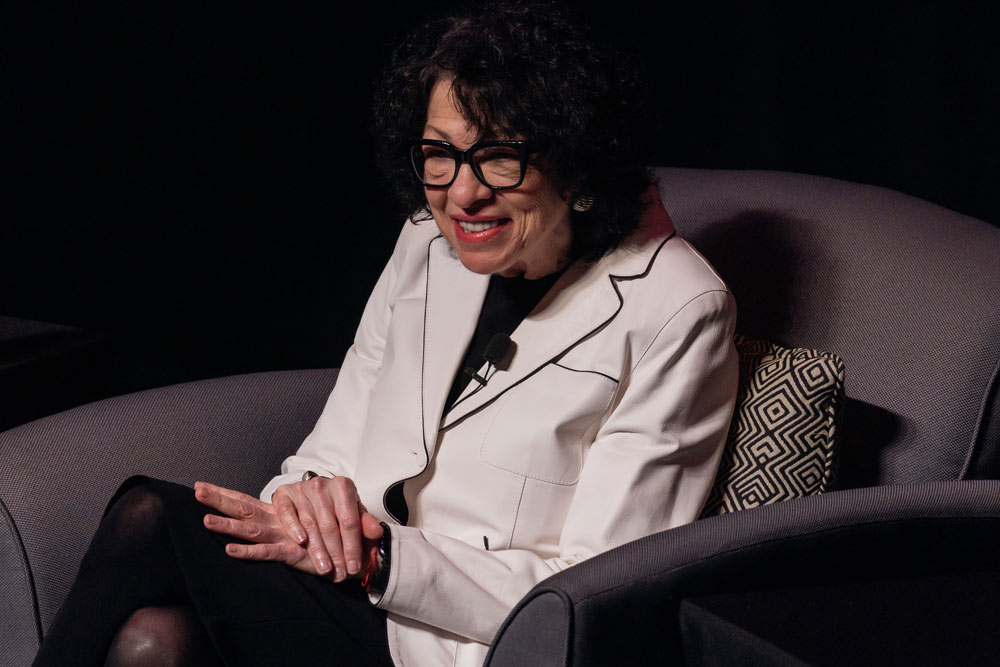
The notion of continued hard work extends to all, she said, when it comes to sustaining the republican form of government. One of multiple responses that gained Sotomayor a standing ovation from the Lied Center crowd was about that effort.
“The beauty of this country is staggering; the differences are astonishing,” she said. “And yet, that we all are proud Americans is really an extraordinary feat by a nation. We have to hold on to that spirit of permitting our differences to exist while being united in building this more perfect union. … It requires work and requires active participation by all of us—in making this great nation remain great.”
The discussion, which was hosted by the School of Law, was moderated by two Latina trailblazers in their own right, twin sisters and KU alumnae Mary and Janet Murguía. Mary Murguía, c’82, j’82, l’85, is the first Latina to serve as chief judge of the federal appellate court in the U.S., and Janet Murguía, c’82, j’82, l’85, serves as president and CEO of UnidosUS, the largest and one of the most influential Latino civil rights and advocacy organizations in the country. Other discussion topics included judicial discretion, the emergency docket, and Sotomayor’s dissent in Noem v. Vasquez Perdomo, which argued against profiling by federal agents.
One of the last questions was whether Sotomayor, who has published a memoir and several children’s books, was working on anything new. Sotomayor said she was.
“It’s another children’s book, and it’s called Just Try!” she said. “It’s about how to deal with the fear of trying something new.”
Rochelle Valverde, c’08, j’15, is staff writer for Crimson & Blue.