
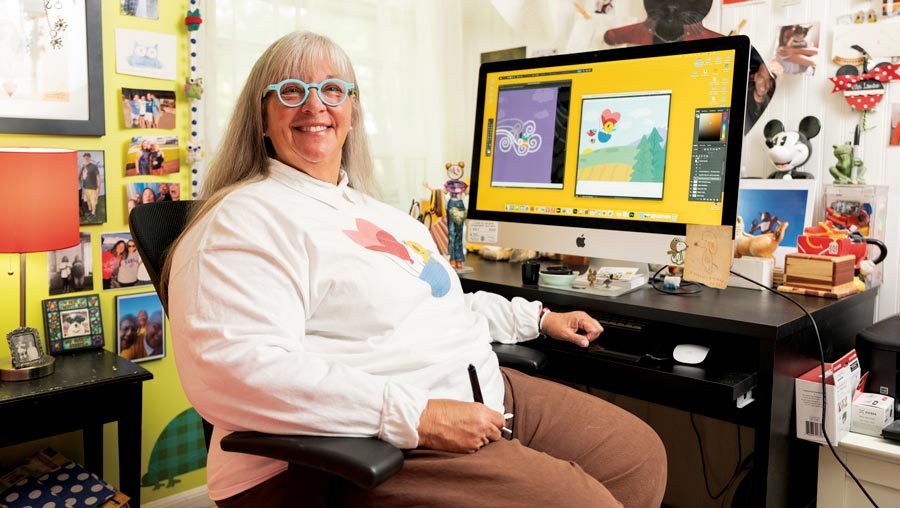
Stacey Leslie Lamb always knew she wanted to be an artist. She just didn’t know her art would end up in the hands of children navigating some of life’s darkest moments.
A Lawrence resident and longtime Hallmark Cards illustrator, Lamb, f’82, spent more than 30 years filling greeting cards with warmth, whimsy and wit. But it wasn’t until she lost that dream job—caught in a wave of layoffs in 2013—that her second career, and her true calling, began to take shape.
“I went from working in this vibrant creative community to suddenly being home, by myself, trying to figure out what was next,” Lamb says. “I was grieving. That’s really what it was.”
In the quiet that followed, she began drawing again—starting with 100 small cards for a friend facing a bone marrow transplant. The drawings were hopeful, humorous, spiritual, and the idea was simple: one card per day, to help her friend endure 100 days of germ-free isolation. Lamb’s cards, hung with clothespins and a clothesline, became a countdown of healing.
Word spread. A doctor at the University of Kansas Cancer Center saw them and ordered 40 sets. Encouraged, Lamb launched her own company, HAPPYtown, in 2015. Its mission: to create illustrated tools—books, cards, activities—for children and families navigating medical treatment, trauma and grief.
What started as a deeply personal project evolved into a line of products used in children’s hospitals, therapy centers and homes. Lamb recently released her most ambitious and emotionally resonant project yet: Hope and the Winds of Grief, a picture book designed to help children process the loss of a loved one to suicide.
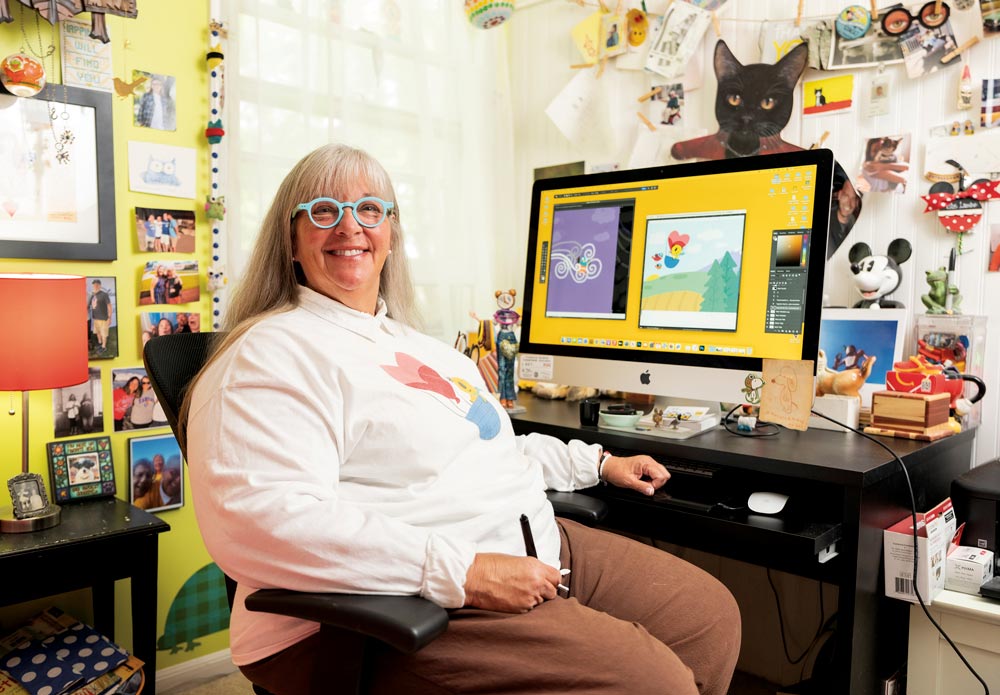
The project began in a play therapy conference, where Lamb met several professionals with similar requests: Could she create something to help children surviving suicide loss?
“There are books out there that address grief,” Lamb says, “but hardly any that use the word ‘suicide.’ And that’s what these children are dealing with. They know what happened. They need something that meets them where they are.”
The result is a 32-page storybook featuring a yellow koala named Hope, who travels by heart-shaped hot air balloon and helps children understand their emotions in the wake of profound loss. Hope guides young Orrie as he grieves the suicide of his brother, Kip—gently facing gusts of sadness, anger, guilt and confusion, each represented by a different “wind.”
To write the book, Lamb turned to an old Hallmark colleague, Roeland Park freelance writer Scott Emmons.
“Writing about suicide for children was difficult, as you can imagine, but there’s just no way to get around that. The only way to do it was to be direct, empathetic and simple,” says Emmons, who spent 16 years at Hallmark and later wrote for the digital entertainment studio JibJab and its children’s media franchise, StoryBots. “I would say my guiding principle was to keep it as empathetic as possible, to make the story almost minimalist, so I could create a very real, very simple, very straightforward telling of the story, using the winds as the metaphor for grief and all the different forms it can take.”
Emmons and Lamb worked closely with therapists throughout the process. “We didn’t want to make assumptions,” Emmons says. “We had to get this right—for the kids who would read it and for the adults helping them through it.”
The story, and Lamb’s illustrations, have struck a chord. The book has been praised by mental health professionals and is now under consideration for a Kansas Notable Book Award. Its companion workbook—over 100 pages of guided activities for families, caregivers and counselors—has been dubbed “the grief bible” at conferences.
Creating the book was not only a professional challenge for Lamb—it also became unexpectedly personal.
“I was moving along, doing the illustrations, and then one just hit me,” she says. “I had to walk away for two or three weeks. I realized I hadn’t dealt with the suicide of a friend years earlier. The project brought that back. It was intense—but healing, too.”
Lamb designed the character Hope more than two decades ago but wasn’t sure what role the cheerful koala would eventually play. “I knew she had a mission,” Lamb says. “I just didn’t know what it was yet.”
Hope is now the face of HAPPYtown’s grief products. She first appeared in “Hello Hope,” a card set Lamb created for MedStar Georgetown University Hospital in Washington, D.C., after shadowing their child life specialists. The cards became part of bereavement bags for grieving families.
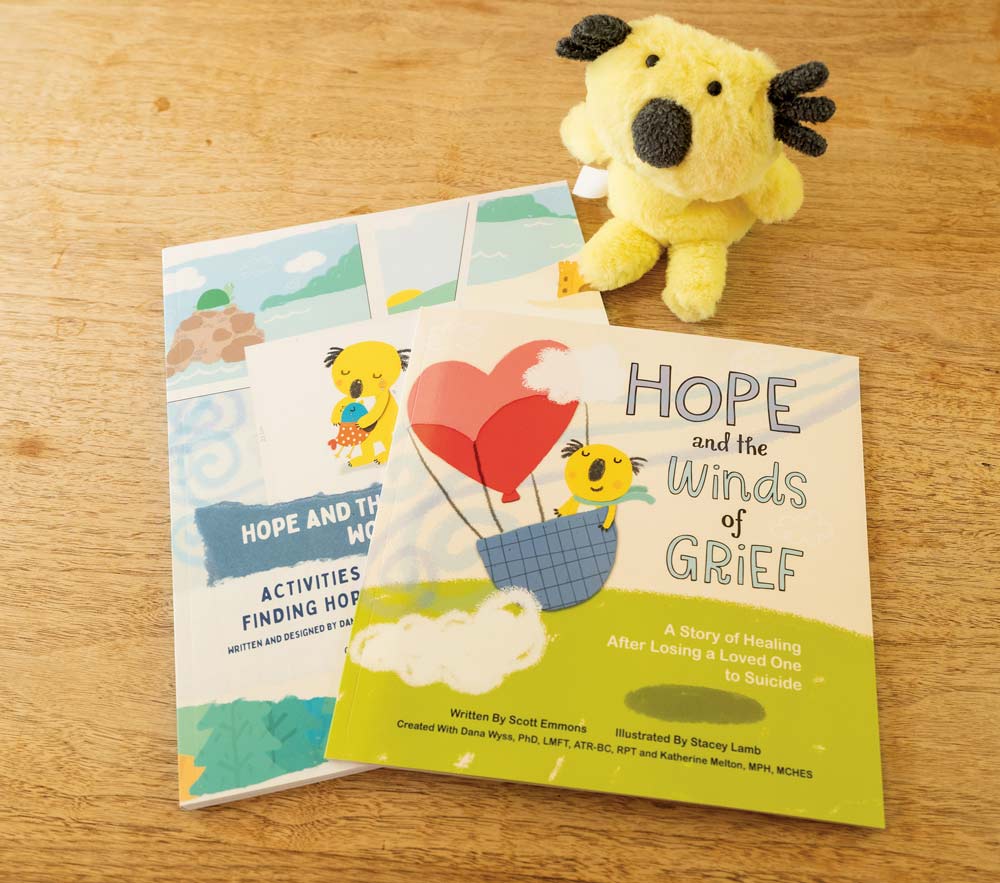
“Hope has kind of become our spokesperson,” Lamb says. “She’s there to say, ‘It’s OK to cry. It’s OK to feel angry. And it’s OK to smile again, too.’”
Lamb, who grew up near St. Louis in southern Illinois, traces much of her success—and resilience—to KU, where she studied illustration and graphic design after seeing Mount Oread during a high school visit in 1978.
“I walked down Jayhawk Boulevard and just knew,” she says. “I looked out over the Wakarusa Valley from the back of Wescoe Hall and said, ‘This is it. This is where I belong.’”
She met her husband, Brent, c’84—who is retired from KU Endowment—and commuted for years to Hallmark in Kansas City. “People thought I was crazy for doing that drive, but I loved it. It gave me time to think.”
Today, she’s still thinking, still drawing and still inspired by the KU students who remind her of where she started.
“I tell young artists, ‘Love what you do. Stick with it. Be ready for rejection, and don’t take it personally. And if you get knocked down? Well, maybe that’s where the best work begins.’”
She dreams of a course at KU to prepare design students for real-world careers—how to interview, work with clients and handle the financial side of freelancing. “So many young artists have talent,” she says. “They just need the tools to get that first opportunity.”
For both Emmons and Lamb, Hope and the Winds of Grief represents the best kind of collaboration: personal, purposeful and lasting.
“Life can break your heart,” Lamb says. “But then it gives you the chance to use that experience to help someone else. That’s what Hope is about. And that’s what I hope people see in the work.”
Chris Lazzarino, j’86, is associate editor of Crimson & Blue.