
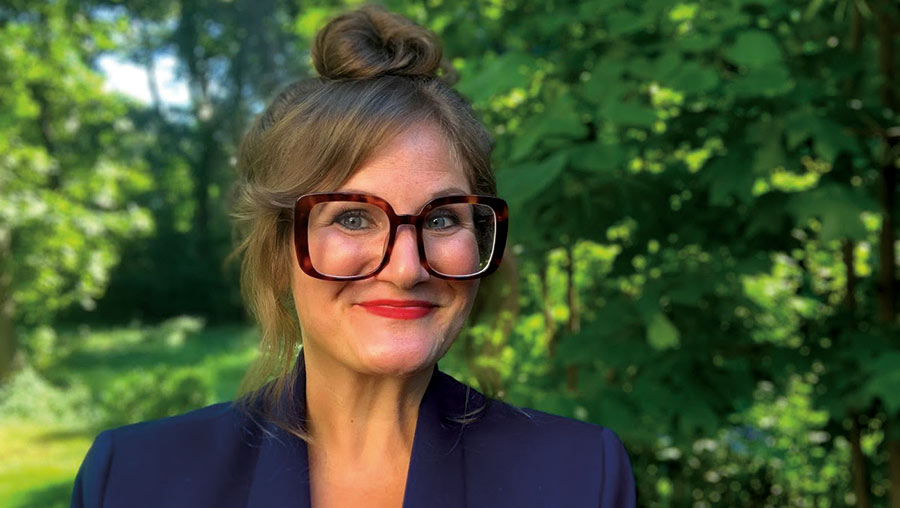
Portolan charts were some of the first navigational maps of the seas, guiding sailors using networks of rhumb lines and precise, hand-drawn depictions of coastlines and ports. Centuries after mariners first used the charts to navigate, Stephanie Stillo, PhD’14, sat captivated in front of one at KU’s Kenneth Spencer Research Library.
That day in 2012, and the shift in thinking it provoked, would lead Stillo to her current job managing materials at the largest library in the world. As chief of the Library of Congress’ Rare Book and Special Collections Division, Stillo now oversees a collection of more than 1 million items. When she encountered the portolan chart, Stillo was a graduate student in history at KU. Though she was used to looking at the past through historical documents, the focus had always been on the text.
“I had worked in archives in several countries at that point, but it was really at the Spencer Research Library that I first encountered books in a new way,” Stillo says.
What brought her to the Spencer that day was a Council on Library & Information Resources grant application to work at the Library of Congress. Applicants were called to design a project that used forensic technologies to analyze the materiality of historical documents. Stillo was intrigued by the idea of looking at library collections in a new way, but she didn’t really know what the task entailed. “Can you just talk to me?” she recalls asking the Spencer librarians.
“And they did, and they were so lovely,” Stillo says. “The librarians there in special collections pulled out a bunch of material for me. And we really talked about what it means to look at historical documents, not just in terms of what they are saying as a text, but what they’re saying as an object. And that really sparked something really deep for me.”
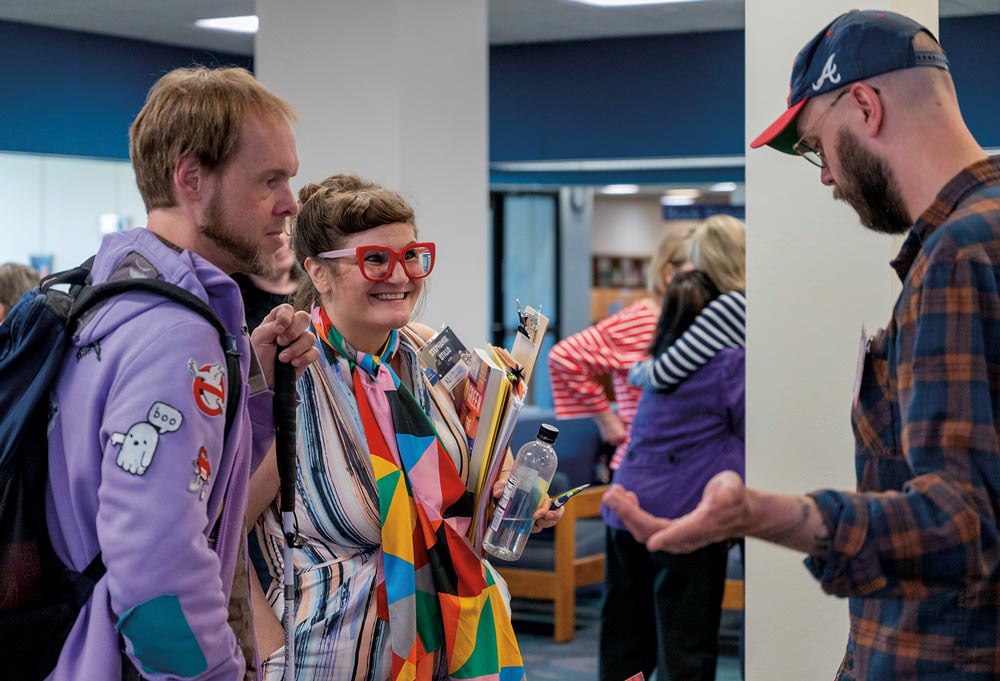
Stillo, who returned to KU on April 16 as the keynote speaker for KU Libraries’ Snyder Book Collecting Contest, says a librarian sat with her for a long time in the reading room at the Spencer. Among the material they explored, it was the portolan chart that most caught her attention. While Stillo doesn’t remember the chart’s location or exact date—which she says was likely from the 14th or 15th century—she clearly recalls the feeling she got looking at it.
“It was all hand-done, and it was so beautiful,” Stillo says. “The hand of the maker in that document was so apparent. When you talk about the materiality of history—it was there. You could see someone hand-writing and drawing on the parchment. You could just feel this very intense connection to the person who created the document. And I just remember that portolan chart really changed my life.”
‘The whole spectrum of human history’
Stillo received the fellowship, during which she investigated a world atlas from the 17th century, using pigment and annotation analysis to trace its changes and movement across three centuries. After graduating from KU, she spent two years on the faculty at Washington and Lee University in Lexington, Virginia, before making her way back to the Library of Congress in 2016. She served as the curator of the Lessing J. Rosenwald Collection and the Aramont Library, two of the Rare Book and Special Collections Division’s notable collections, before beginning her current role in 2023.
As chief of the division, she oversees the largest and most wide-ranging collection of rare books in North America, comprising well over 1 million items. In addition to books, the collection includes pamphlets, theater playbills, title pages, prints, posters, photographs, and medieval and Renaissance manuscripts spanning eras and subjects, as well as President Thomas Jefferson’s library.
Stillo and her team of reference librarians and curators serve as a general resource for Congress and work with scholars to dig into historical projects and answer questions. Her other duties include strategic planning, acquisitions of new materials and educational outreach. As an example of the latter, at the division’s Rare Book Classroom, Stillo says visitors can see the workings of an actual printing press, write with a quill and learn about the history of communication.
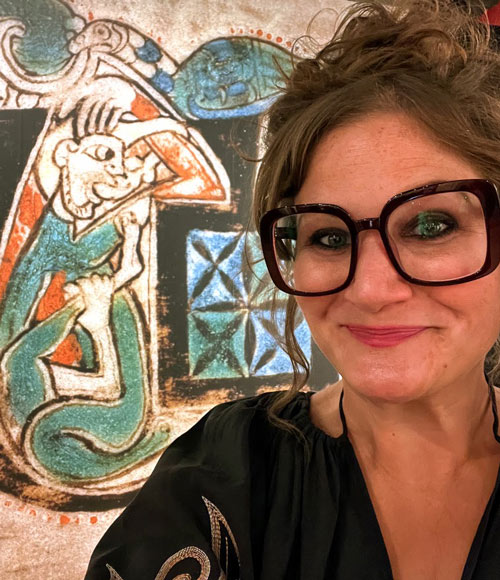
“There’s so much that’s already at the Library of Congress, which is so exciting, but it’s also really fun to be thinking about where are the silences in our collections, and how do we bring new material in to enlighten the whole spectrum of human history?”
Her favorite aspect of her job is working with the antiquarian book market to purchase new material for the Library of Congress. Stillo and her team seek to deepen existing collections and address underrepresented areas, such as material by women. Recent acquisitions have included an illustrated Bible from the 15th century, a new portfolio by modern artist Sonia Delaunay, children’s literature, and historic and contemporary poetry. All told, she says they make hundreds of acquisitions per year.
“That can range from new medieval manuscripts to 18th-century American broadsides,” Stillo says. “There’s so much that’s already at the Library of Congress, which is so exciting, but it’s also really fun to be thinking about where are the silences in our collections, and how do we bring new material in to enlighten the whole spectrum of human history?”
Going from a history classroom to browsing antiquarian book fairs in the U.S. and Europe isn’t necessarily a typical path. Stillo credits KU with being the “springboard” that helped her make the leap from a university setting to libraries and archives. She says her KU adviser in the history department, Luis Corteguera, was supportive of her branching out and thinking about her career in new spaces. Through it all, that moment at the Spencer, when the everyday humans behind historical documents came to life, continues to resonate in her career.
“These were people who were making things with their hands,” she says. “It was just so much labor and intense care, and it brought me into closer communion with the past. And that was a really striking moment for me, and that’s something that I continue to chase in my life—is to find those stories.”
Collecting stories
Stories are a key element of KU’s Snyder Book Collecting Contest. As part of the annual competition, students submit a description of their collection, an annotated bibliography and a personal essay. Beth Whittaker, c’92, g’94, director of the Spencer Research Library and associate dean of distinctive collections at KU Libraries, says she always tells students that the competition is a book collecting contest, but also an essay contest.
“The books by themselves are just books,” Whittaker says. “It’s only when they tell their story of how they came to have the books that it becomes a collection.”
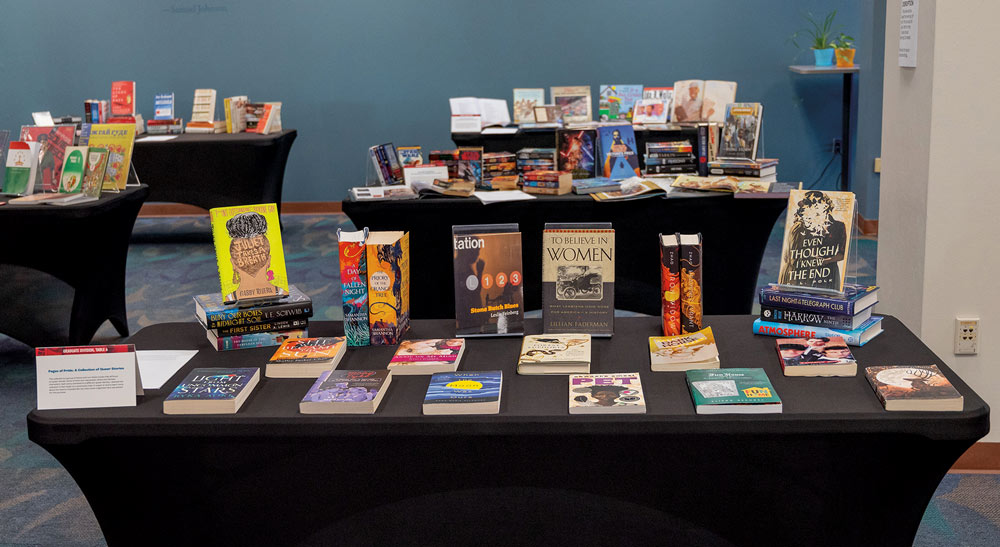
Whittaker says the contest encourages students to think about their books and texts more broadly. That includes considering the theme of the collection and reflecting on their own relationship with the material.
“I think it’s a great marriage of informal, self-education but also self-reflection,” Whittaker says. “And it’s all done in the context of printing and books and texts.”
In recent years, the topics of winning collections have included Shakespeare and early modern occult theater, music and identity in the post-industrial Midwest, and Crimea and the Crimean Tatars. While entries must be organized around a particular topic, they do not need to be rare or expensive. For instance, one recent winner’s collection was free books found on four college campuses.
Finalists in this year’s contest, which had 22 entrants, set up their collections April 16 in Watson Library, standing attentively behind their displays and discussing them with visitors. After Stillo’s address, the winners were announced. Riley Verdict won first place for his collection, “Gaudiya Vaishnavism: A History and Living Theology,” in the undergraduate division, and Jessina Emmert, g’22, won first place for her collection, “African American History in Children’s Literature: Slavery to Civil Rights,” in the graduate division.
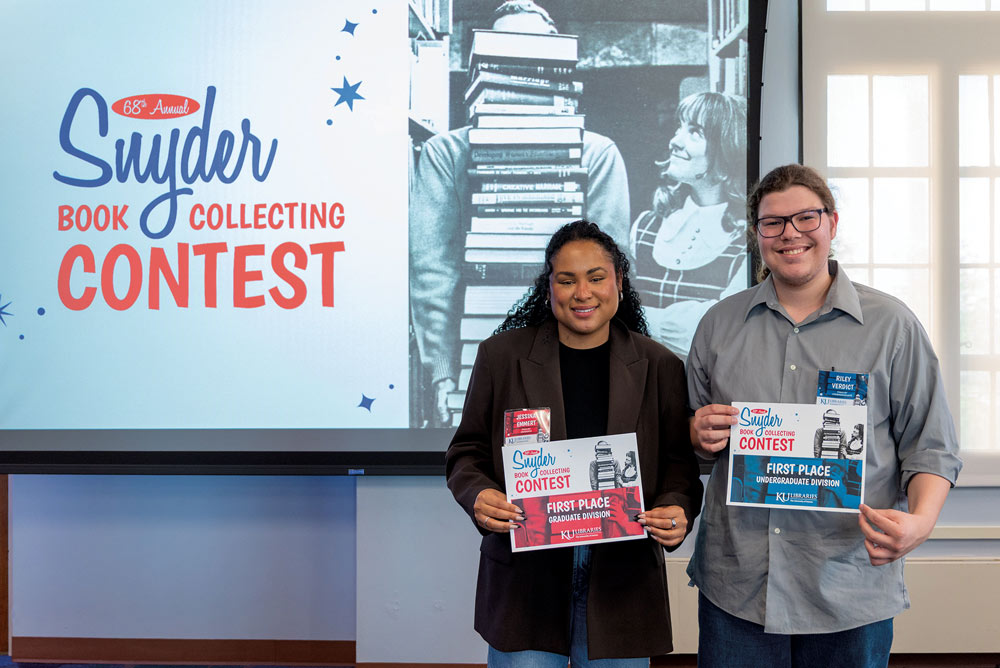
The first-place winners are eligible for the National Collegiate Book Collecting Contest, and first place, second place and honorable mention in both divisions received cash awards. They all join a decades-long KU tradition: The first Snyder Book Collecting Contest was held in 1957 thanks to a gift from Elizabeth Morrison Snyder of Kansas City. Snyder later established an endowment to provide permanent funding.
Whittaker says the contest has been fortunate to host great keynote speakers over the years. She says Stillo’s experience provides students an example of both an interesting career trajectory and an impressive achievement.
“She’s a really outstanding person in the field,” Whittaker says, adding that providing examples for students of where their KU education can take them is important.
For her part, Stillo says she was delighted to return to where it all began for her and to support young collectors, as well as the faculty and libraries that helped her evolve to where she is now.
“What’s so exciting about this trip is that I’m coming back as my most realized self,” she says. “I get to talk about the things that I am doing now at the Library of Congress and encourage young collectors with the Snyder Book Collecting competition to continue on.”
Rochelle Valverde, c’08, j’15, is staff writer for Crimson & Blue.