
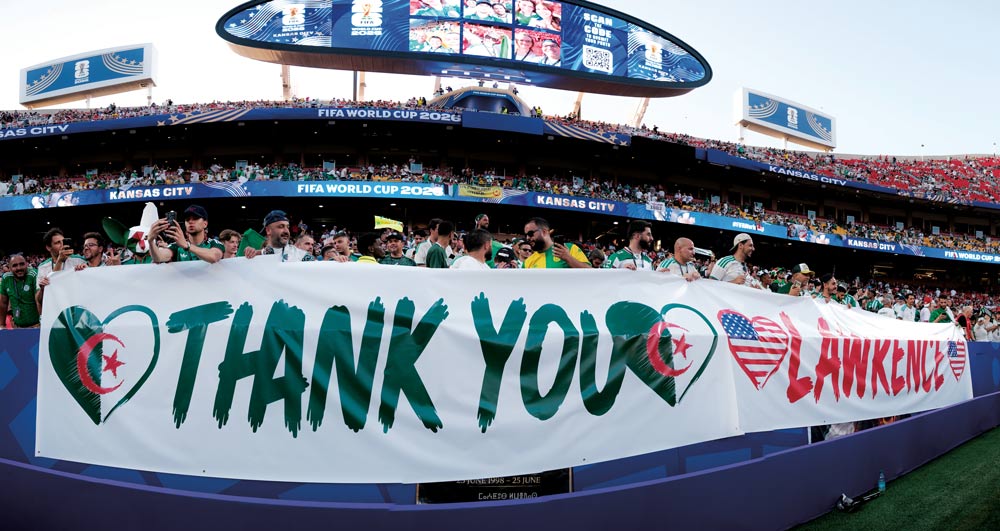
A midnight welcome party outside a hotel. The familiar notes of the Algerian national anthem rousing a crowd. People from across the world, celebrating together in a big screen’s glow.
The camaraderie on display between Lawrence and Algeria during the 2026 FIFA Men’s World Cup offered a poignant example of how communities oceans apart can still come to feel closely knit. International media coverage—including articles in The Guardian, the BBC and The New York Times—highlighted the unique spirit of KU’s hometown and the heartwarming Lawrence-Algeria bond, sharing with the world what Jayhawks and locals have long known: There is nowhere else quite like Lawrence, Kansas.
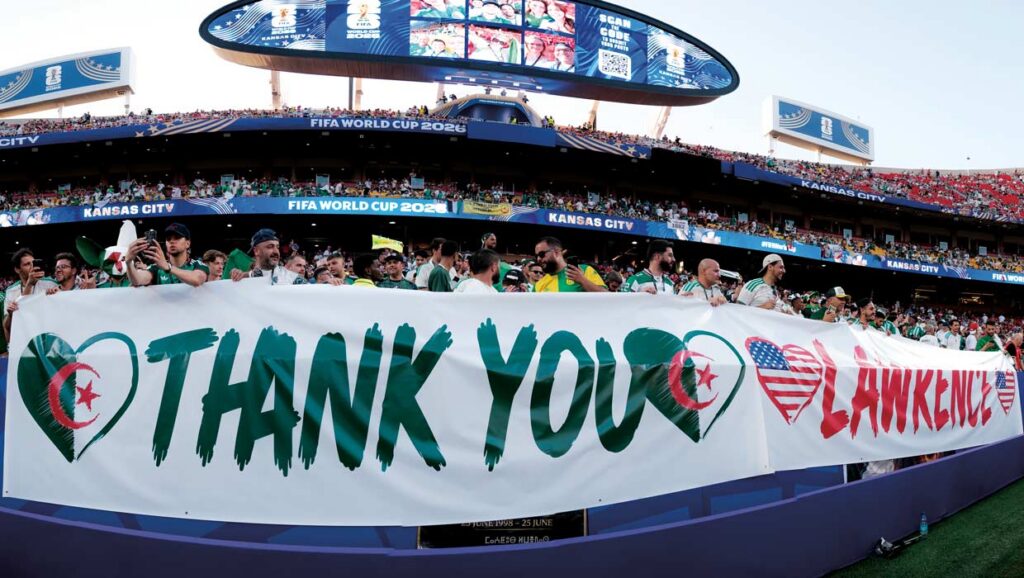
Behind every viral social media moment and international news story, there was thoughtful preparation, genuine interaction and a sincere desire to connect. Among the many purveyors of Lawrence’s warm welcome and weeks of World Cup-focused community activities were KU faculty, staff, students and alumni. Each brought their own knowledge, experience and personal histories to the fore, helping forge the endearing and enduring connection between Algeria and our Midwest college town.
One community
When Ph.D. student and lecturer Aya Fayed, g’25, watched Algeria’s first World Cup match against Argentina at Liberty Hall in downtown Lawrence on June 16, she couldn’t differentiate between the Algerian supporters and the locals in attendance.
“Everybody was cheering for Algeria, and even jokingly booing when (Argentina’s star forward Lionel) Messi would score—and everybody was laughing,” Fayed says. “It was really hard to separate the groups, (to tell) who were the locals and who were actually the fans who came all the way from Algeria.”
After the game, Fayed says whenever someone would shout the opening of the Algerian chant, “1, 2, 3,” the crowd would chorus the second half: “Viva l’Algerie!”
And while the passionate game-day crowds drew camera lenses, many other lower-key gatherings—a meeting of business owners, an Arabic language class—also drew enthusiastic participants.
At the time, Fayed was serving as the communications and outreach coordinator for the Kansas African Studies Center, which is based at KU. She was among the many faculty and staff who worked to prepare the Lawrence community to welcome the Algerian National Team and its supporters after the team selected Rock Chalk Park in February as its base camp for the tournament.
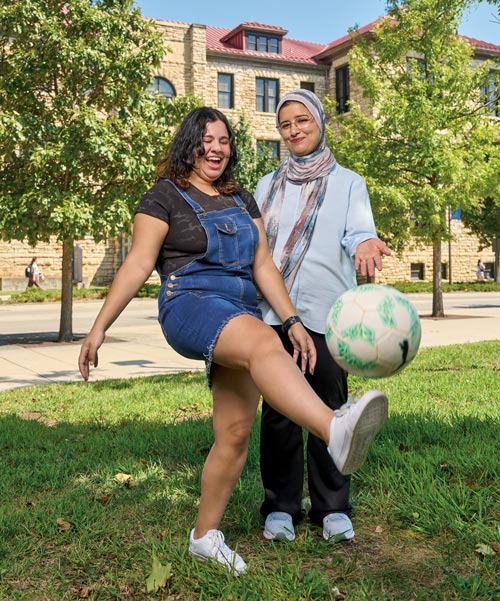
Like the watch parties, Arabic language classes—organized by KASC, KU’s African and African-American studies department and the Lawrence Public Library and held throughout the team’s World Cup run—filled up. Fayed says 20 people registered for what was initially a stand-alone class, but about 35 people attended, showing so much interest that the library brought in Ahmad Sobhy Mustafa, a Ph.D. student and Arabic instructor in the AAAS department, to teach a six-part series.
Score Lawrence—a coalition of the City of Lawrence, Douglas County, KU, Explore Lawrence and the Lawrence Chamber of Commerce—organized cultural training sessions and other learning opportunities for businesses, restaurants and government employees, and Fayed said more Lawrencians reached out with additional training requests.
“They weren’t just hosting an event,” says Fayed, who is from Egypt. “No, they truly wanted the Algerian fans to feel welcomed and appreciated. As someone from North Africa myself, it was really meaningful to help build this bridge between cultures and share information that would help people connect.”
Information spread by other means as well. Amal El Haimeur, AAAS assistant professor and coordinator of the department’s language program, created slides for a presentation, which Fayed turned into a 30-minute video. The video, which was posted online and shared with interested parties, covered Algeria’s history, language and culture, from halal food to communication styles.
El Haimeur and Fayed, who both assisted with trainings or other events, were also among the KU faculty who provided Arabic translations for Kansas Athletics, campus museums and local governments. Though much of the work was behind the scenes, Fayed, who did the Arabic portion in a multilingual welcome video posted by Johnny’s Tavern, had her own viral moment after the video racked up more than a million views and was featured by national media outlets.
In addition to KU’s role on Score Lawrence committees, staff from four departments, two area studies centers and KU International Affairs worked together to disseminate knowledge, answer questions, and provide translation assistance and cross-cultural training for the diverse array of visitors who came to the region for the World Cup. The result was a true “team effort,” says El Haimeur.
“Lawrence was ready for them, which was amazing,” she says. “It’s about the community at the end—and taking expertise outside of KU and connecting it to the real world.”
A meshing of worlds
Sajedah Andalsi estimates that the caravan she organized from Kansas City to Lawrence on Sunday, June 7, stretched about 50 cars long. Despite the rainy evening, fans began arriving at the Lawrence DoubleTree by Hilton Hotel, where the Algerian Team would be staying, around 7 p.m. By the time the team’s bus rolled into the lot at 12:20 a.m., the crowd was reported 2,000 strong.
About a week before the team’s arrival at base camp, Andalsi, an Olathe senior studying graphic design, had started Instagram and Facebook pages to share logistics with the significant number of Algerians who call Kansas City home. The group met at an Algerian-owned coffee shop in Olathe before caravaning to Lawrence. The crowd at the hotel, waving Algerian flags, cheering, whistling and drumming, proved just the first of many examples of the community’s exuberant support for Algeria that would come to define the team’s World Cup run. Local news coverage of the hotel rally featured the interview with an earnest Lawrence resident that quickly went viral—a man brushed up on his Algeria knowledge and overjoyed for the team’s arrival.
“It felt like Algeria came to Kansas, essentially,” says Andalsi, whose mother is from Algeria.
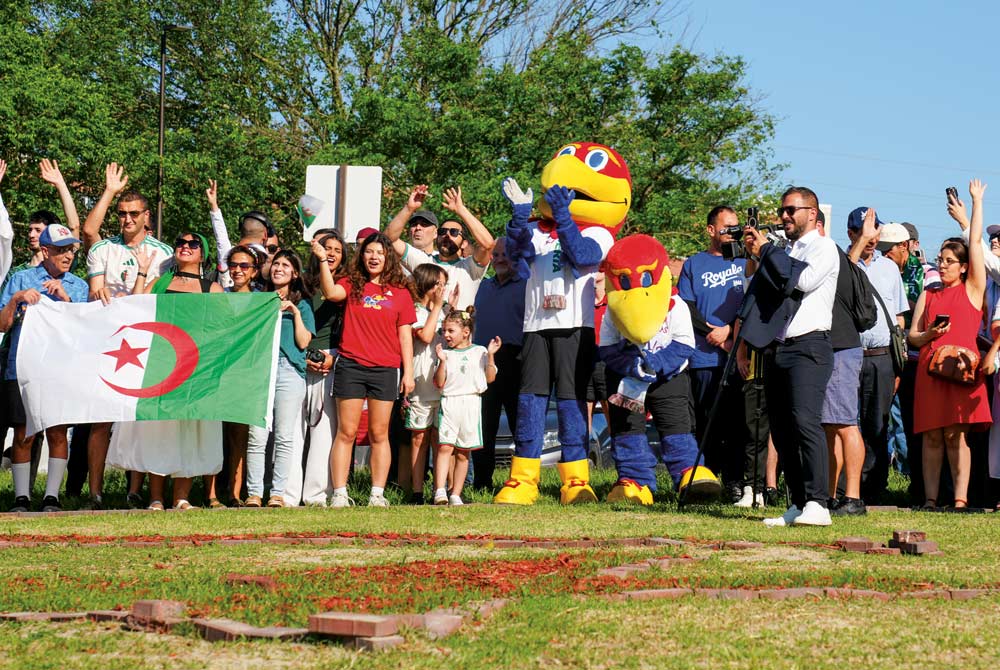
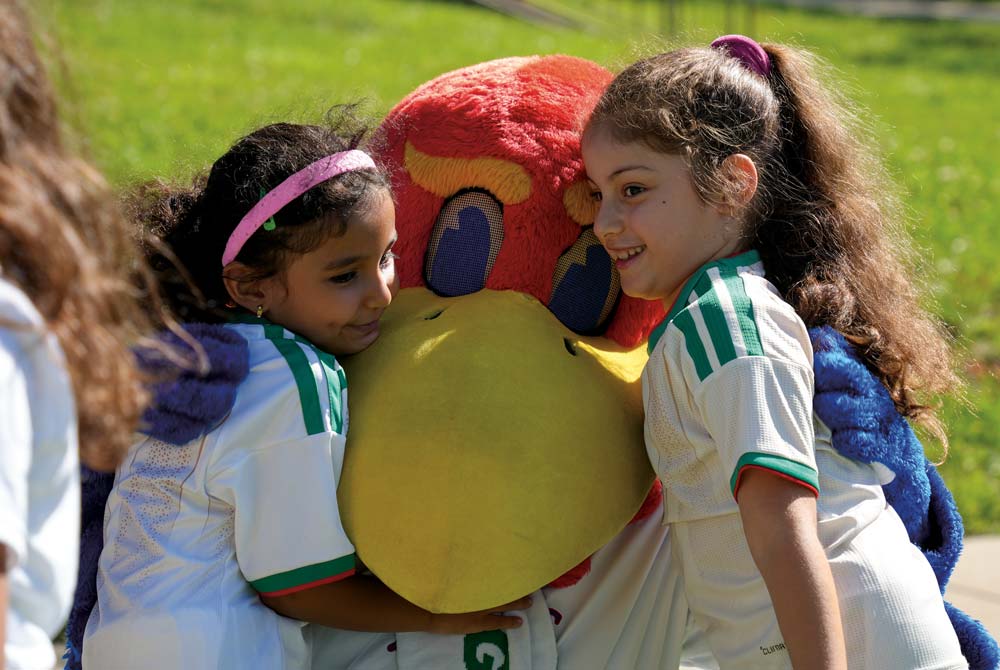
At events for an earthwork of the Algerian flag on the Lied Center grounds, Andalsi again used her pages, which by then had thousands of followers, to rally the community. There, artist Stan Herd had formed a quarter-acre Algerian flag from soil, grass, limestone, coco shell, wood mulch and bricks. At the second event on June 26, the day before the team’s game against Austria, people wearing the flag’s red, white and green joined together to form a living version. Andalsi says it was a “meshing” of her two worlds and a standout moment among many special moments.
“We brought two communities together, into one,” she says.
An international language
Before the gates opened for the Algerian National Team’s community training session and youth clinic at Rock Chalk Park on June 11, an Algerian player stopped to chat with members of the KU band, on hand to help ensure a festive atmosphere at the event. Band members asked the player what songs he wanted to hear, and his one request, says Sharon Toulouse, f’97, g’05, director of athletic bands, was the Algerian national anthem. Fortunately, KU’s musicians were ready to deliver.
It turns out, Kansas Athletics had recently asked Toulouse whether the band could play the anthem for the event. As former military, Toulouse had connections with Pershing’s Own, the U.S. Army Band, and she was able to quickly obtain the anthem’s sheet music. The band met ahead of the event and spent about 15 minutes rehearsing. It was enough, Toulouse says, that when the player asked, the response was, “Yep, we got you.”
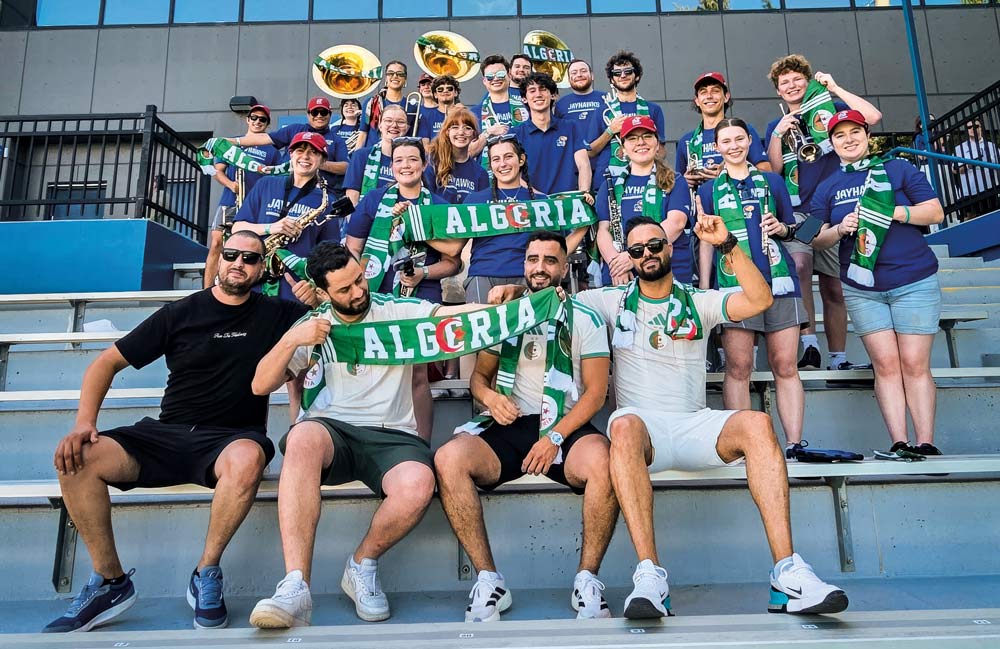
Fans filled the park’s 2,500-seat stadium, among them local soccer aficionados, youth players from area leagues and their families, and hundreds of Algerian team supporters, including some who had driven for hours or had recently disembarked flights. In the middle of this crowd stood the band, who had stretched green Algerian scarves across the flared bells of tubas, tied one to the slide of a trombone and wrapped another around a drumhead. As the band played the anthem’s first notes, the energy in the stands shifted. Those who knew the words by heart began singing along, some raising their arms, others their young children.
“To be able to play that for them and share that moment with them meant a lot to my kids,” Toulouse says of the band. “And seeing the aftereffects, I think it just means even more to them, because they realize that music is an international language.”
Toulouse says the band got a “rock star” reception, with Algerian fans requesting to take photos with them. Beyond an uplifting moment, Toulouse says the anthem showcased the transcendent power of music. “What means more to you personally in a foreign country than hearing your anthem?” she says. “That means a lot. It really does.”
Returning the welcome
The sticker on the front of Bander Almohammadi’s official FIFA volunteer uniform shirt read, “I speak Arabic.”
Almohammadi, g’17, SJD’23, who moved to the U.S. from Saudi Arabia 12 years ago to attend KU, was now on the other side of the welcoming committee. After being among more than 1 million FIFA volunteer applicants, he had been selected as one of the 65,000 official volunteers across the tournament’s three host countries, the U.S., Canada and Mexico.
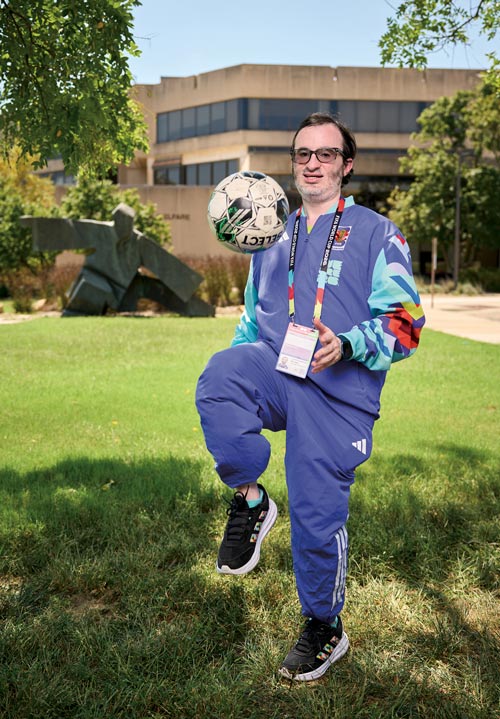
As a Kansas City ambassador for FIFA, Almohammadi, who works as an attorney at KU’s Legal Services for Students, was based at KCHouse on the Country Club Plaza, a hospitality venue for global leaders, civic stakeholders and business partners. During his volunteer shifts, Almohammadi welcomed ambassadors from several countries—and the sticker on his shirt got people talking. He ended up teaching several visitors greetings and other simple phrases in Arabic.
“They wanted to know how to say ‘Hello,’ how to say, ‘How are you?’” he says. “Language is more than communication. It’s a way to make people feel at home.”
For Almohammadi, who had only a basic command of English when he moved to the U.S. to pursue a law degree, being a FIFA volunteer was an opportunity to return the Midwestern hospitality he’d received upon arriving in Lawrence and later in Kansas City, where he earned his Juris Doctor at the University of Missouri-Kansas City.
“Volunteering allowed me to give back to the country and to the community that have given me so much,” he says.
Rochelle Valverde, c’08, j’15, is staff writer for Crimson & Blue.