

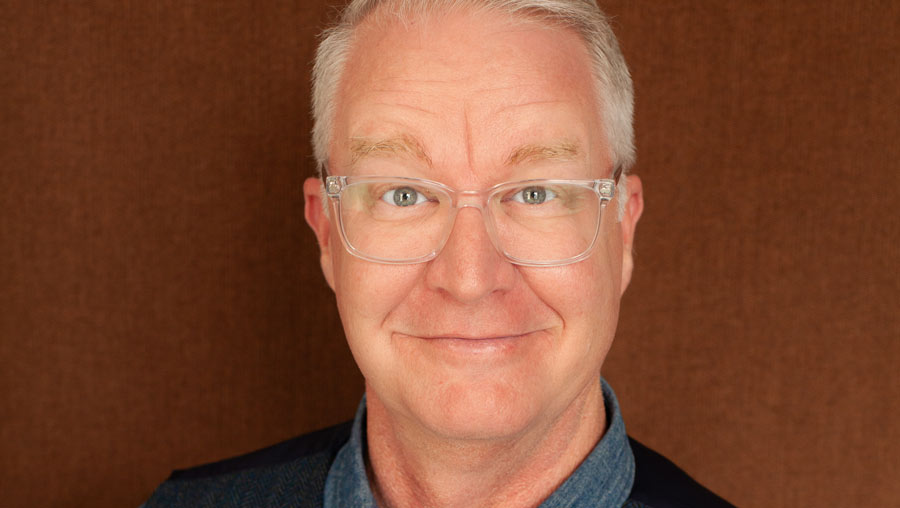
If you’ve tuned in to network TV lately, you’ve probably met Dr. Rick.
He’s the mustachioed “Parenta-Life Coach” who appears in Progressive insurance commercials, gently steering new homeowners away from the cliff’s edge of becoming their parents.
Stop narrating your own actions. Don’t clap when the plane lands. Don’t offer unsolicited advice on pumping gas. Refrain from gasping at the sight of someone with blue hair.
Dr. Rick delivers his interventions with the calm authority of a man who has seen it all and the patient optimism of someone who still believes in change. And the inspiration for this particular blend of sincerity, self-importance and exasperated care can be traced to, of all places, KU, where Bill Glass, ’94, the actor who portrays Dr. Rick, spent four years as a student.
In a recent interview with Crimson & Blue from his home in Los Angeles, Glass shared that, as he began digging into the Progressive campaign and bringing Dr. Rick to life, he didn’t model the character on a motivational speaker. Instead, he thought about a recognizable academic type he had discovered during his KU days: the earnest professor delivering a lecture on a niche topic with full conviction that it matters to the fate of civilization.
It’s a wonderfully specific observation, and it explains a lot about why Dr. Rick works: He isn’t trying to dominate the room; he’s trying—almost heroically—to educate it. Like any great professor, he is also occasionally baffled that his students aren’t getting it.
“Remember,” Glass says to close his wholesome @_billglass Instagram posts, “I’m on Team You.”
As with Dr. Rick, Glass’s thoughtful blessings for success are sincere, and the sentiments encapsulate the veteran comedic actor’s supportive, humble nature, shaped by years of stage work, auditions, sitcom guest spots and long stretches of the kind of steady, working life in entertainment that rarely garners much fanfare.
Comedic aspirations
Glass grew up in Arlington Heights, a Chicago suburb, in a home where practicality mattered. His father was an electrician—“old school,” as Glass puts it. His mother was an easy mark. Making her laugh at the dinner table was fun. Making his dad laugh, he says, was big.
“I wasn’t the most handsome fellow in the world,” Glass says. “I wasn’t the leading man in my school.” He memorized bits from Eddie Murphy, Robin Williams and other greats of a comedy golden age and performed them for anyone who would listen. Murphy’s 1983 stand-up special “Delirious” was transformative for Glass on his quest to unlock the secrets of comedic rhythm and understand the basic truth that comedy isn’t about the jokes. It’s connection. It’s survival. It’s a way in.
Sometimes it was a way out, too. Humor could be social currency—make the girls laugh, win a little approval, soften the target on your back when the wrong guy in the hallway decided today was your day. Glass describes it as a triple dip of motivations that probably sound familiar to anyone who’s ever used wit as armor.
Watch Dr. Rick help young homeowners resist their rule-following instincts.
His dream, even then, was to do what he saw hometown heroes from the Chicago-based improv troupe The Second City doing. He’d grown up watching Second City legends on “Saturday Night Live”—Belushi, Aykroyd, Radner, Murray—and as a teenager saw Second City’s Mainstage cast in person. Chris Farley and Tim Meadows were there. It made the dream feel real.
It also made his parents insist, even more firmly, on a backup plan. So Glass went to college.
“When I left for KU,” Glass says, “I was inspired.”
Far enough from home to feel like his own person, Glass arrived at KU as a business major. Then he failed a required course and promptly looked for an option truer to his dreams.
ESPN was rising then, and it hadn’t yet morphed into a polished, corporate machine. It was looser—sports coverage with a wink. “In the early ’90s, ESPN was sort of comedy sportscasting,” Glass says. He could imagine himself in a world where you loved sports, told stories and still got to be funny. So he switched his major to broadcast journalism. (A classmate, Bob Wiltfong, j’92, found his own insurance pitchman fame as Nationwide’s “World’s Greatest Spokesperson in the World.”)
Glass lived in Oliver Hall, and later moved off campus to a rental with more character than comfort—a house at 14th and Tennessee that he remembers as “almost condemned.”
After KU, Glass returned to Chicago and threw himself into the one thing he’d promised himself he’d try: improvisational comedy. He took classes at Improv Olympic and, when he could, snuck in classes at The Second City.
Glass came up during what he calls a “murderer’s row” era of talent in Chicago, and as he watched performers who would become household names, he learned the less touted skills of comedy: how to fail in front of people, how to recover, how to build trust with scene partners, how to make the room feel alive. He remembers seeing a kind of seasoning onstage—moments when performers weren’t “trying” at all, just operating on instinct and trust.
That education would matter later, especially in the commercial audition world. Although Glass never got paid to perform as an onstage improviser, improv paid him back in another currency: versatility. The ability to walk into a room, do the lines on the page, then offer something extra. A different take. A button. A small, weird moment the director and producers didn’t know they needed until it was there.
Enter Dr. Rick
Progressive’s “Don’t Become Your Parents” campaign began airing in 2020 and was an outlier in the insurance ad universe—smart, specific and oddly comforting. But Dr. Rick didn’t begin as Dr. Rick. Glass explains that in 2017, he appeared in the nascent ad concept as an unnamed group leader for a prototype of the eventual campaign’s “Parentamorphosis Anonymous” meeting. Two years later, the campaign’s creative team decided to bring the group leader back, and Glass had to re-audition.
The current version of the campaign began filming in November 2019, and Dr. Rick began airing in 2020. As the pandemic forced a collective retreat into homes, the TV counselor with the soothing voice offered a sort of balm to pervasive fears. Viewers sought out the commercials on YouTube. Glass did too, at first simply to see how the work was landing. The early spots racked up millions of views. That’s when he realized the campaign had struck a chord.
“We’re in this world of paying to avoid commercials,” Glass says, reflecting on his reaction at the time, “and people are seeking it out?”
Dr. Rick reminds young homeowners that not everything needs a plan.
Glass talks about Dr. Rick the way a seasoned actor talks about any satisfying role: Tone is everything. Too bossy, and he becomes insufferable. Too sweet, and the comedy dissolves into syrup. The character lives on a narrow ledge: He has to be nurturing and helpful, sincerely invested in people improving their lives, and he has to be human enough to feel occasional frustration when people aren’t learning.
“There’s an old axiom,” Glass says, “that you try to find the truth in comedy.” Even a ridiculous premise needs emotional logic. Dr. Rick wants to be a doctor. He wants to help. He is also, in his own way, holding back the urge to say, Come on. We’ve talked about this.
The balance is shaped by Glass’s instincts, but also by a director’s hand. Glass credits the commercials’ director, Martin Granger, for shepherding tone. After a few shoots, the rhythm settled in. They now shoot twice a year, usually a week at a time, producing several commercials per session. “We get the band together,” Glass says, “and we go crank them out.”
And that band is stacked. The campaign uses a deep bench of improv talent—“The best improvisers working right now,” Glass says, and he lights up when naming his colleagues, who include Chris Witaske, Mike Nelson and Abra Tabak. “Every actor who has stepped into this chaos hits a home run,” Glass says. “My job, literally, is to not laugh, not break, stay out of the way.” Serving his scene partners, Glass adds, is a philosophy that seems to come with age.
“When I was a younger improviser,” he says, “I was big and loud.” Now he believes the material wins when you stop trying to win.
Sitcom dreams
Glass moved to Los Angeles in 1998. Since then, his face has floated through the American pop culture bloodstream: sitcom roles, guest spots, recurring turns. He’s appeared on shows like “Justified,” “The Middle” and, more recently, “Rutherford Falls,” the smart comedy (co-created by Mike Schur, a writer and producer known for “The Office” and “Parks and Recreation”) that gave Glass one of the highlights of his career: the opportunity to return, not just visit, for four episodes as the charmingly daffy Mayor Frank.
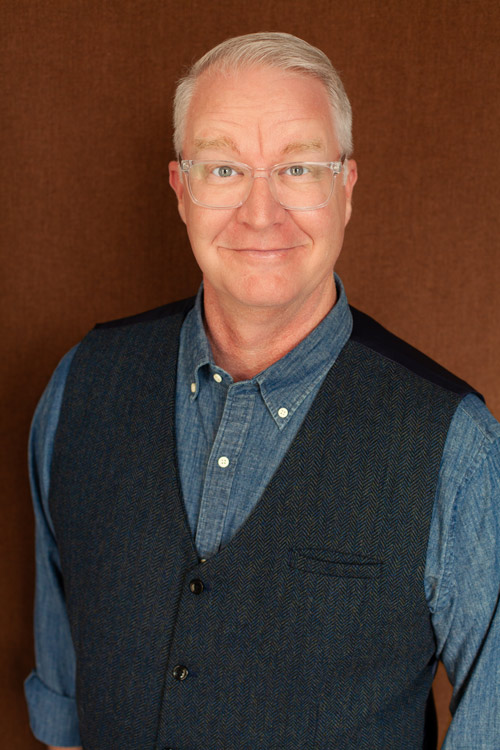
His work has also included more emotionally complex material. In a recent role in episode nine of the first season of “St. Denis Medical,” Glass and his character’s sister argue ruthlessly at their father’s deathbed—an experience that carried an uncanny personal resonance. He shares that the shoot came at the one-year anniversary of his own father’s death. He hadn’t told the production. He simply went to work and let the moment be real: When the doctor finally announces that the old man’s death is imminent, the squabbling siblings fall to their knees at Dad’s bedside, hand in hand, and Glass turns to the doctor with an innocent, frightened gaze, awaiting the pronouncement—a fleeting second of silence that rings pure and powerful.
The story lands not as a dramatic reveal, but as another piece of who Glass is: an actor who thinks about tone, truth and the people around him. He repeatedly returns to a theme that feels almost quaint in a fame-obsessed culture: how much “nice” matters.
In his telling, sets like “Rutherford Falls” and “St. Denis Medical” are joyful not only because the writing is sharp, but because the people are decent. Talented and kind. A rare combination that makes you want to come back.
The dream, he says, is still a sitcom: a regular place to go each week to build the comedy puzzle with a group of smart, funny colleagues. He’s also candid about the shifting dynamics of the industry—how social media, followers and visibility now shape opportunities in ways that didn’t exist when he started. He’s not bitter; he’s realistic. The goal posts have moved.
Meanwhile, he keeps showing up. Keeps working. Keeps getting better.
If Dr. Rick teaches people to stop acting like their parents, Bill Glass embodies another kind of lesson: Keep your center.
In recent years, the Midwest has pulled him back. As part of Big Slick, the Kansas City charity event benefiting Children’s Mercy, he reconnected with the region and its web of KU- and Kansas City-tied entertainers. Glass describes it as “life-changing”—the kind of experience that reminds you how communities can rally for something bigger than themselves. He found that the hosts— Rob Riggle, c’92, Paul Rudd, ’92, Heidi Gardner, ’06, Jason Sudeikis, Eric Stonestreet, David Koechner and others—were exactly what you’d hope: funny, caring, present.
Glass has a phrase for what he felt returning to the region after years in Los Angeles: Kansas City, he says, is a “We city,” not a “Me city.”
It’s a line that echoes his whole career—ensemble-driven, partner-forward, quietly grateful.
Glass has returned to KU, too, taking in the new David Booth Kansas Memorial Stadium and savoring the kind of experience only Lawrence can provide. He’s thrown out the first pitch at a Royals game. He calls himself a Royals fan and says he pulls for the Chiefs while acknowledging that his Cubs and Bears are blood inheritance.
And if you ask him what he tends to root for most, he answers true to form: “I’ve always pulled for the nice guys,” he says.
That might be why Dr. Rick works as more than a bit. Underneath the mustache and the perfectly timed, painfully accurate jokes about adulthood, the character is rooted in a sincere belief that people can improve—not through humiliation, but through guidance, patience and a gentle dash of truth.
Chris Lazzarino, j’86, is associate editor of Crimson & Blue.