
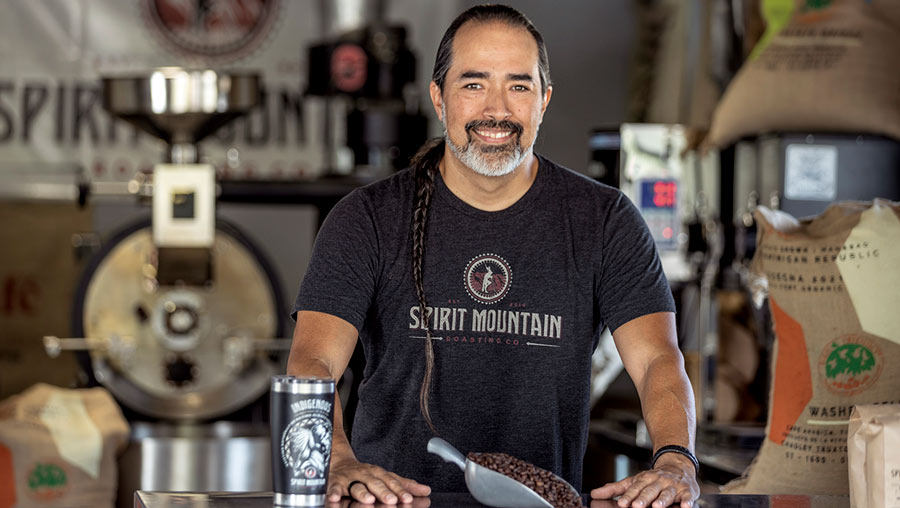
Artisanal coffee roaster Tudor Montague, an enrolled member of the Fort Yuma Quechan Indian Tribe, grew up on his tribe’s desert reservation, 45,000 acres in southern California and Arizona. Irrigation from the lower Colorado River allows for industrial-scale agriculture, yet Quechan families rarely experience the wonders of fresh, farm-grown foods.
“I come from a rural community, and we have farming, so you’d think everything is grown fresh, but it’s not accessible. It’s just something we grew up around,” Montague, c’01, says from Winterhaven, California, where he owns and operates Spirit Mountain Roasting Co., as well as a new brick-and-mortar cafe created to employ members of his Quechan community. “It was Lawrence that exposed me to farmers markets, fresh produce, fresh-crafted coffee, fresh-crafted beer.”
After graduating high school as class valedictorian, Montague tried college in San Diego. The state university system’s tuition rates proved “absolutely prohibitive,” so he was open to options when a friend told him about Haskell Indian Nations University—in a distant, mysterious place called Kansas—where he would pay no tuition. Moving from rural desert to a Midwestern college town with relentless winters “was a huge culture shock,” Montague concedes with a laugh, but he was determined to succeed.
Making friends with Native students from across the country and learning about their cultures and customs “softened the blow” of living far from his own family and culture. Montague earned his associate’s degree from Haskell, then turned to the Hill, where he knew faculty from KU-Haskell exchange programs.
“There was a good partnership in place, and I had friends who were making the transition from Haskell to KU, so it was pretty much a no-brainer for me,” Montague says. He joined KU’s First Nations Student Association, earned his degree in environmental studies with an emphasis on public policy, and took his first job with a tribe in Phoenix.
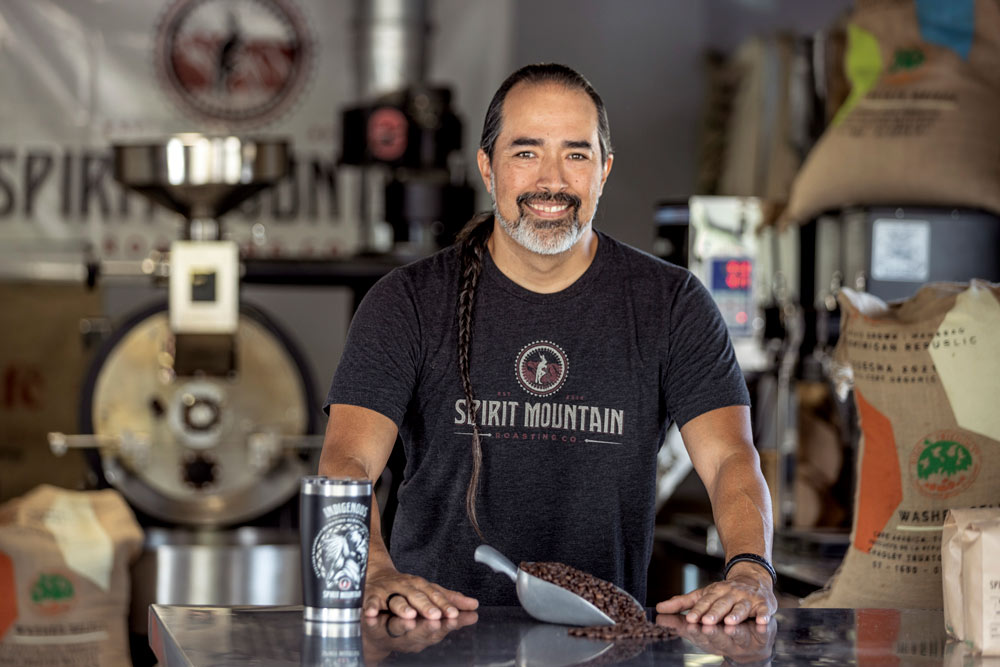
Inspired by the joys he found in the craft beer community at Free State Brewing Co., Montague became a home brewer. The hobby held his interest as he developed his career as an environmental consultant to tribes and nonprofits in the Phoenix Valley, and he saved enough to put himself through a professional brewing school. While hatching a business plan, though, he realized that the finances of startup breweries matched his California tuition bill: prohibitive.
Montague reflected on chapters he’d read on coffee roasting while studying textbooks for craft brewing. The coffee business, he reasoned, would be far more affordable while still offering the allure of “taking a raw ingredient and creating something good, something delicious. That was still there for me with coffee.”
Montague again dipped into his savings to properly educate himself, this time at a roasting school in Northern California. He bought a small roaster, tested techniques and ideas by sharing his coffee with family and friends, and quickly saw that the steep learning curve of mastering craft beer translated to coffee roasting: He got good, fast, and didn’t spend a fortune.
“It was 2015 when I made the decision: OK, if I’m going to step away from the career, there’s a whole new journey ahead. So, I made the decision to move back home, to the reservation,” Montague says. “If I was going to make this work, I wanted to do it here. There were a lot of obstacles to overcome, it took some time, but I built out a space and scaled up my production.”
Three years later, Montague took out his first small-business loan, purchased a commercial-grade roaster, built an online presence and began developing a wholesale customer base, including tribal communities and nonprofits across the country that feature his flavorful beans at communal events.
“Everything goes back to KU, to the farmers markets in Lawrence. Everything is fresh. You get a fresh tomato—freshly grown, freshly harvested—it’s going to taste 10 times better than what you get at a supermarket. The same with coffee. Everything we do is fresh. We get orders online, I’ll roast it and ship it out within the next couple of days. Anytime anybody tastes it, they’re going to get something that’s really, really appealing.”
Along with delivering a fresh product, Montague is equally passionate about sourcing his beans. He buys from Indigenous communities or women-owned cooperatives in Central and South America, scrupulously examining business portfolios before agreeing to purchases.
“One of our taglines is ‘Indigenous from seed to cup,’” he says. “People don’t think about how much time and energy it takes to find the land, grow the coffee, care for it throughout the season, to harvest it correctly and process it correctly. And then it makes that journey and gets to the roaster, and it has to be roasted correctly, and if it’s being served in a cafe, it has to be prepared correctly—all for that one cup of coffee to truly shine.
“That’s a disconnect from today’s society, where it’s all about convenience. This is not just a random cup. It’s very intentional, and that’s an aspect of this coffee that people appreciate. It takes a lot of work to make it right.”
Chris Lazzarino, j’86, is associate editor of Crimson & Blue.