
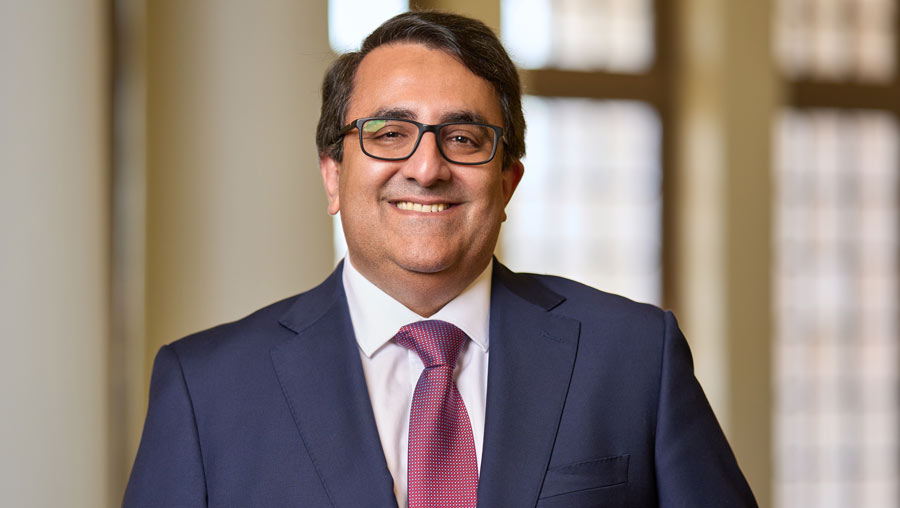
Arash Mafi, formerly executive dean of the College of Liberal Arts & Sciences, has been named provost and chief academic officer for KU and executive vice chancellor for the Lawrence and Edwards campuses.
The appointment, announced Feb. 19 by Chancellor Doug Girod, follows an in-house search that began after Barbara Bichelmeyer, j’82, c’86, g’88, PhD’91, in October announced her intention to step down as provost and executive vice chancellor and return to the faculty of the School of Education & Human Sciences. Mafi began his new post March 2.
Mafi joined KU in 2023 as executive dean of the College of Liberal Arts & Sciences, where he has led efforts to improve student success, expand research activity and strengthen partnerships across campuses.
“Arash has demonstrated his leadership ability in our environment, his ability to bring people together to work through difficult change, and his ability to do so in a way that has driven a lot of respect and camaraderie in the College,” Girod told Crimson & Blue. “He’s also an outstanding scholar in optical physics, so he understands what it means to be an (American Association of Universities) research university as well, and how to prioritize that. He has the complete package.”
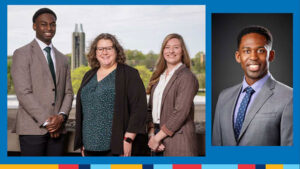
In addition to Mafi’s appointment, Jennifer Roberts, KU’s senior vice provost for academic affairs, was named the David B. Pittaway Executive Dean of the College of Liberal Arts & Sciences. Roberts has held a range of leadership roles at KU, including geology department chair and vice provost for graduate studies, with experience spanning undergraduate and graduate education, academic affairs, and institutional initiatives tied to student success and research.
Mafi brings nearly a decade of senior academic leadership experience at major public research universities. Before joining KU, he served as interim dean at the University of New Mexico and directed its Center for High Technology Materials, leading interdisciplinary research initiatives and building partnerships with government, industry and national laboratories.
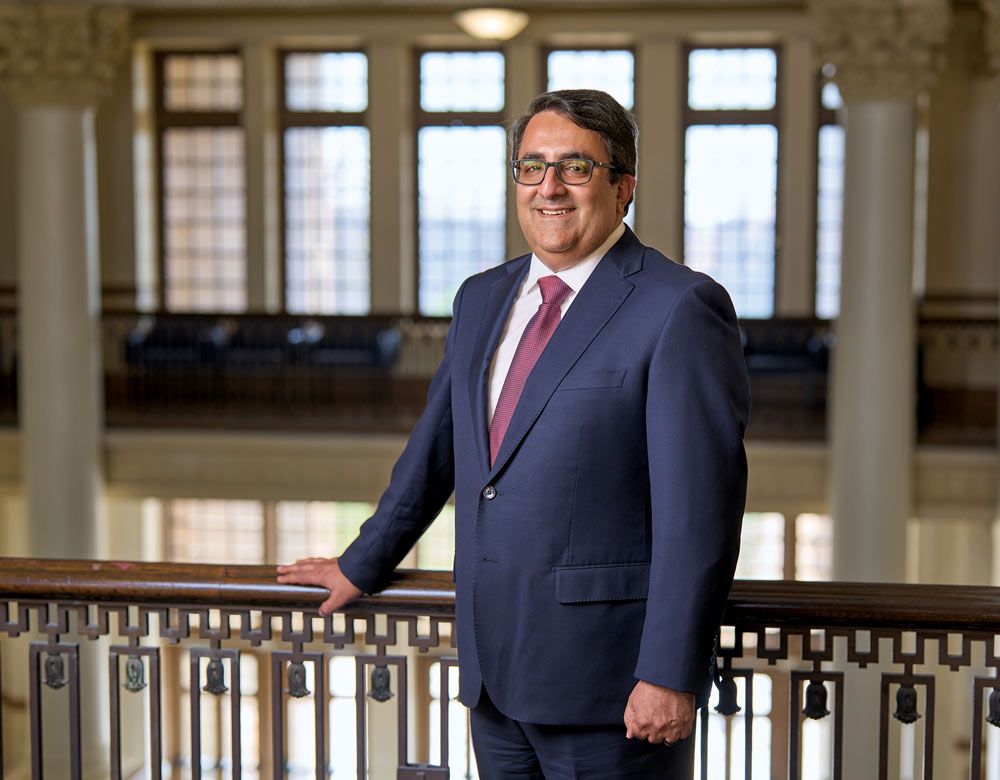
In an interview with Crimson & Blue, Mafi described his approach to leadership as rooted in both philosophy and execution.
“There are deep, personal and philosophical guidelines for me on how I view the University,” he said, “but when it gets to the nuts and bolts of it, I get very actionable. I build systems, typically from the ground up.”
At KU, that approach has included a strong emphasis on student success. During his time as dean, the College reduced DFW rates—grades of D, F or withdrawal—while also improving retention, translating to an increase of 10,000 annual credit hours completed successfully.
“Behind that number are students who stayed on track, students who didn’t leave because one course became a wall,” Mafi said. With a data-driven focus, he said, faculty and staff redesigned high-enrollment courses in which students had previously struggled in unacceptable numbers, “without lowering academic standards.”
Mafi emphasized that such gains come from coordinated, system-level efforts rather than any single initiative.
“You need to understand what the roots of the problem are,” he said. “Then you build systems around students—connecting them with services, supporting faculty and making sure those pieces work together.”
A physicist by training, Mafi said his academic background shapes how he approaches complex challenges.
“My mind goes into, ‘How would I simplify it? How would I attack it as a problem, and how would I solve it?’” he said, noting that he draws on both quantitative analysis and perspectives from the humanities and social sciences.
In the wake of Bichelmeyer’s resignation as provost, Girod chose to add chief academic officer for the entire university to the new provost’s portfolio, a critical step in his One KU initiative and a change long suggested by KU’s accreditation agencies. The goal, Girod explained, is to have one person in charge of the entire academic mission, in order to eliminate redundancies and campus silos, develop assets that serve the entire university, and provide seamless leadership at a time of growth in competency-based and online education, neither of which is place-based.
In his new role, Mafi works closely with Steve Stites, executive vice chancellor and chief health sciences officer for KU Medical Center, along with deans and leaders in research and other areas across all five KU campuses, to help the chancellor set priorities for limited resources in a time of economic uncertainties.
“This creates a clear structure that allows us to leverage some of the great assets that have been developed across all campuses to elevate our game,” Girod said. “We were sort of two universities under one title. We had two of everything, probably not just for decades, but maybe close to a century worth of history, with the medical center running on its own, independent of Lawrence, and then ultimately the Edwards Campus, and vice versa. We created so many artificial barriers, and in this moment of incredibly tight resources, we can’t afford two of anything.
“We have to be able to streamline and make it easier for our people, and, at the same time, make it much less expensive to operate than it is today, so that we can deploy those resources into our people and not into administration.”
As for his decision to keep the provost search in-house, Girod explained that, at a time when KU is facing multiple challenges, he didn’t want to lose momentum by taking the time to identify an outside candidate and familiarize that person with the unique KU landscape.
“We helped develop these incredibly talented leaders,” Girod said. “Why wouldn’t we do our best to keep them and let them thrive with new opportunities here at our university, rather than making them go somewhere else to have their next opportunity? It’s a win-win-win for us.”
Chris Lazzarino, j’86, is associate editor of Crimson & Blue.