
There were cockleburs in the corn that year. When the burs’ hooked spines caused the corn to stop flowing as Joey Berntsen and his sisters unloaded a grain bin on their farm near La Harpe, Kansas, he climbed inside to use a pipe to loosen it up. In a matter of seconds, the slick, dense kernels had buried him up to his chin.
Grain behaves like quicksand, rapidly enveloping a person and exerting immense pressure on the body. An adult can become completely covered in less than 20 seconds and suffocate within two minutes. National data indicate that, historically, 58% of such incidents result in fatalities. Others result in workers losing limbs to the machinery used to extract grain from the bins.
Fortunately, Berntsen’s right arm was left partially free, and his cellphone was in his breast pocket. He was able to call one of his sisters to tell her to turn off the auger and shut the door on the bottom of the bin. His sisters then called 911 and Joe Meiwes, a family member and firefighter for the Moran Volunteer Fire Department who lived just 3 miles away. Meiwes, the first person on the scene on that hot and humid Thursday in August 2025, knew they had to keep Berntsen’s head above the grain.
“It wasn’t as bad as it could have been, but I knew it was going to be bad as soon as I saw it, because he was literally up to his chin, and one arm kind of sticking out a little bit,” Meiwes says. “It looked like the old movies where the pirates buried the people in the sand.”
The 10,000-bushel grain bin, which has a funnel at the bottom, was about two-thirds full. Meiwes says the corn around the bin’s edges towered about 6 feet over Berntsen’s head. If the corn were to shift again, it could bury him completely. Improvising, Meiwes put plywood in front of Berntsen to stop more grain from sliding down on top of him.
“I just knew that we didn’t want him to go down further or cover him up, and so that was the first try to get stuff around him,” Meiwes says.
Members of the La Harpe Fire Department and Iola Fire & EMS arrived soon after, among them Lieutenant Andy Hill, a firefighter and paramedic with Iola Fire & EMS.
“Initially, our concerns are the pressure that he has on his chest being buried that deep,” Hill says. “So we did a quick assessment, just verbally, talking to him. He said that he wasn’t having any troubles breathing.”
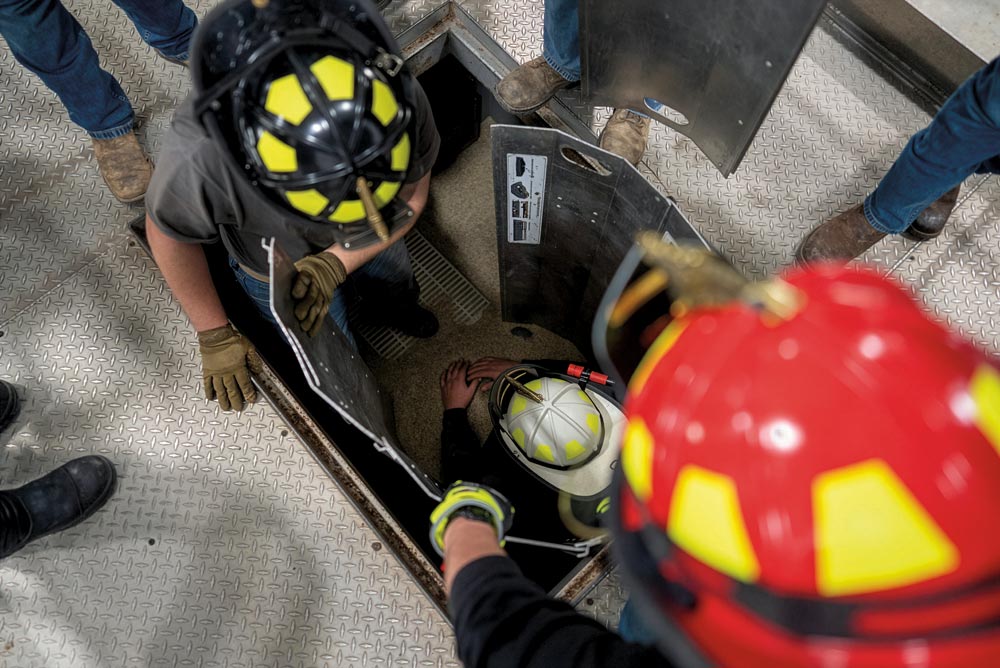
Rescuers laid plastic Pepsi crates on top of the corn to help distribute their weight and minimize additional pressure on Berntsen as they entered the bin. They then drove a plastic rescue tube into the corn around Berntsen and began to auger out grain. This succeeded, at least momentarily, in getting the corn down to Berntsen’s waist.
“It worked really, really well initially,” Hill says. “But once we started evacuating more grain, it just wasn’t sturdy enough to hold up, and it started collapsing in on itself.”
As they awaited the arrival of additional rescue equipment from Colony Volunteer Fire Department, in neighboring Anderson County, the rescuers needed to reset, Hill says. But if they pulled the plastic tube out now, they were going to rebury Berntsen, probably over his head.
All the departments that responded to the Berntsen farm on that summer day had received grain bin rescue training from KU’s Kansas Fire & Rescue Training Institute. Equipped with that specialized skill set, emergency personnel knew not only what to do, but what not to do to keep Berntsen’s situation from going from bad to worse.
Bringing the training to the workforce
The average grain bin rescue takes 3 1/2 hours, and understanding how grain behaves and what technical skills to employ are imperative to a successful rescue.
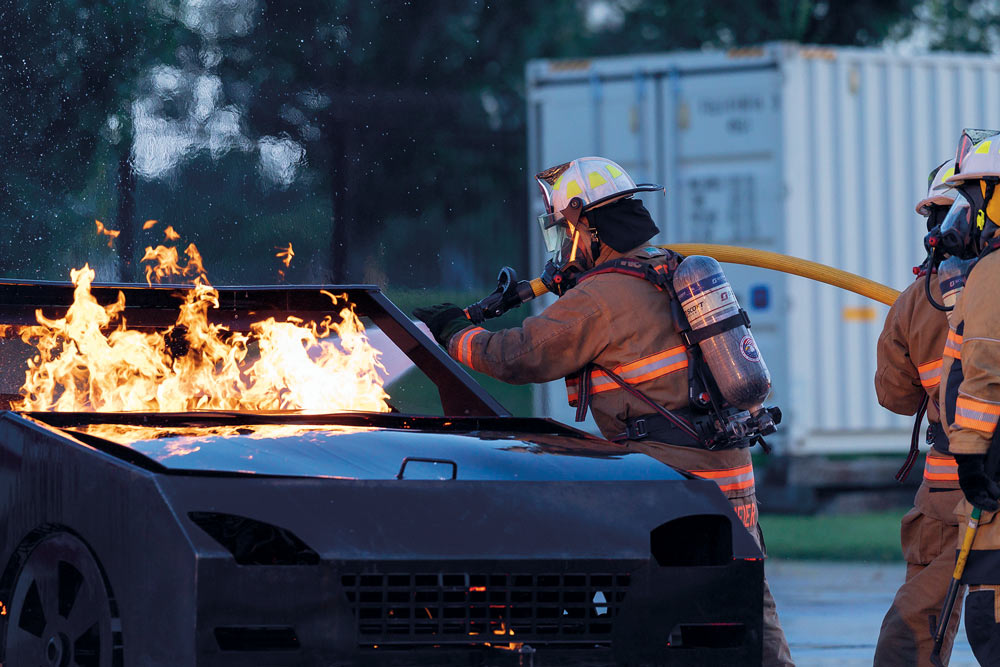
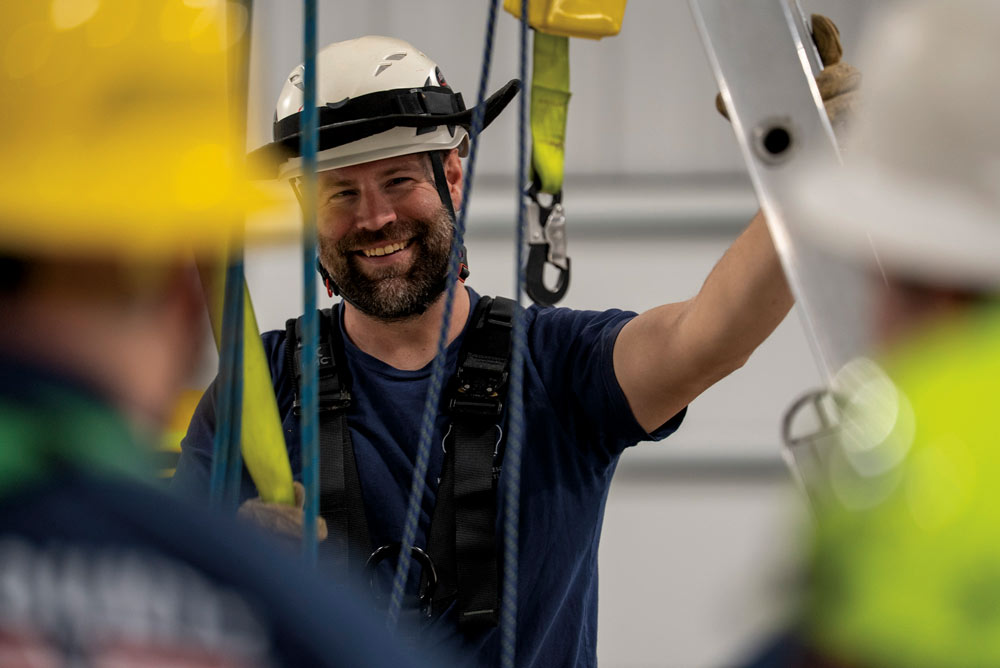
In Kansas, 90% of firefighters are volunteer, which means easily accessible training is vital to ensuring departments across the state are prepared to handle whatever the day may bring. The Kansas Fire & Rescue Training Institute (KFRTI), a program within KU’s Jayhawk Global continuing education unit, provides certifications and training to local jurisdictions throughout the state. In addition to credentialing for fire and emergency response personnel, KFRTI provides special operations trainings such as grain engulfment rescue, rope rescue, vehicle rescue, and flood and water rescue.
The service, instituted by the state of Kansas in 1949, has provided certifications and trainings to Kansas fire and emergency response personnel at no cost for more than 70 years. In fiscal year 2025, KFRTI issued industry‑recognized national certifications to 2,805 first responders and community college students and provided trainings to 3,623 participants.
“Without the opportunity to get those industry-recognized certifications, those folks couldn’t get jobs,” says Jenn Johnson, j’97, director of KFRTI. “So not only are individuals getting jobs, but communities are able to get firefighters. It is a win-win.”
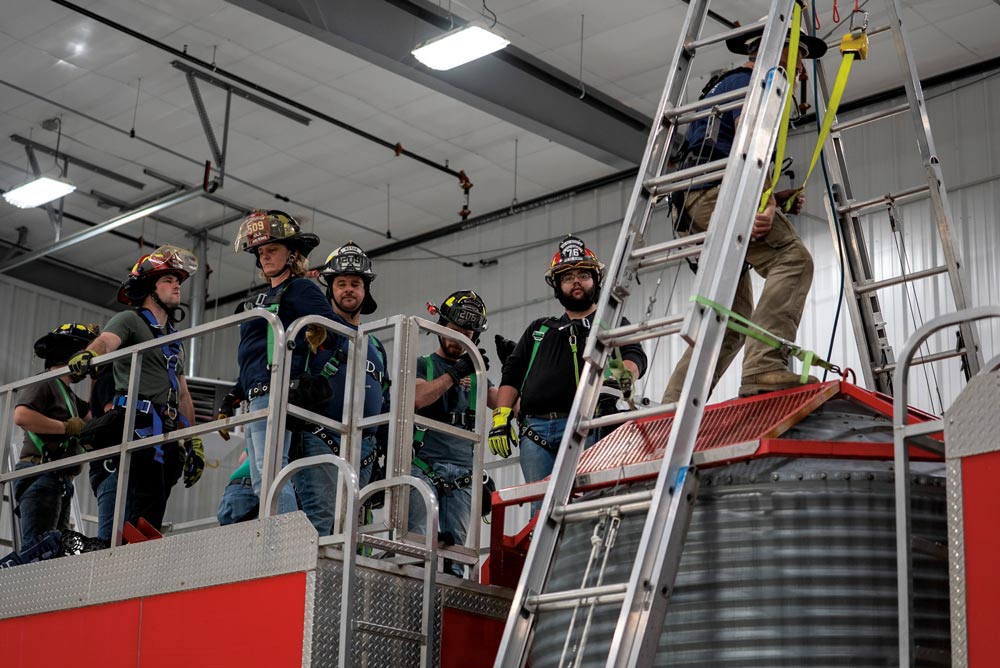
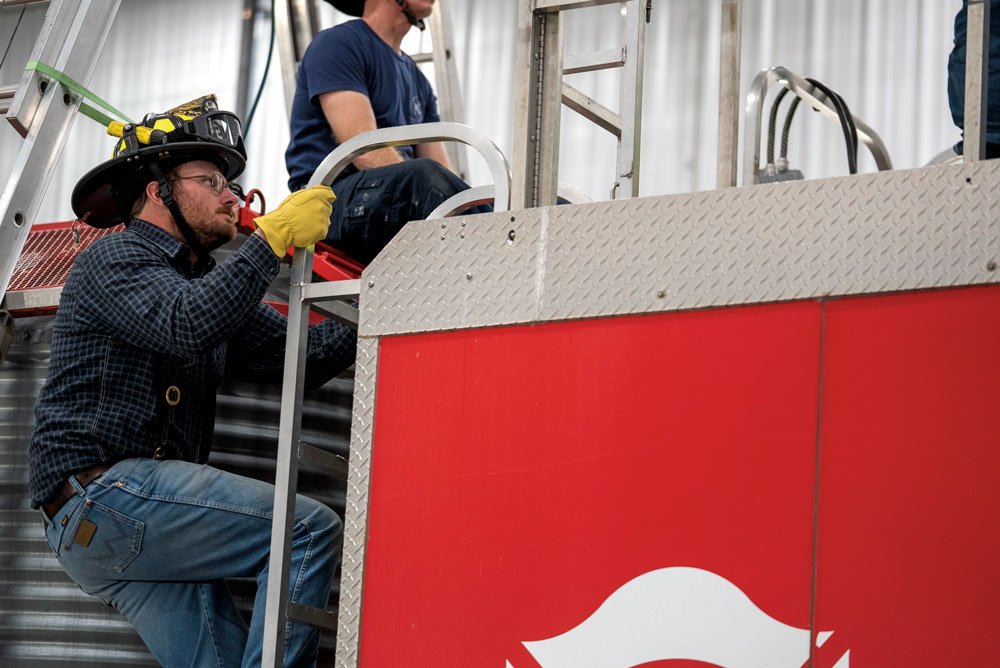
KFRTI’s training equipment is completely mobile, allowing the institute to bring its grain bin rescue simulator or its three-story training tower to firefighters and other first responders at their stations. Johnson says this mobility is key to the institute’s mission: She notes that since most Kansas firefighters are volunteer, they generally have full-time jobs, making on-site training the most accessible option.
“To ask them to go to a training site, an academy, would put undue responsibility on their departments, their families and their employers,” says Johnson, who has led KFRTI since 2023. “We can show up for a weekend, bring the class to them, no matter where they are.”
A methodical rescue
Even with the corn reduced to his waist, Berntsen’s legs remained immobilized. Because of friction and pressure, attempting to pull him free at that point would have required about 600 pounds of force—enough to cause severe or fatal injury.
As first responders awaited additional equipment, they reinforced the collapsing setup with plywood and 55-gallon plastic drums cut in half. When the Colony Volunteer Fire Department arrived with metal coffer dams, it also brought additional expertise: KFRTI part-time trainer and grain bin rescue instructor Shon Price.
“That was a big help—the proper equipment and good equipment, and also people who knew how to use it,” Meiwes says. “Because you can have everything there in the world; if nobody knows how to use it, it’s absolutely useless.”
First responders secured the interconnecting panels around Berntsen, then removed the plastic tube. Though the panels held, small gaps remained.
“Grain moves almost like a fluid,” Hill says. “If there’s any sort of gap in those coffer dams or in something you’re trying to build, it just comes right back in. And it’s not slow either. It comes right back, which is really surprising. That was something we had to navigate.”
Berntsen had fallen in the grain near the end of the workday, and as darkness descended, the first responders set up lights inside the bin. An oxygen tank was on hand, and a fan and tubing system for confined space rescue improved ventilation. Personnel rotated in, and after two hours of evacuating grain, Berntsen was free.
Though the bin was equipped with a ladder, Hill says that because of how long Berntsen had spent compressed—and the buildup of lactic acid in the body that occurs—crush injuries or compartment syndrome were a concern. Rather than risk a fall, they rigged up a pulley system using La Harpe Fire’s ladder truck to hoist Berntsen out. Within an hour, Berntsen had been lowered to solid ground.
Coming full circle
Though Berntsen remained calm throughout the approximately three-hour rescue, he understood the stakes. Reflecting on the incident several months later, he named farmers or workers who had lost their lives in grain accidents or needed amputations from injuries caused by grain equipment.
“I got lucky that both of my sisters were down there,” he says.
Berntsen recalls that once he was out of the grain, he and his rescuers shared a lighthearted moment after someone pointed out he had cockleburs in his beard. “(The first responders) were picking on me about that,” he says. “How many cockleburs I had to take out.”
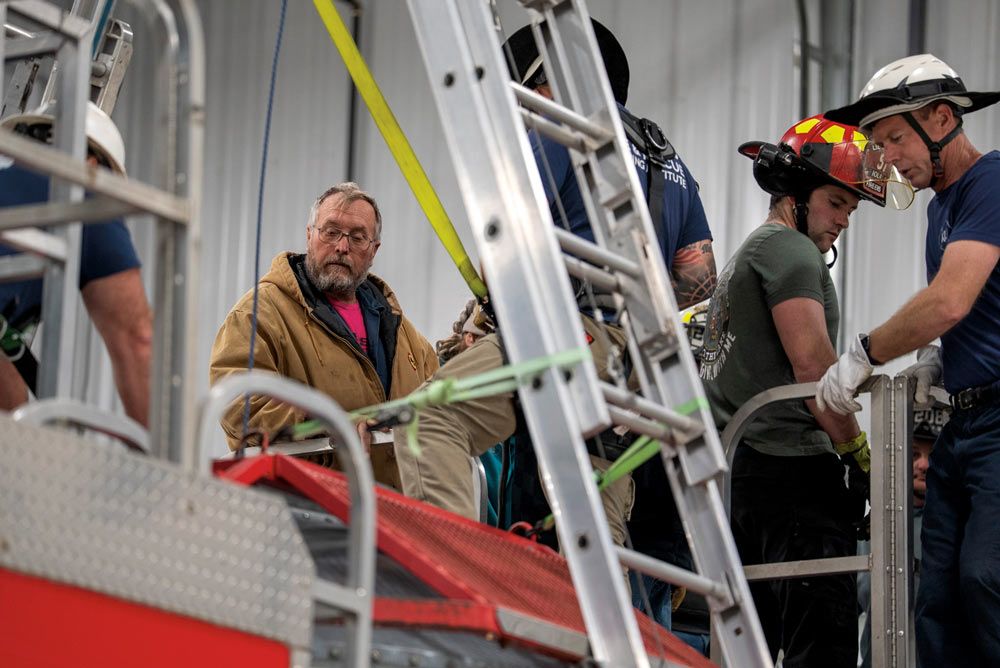
Since the rescue, the departments involved have purchased additional grain bin rescue equipment, and in February staff attended a Kansas Fire & Rescue Training Institute refresher class on grain engulfment rescue.
For Hill, who first took the training in 2023, the refresher refined skills for the next time such a call is dispatched across the airwaves.
“I took the refresher because I feel like for every one thing that went right, there was probably five things that we could have done better,” Hill says of Berntsen’s rescue.
Meiwes, who took the training for the first time in February, says he learned when to use what resources, tools and methods, and how to avoid creating bigger problems. He also appreciated that Price was one of the instructors.
“A lot of the people who were at the training were also at the rescue, so it kind of came full circle that way,” Meiwes says.
Among those present were Berntsen himself. Though he and his wife had thrown a pizza party for first responders to show their gratitude, he wanted to do more.
“Number one, I wanted to thank them again,” he says.
At the KFRTI training, Berntsen offered observations from an uncommon perspective—someone who has experienced being trapped and rescued. He also hopes that sharing his experience helps others in agriculture avoid similar accidents.
“Just to have farmers think about what they’re doing,” he says of what he hopes people take away from his story. “Because I just went up there, and I thought, ‘OK, I’ll clean this, get this going, and I won’t be in danger.’ Well, I found that didn’t work.”
What did work, fortunately, was teamwork combined with critical know-how from KFRTI training. The KU-administered program helps first responders in all 105 Kansas counties more effectively serve their communities in emergencies like Berntsen’s, when technical skills matter. For the crew that responded in La Harpe on that hot summer day, the training helped them lift Berntsen from a potentially fatal situation completely unharmed.
Preparing for rescue: A day at KFRTI training
“Rescuer, ready?”
“Ready.”
“Haul team, ready?”
“Ready.”
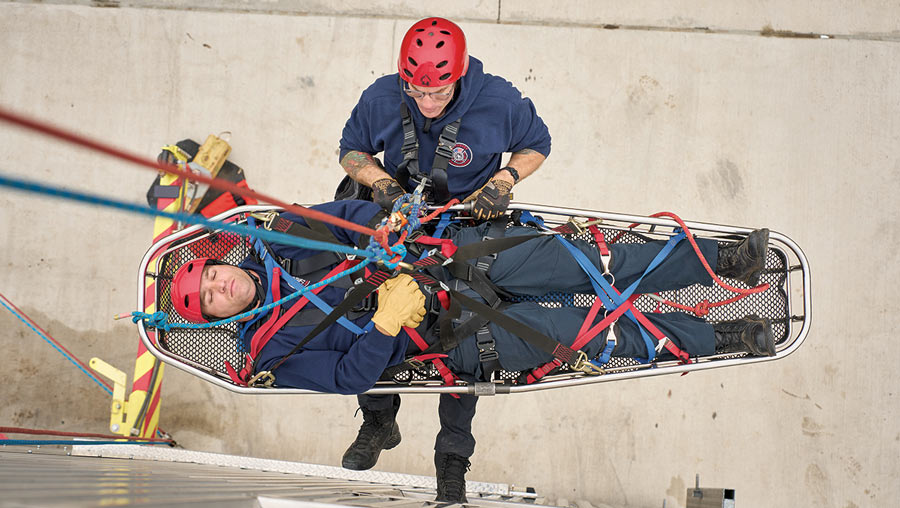
It’s day two of a five-day rope operations training, and firefighters with the Northwest Consolidated Fire District, which serves the city of De Soto and northwest Johnson County, are on the ropes preparing to hoist one of their own up the side of the Kansas Fire & Rescue Training Institute’s mobile, three-story training tower.
After a run where the firefighter role-playing the patient, strapped on his back into a wire-mesh stretcher known as a litter, was sent up and then back down the 43-foot tower, the trainees are ready to practice litter-tending. In this rescue technique, a firefighter, his or her body in an L-shape around the litter, ascends or descends alongside the patient to provide ongoing care.
Readiness assured, the haul team pulls on the two-tension rope system, and the patient rises a few feet off the ground. The rope technician tending the litter checks in.
“How are you doing, sir?” NWCFD firefighter Lawrence Kraft asks.
The haul team pulls, and slowly, Kraft, the soles of his black boots flush against the tower’s metal siding, begins to walk the patient up the wall. He passes one window, then a second, before reaching the third-story window, which is open, ready to receive them.
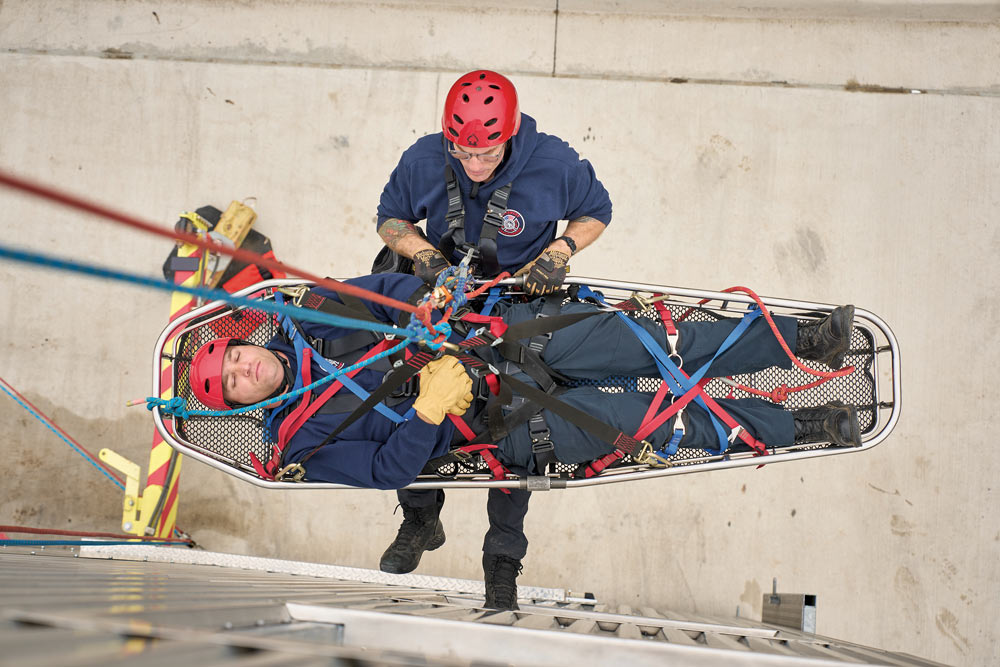
“If we were going in the window, Lawrence would climb over the top of the patient,” Ben Green, KFRTI Fire & Rescue program manager, explains to the haul team.
This patient, though, is going back down. But first, Green takes a look at the rope setup.
“This red line really needs to be down here,” Green tells the haul team.
With both patient and rescuer still suspended three stories in the air, the team adjusts. Calls of “Ready?” go out again. The ropes move, and Kraft, the litter still suspended over his legs, begins the slow descent to steady ground.
“Lawrence will have to be really careful of not getting his foot caught on something,” Green calls as the technician scales down the tower.
Kraft adjusts his ropes, and step by step grapples backward, bringing both himself and the patient carefully toward the awaiting concrete. Once he has his feet back under him, the haul team gently lowers the litter the remaining few feet.
Green says that in Kansas, these high-angle rescues—rescues that are anywhere from 50 degrees to vertical—can be used to retrieve patients from high-rises, water towers, industrial catwalks and confined spaces. The class also teaches low-angle rescues, commonly used to retrieve people from ditches if they’ve slid off the highway. Both techniques allow rescuers to stabilize and safely move patients without having to carry them.
On the other side of the tower, KFRTI trainer Josh Hunt works with another group of firefighters who are practicing ascending and descending solo on the tower. “It’s tough to talk about; it’s easier to do,” Hunt advises as he coaches the trainees through the synchronous gestures—a raise of the arm controlling the rope, a downward step of the opposite, stirruped foot—that will propel them upward. “It’s like patting your head and rubbing your stomach at the same time,” he adds.
The firefighters, all of whom are also emergency medical technicians (EMTs) or paramedics, will get their turn grappling up the tower, as well as their own ride up and down the ropes inside the litter. Green says the training is the foundational course for special rescue operations, and the firefighters will be tested on their skills at the conclusion of the class at the end of the week.
Green says the trainees only spend about 25% of the time in the classroom, including an online portion they complete ahead of the in-person training. The rest of the time consists of hands-on practice, working to hone the skills that in a real rescue will need to be second nature.
Rochelle Valverde, c’08, j’15, is staff writer for Crimson & Blue.