

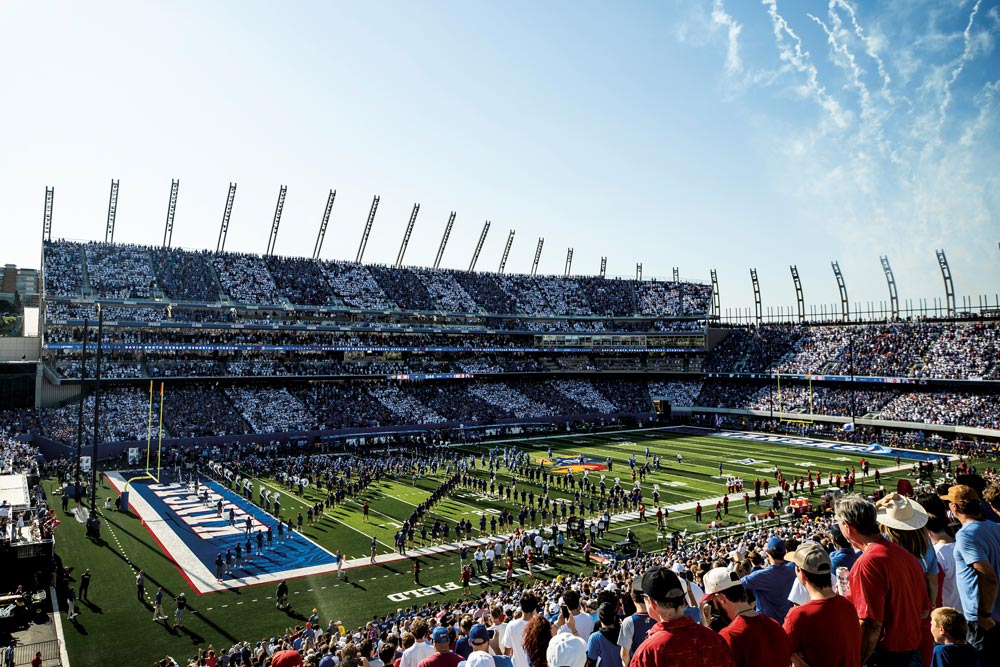
On a bright Saturday in fall 1960, a 13-year-old Boy Scout pinned on an usher’s badge, straightened the slide on his troop’s neckerchief and stepped through the gates of Memorial Stadium, straight into the first chapter of the rest of his life. Sun sparkled off his usher’s badge, and a hum gathered itself into a roar. David Booth—fresh from small-town life in Garnett, newly moved with his family to Lawrence—stood at the lip of a bowl in the stadium that would one day bear his name, a nexus connecting all he knew before to everything yet to come, and learned his first lesson about university life: Community sounds like 47,000 people.
“I was blown away by all the people in the stands,” Booth says. “I’m feeling the same way now. I’m ready to celebrate with everyone.”
Sixty-five years later, the Boy Scout is a 78-year-old investing pioneer whose name crowns two of KU’s beating hearts: the cathedral on Naismith Drive, where the Booth Family Hall of Athletics fronts Allen Fieldhouse, and, since 2018, the football stadium that Jayhawks now call The Booth. In August, Booth did something that doesn’t happen much in higher education: He moved history. His approximately $300 million commitment—the largest in KU and Kansas Athletics history and among the largest in college sports—pushes the 11th and Mississippi Gateway District into Phase 2, including completion by 2027 of David Booth Kansas Memorial Stadium’s new east stands. The gift also builds a perpetual monetary engine for Kansas Athletics at a time when college sports are rewiring themselves in real time.
Big numbers make big headlines. David Booth, c’68, g’69, is interested in something quieter and, to him, more enduring. “One of life’s greatest privileges is being able to give back to the people and places that gave so much to you,” he says. “Philanthropy, like investing, pays dividends over time. Each gift compounds, creating opportunities not just for today, but for years to come.”
Naismith Drive, a radio, a shoe store
The Booth family’s first Lawrence address—1931 Naismith Drive, a modest home south of Allen Fieldhouse—reads now like a novelist’s wink to destiny. Money was scarce in 1960; fandom was not. The Booths and their extended eastern Kansas clan had for years gathered around their radios to hear Max Falkenstien, c’47, call games in a voice that felt like a handshake. KU sports were the public square of a university they loved from the outside.
The public version of David Booth’s story—which began circulating among Jayhawks with his family’s first prominent athletics gift, $5 million in 2004 that created the Booth Family Hall of Athletics, which soon expanded with another donation, worth $4 million—had begun in Garnett before shifting 50 miles north to Lawrence, shortly before David began high school. The Booths’ roots, however, are in Lone Elm, population 29 at the time of Booth’s 1946 birth in Lawrence, which was then the site of the nearest hospital.
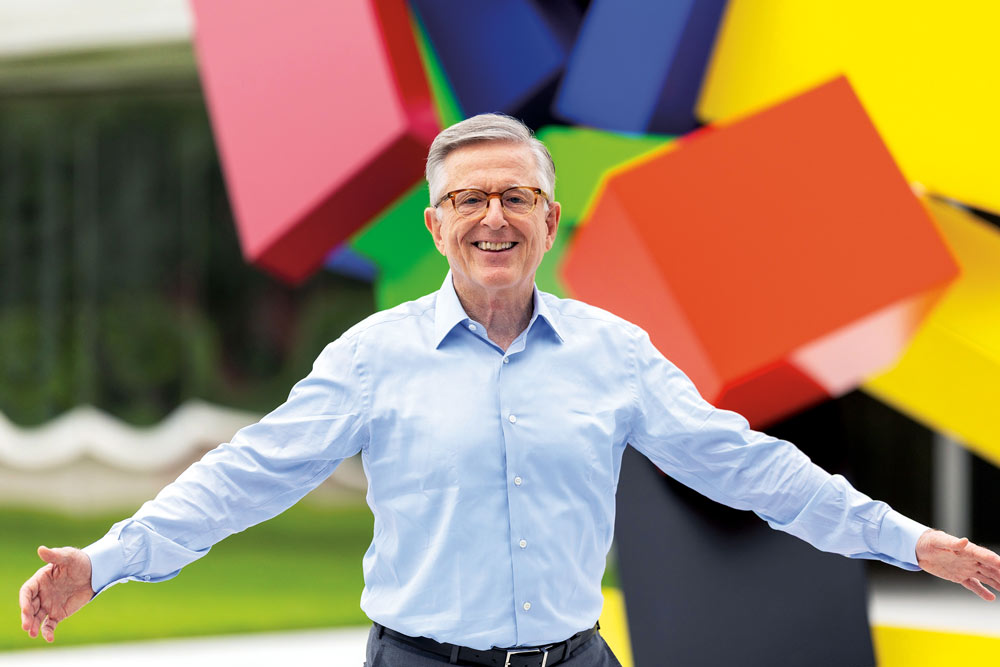
When Booth’s father, Gil, returned to Lone Elm from South Pacific duty in the Army Air Corps, Uncle Till—“My dad was Gilbert Lee, one brother was Tillman Willis and the other was Wilbur Leroy,” Booth says with a grin. “I mean, we had some names!”—suggested Gil generate income with the family’s new automated corn picker. “It doesn’t sound like much,” Booth says, “but there were very few, and they were very hard to get.”
Booth’s parents, Gilbert and Betty, grew up in Lone Elm during the Great Depression, “when everybody was so poor.” His paternal grandfather one year made $300. Booth’s maternal grandparents ran a grocery and general store in Lone Elm—the structure of which apparently still stands, long abandoned, at First and Main streets. The unincorporated town has allowed the block of decrepit commercial sites to remain, yet also features expansive lawns, unfussy but well-tended public green spaces, a charming community center and a rambling truck and tractor garage that broadcasts the proprietor’s home phone number on a sun-bleached sign.
A search for work and schools drove the Booth family’s move 15 miles north to Garnett. When Gilbert Booth landed a prime job as a distribution supervisor for the Kansas City Star, they jumped at the chance to move again, this time 50 miles farther north to Lawrence, where they could buy a house close enough to campus so that their three children—Jane, David and Mark—could attend KU without having to pay for room and board. “I didn’t know anybody,” Booth recalls, “and we were all intimidated, because Lawrence then was 40,000, versus the 3,000 where we had come from.”
Booth describes himself as a Forrest Gump character who has unwittingly found himself at the right place, surrounded by the right people, at successive stages in life. At the end of fall semester of his senior year at Lawrence High, Booth sat for a calculus exam that would have earned course credits at KU. “The sickest I’ve ever been was the day I took that test, but there was no deferment. Now or never.” Booth failed. Rather than blame the illness, he blamed himself. “I had a lot of pride wrapped up in my math, and I vowed I would never take math again. This is where the miracle comes in, the fork in the road.”
On the first day of spring semester, teacher Margaret McReynolds saw that her star pupil was no longer enrolled in advanced mathematics. She found Booth’s class schedule in the office, then marched to his classroom, where Booth saw her speaking with the other teacher at the front of the room. When Booth was summoned to meet Mrs. McReynolds in the hallway, “she said how bad she felt and that she really wanted me back. I said OK, and it worked. It really worked. I passed that test, I ended up focusing on math and economics at KU, and I got an A in every math course I took.”
Booth was 16 when he landed a part-time downtown job at Arensberg’s Shoes, and discovered a classroom with no chalkboards. With the store swamped one Thursday evening—then a traditional night for families from across the region to do their retail shopping on Mass Street—owner Jack Arensberg sent the shy stock boy onto the sales floor to help a woman shop for heels. Neither employee nor customer knew who was more nervous, but Booth learned fast: Look people in the eye, listen before you speak, sell only what lets you like yourself when you go home. Commissions matter less than character. “Be honest,” he says. “Treat people the way you want to be treated. At the end of the day, I wanted to feel good about myself. That was as important as any undergrad course.” Eventually families showed up on Saturdays because the kid who fit their children’s shoes told the truth.
At KU, where he pledged Alpha Kappa Lambda and lived in the chapter house when finances allowed, the ever-curious, always-seeking Booth dreamed of majoring in every subject he studied. He did, however, recognize his talent in mathematics and earned a bachelor’s degree in economics. Where that might take him, Booth had no idea, so he also completed admissions tests for postgraduate studies in law and business, then took a summer job as a systems programmer with Royal Dutch Shell in New Orleans, where he awaited word of a draft notice that would, in the very best possible scenario, yank him from academia and halt his career progress for at least two years.
Instead, Booth received word that his draft deferment for higher education had been renewed. Problem was, he was no longer a student, so before the draft board could grasp its error, Booth hustled back to Lawrence to “shop for degrees.” Booth assumed he had only the one-year reprieve before the draft board changed its mind, so two years for a master’s in business administration was out. In Summerfield Hall, business professor Wiley Mitchell, b’43, g’47, pulled down a thick binder, flipped pages, and discovered a path: operations research. “Two semesters and a summer,” the associate dean told Booth. “It has something to do with math. You’ll like it.”
Booth applied on Thursday, was accepted Friday, and enrolled Monday. He taught computer labs while taking prerequisites, and discovered passions for teaching—perhaps instilled in him by his mother, a longtime public school teacher—and for finance and statistics. With the notion of earning a PhD that would allow him to both remain in school and one day join the KU economics faculty, Booth followed the advice of his finance and statistics professors and, after loading up his Valiant convertible, arrived at the University of Chicago. The fit was perfect; his reasoning, as he discovered before completing a doctorate, was not.
“I learned that teaching is not so much delivering a great lecture—although that is what you want to do—but also about getting the kids to want to learn,” Booth says of the stint as a KU graduate teaching assistant that sparked his interest in becoming a professor. “That extends to business and sales. Instead of trying to push a product down somebody’s throat, you have to help them learn more about what you do and let them figure it out for themselves. A valuable lesson. So, selling shoes and teaching prepared me for life, and, thanks to the academics, of course, KU prepared me for the PhD program at Chicago.”
At Chicago, Booth studied with Eugene Fama—mentor, friend, future Nobel laureate—and swam in a sea where financial economics was being written in real time. “We didn’t have a book,” Booth says. “In class he’d just hand out a new chapter of the one he was writing.” The electricity was exhilarating, and also clarifying. “I didn’t want to be a professor,” Booth realized. “This stuff was so important, and nobody was applying it.”
Chicago gave Booth theory, but his Kansas home bestowed clarity: In the PhD program, he presented papers to giants and discovered that life at the top wasn’t the life he wanted. The epiphany arrived during a Christmas meal in Bronson, south of Lone Elm, celebrated in his grandparents’ home—linoleum floors, no central heat or indoor plumbing, a table heavy with pies and laughter—while he worried about the next seminar. Grasping that none of these people he loved and respected felt the first whiff of worry for the life-of-the-mind gibberish consuming him, Booth saw that his path was pointing out into the world, not deeper into academia.
“People think I’m trying to say I had a disadvantaged upbringing. Just the opposite. I had a great upbringing. It’s just, we didn’t have a lot of money,” Booth says. “So as we’re sitting there, all the kids and grandkids running in and out and the pies and turkeys and everybody laughing and chuckling, I’m standing there all stressed out. What’s wrong with this picture? Don’t they know I’m in the PhD program at the University of Chicago, being mentored by future Nobel laureates? And suddenly, I get it. It’s just not me. I just want to be happy, and I’m not happy. I have everything set up, the ducks are in a row rowing, I’ve got Gene Fama as a mentor … and that’s when I decided to leave.”
What Booth craved—he realized during his holiday surrounded by a personal tribe of industrious Kansans who valued community, loyalty, hard work—was his own authentic path toward usefulness.
“Life is not about making a prediction and living as though it’s true,” Booth says. “I mean, to an extent you can predict things or cut down on uncertainty, and you want to do that, for sure, but it’s all about coming up with a sensible plan, given the trade-offs. You just do the best you can, be flexible, pay attention, adapt. If you do that, and you’re focused on making quality decisions, pretty soon you realize, ‘That’s all I can do—make quality decisions.’ Once you accept that, then the next step is to say, ‘Look, I’m going to judge myself not by the outcomes, but by the quality of the decision.’”
From chalkboard to spare bedroom
Professor Fama recalls Booth as “the best in his class. He was not just an ordinary student. He was very smart, very engaged, and very much into all the work he was doing for me and my classes and for what he was learning. He says everything he knows he learned at Booth—the business school that now has his name on it.” And yet, Fama did not resist his protégé’s instincts to bolt clear of academia’s haven.
Fama, now hailed for championing the elegantly obvious yet world-changing “efficient-market hypothesis,” in 1971 recommended Booth to the financial data pioneer Mac McQuown, who hired Fama’s Chicago superstar to come to San Francisco and join his Wells Fargo Bank team, what might now be described as a “think tank,” then in its earliest stages of exploring real-world investing applications for index funds and testing Fama’s theories about efficient markets. After completing research and algorithms that, among other claims to fame, helped Jack Bogle launch The Vanguard Group, Booth joined the investment bank AG Becker & Co., based in Chicago and New York City, where his most important client was AT&T.
Unlike most of its peers, AT&T, then caretaker of the world’s largest pension fund, was an early adopter of Fama’s research that touted the wisdom of low-risk, low-fee portfolios based on rock-steady index funds. What confounded Booth was that AT&T also employed 110 stock-picking fund managers, none of whom were interested in the “small cap” stocks of smaller companies—meaning they’d be selecting from the same equity pool used by Booth’s S&P 500 index fund algorithm that already boasted steady annual gains of about 10%. AT&T’s pension portfolio was competing against itself.
“I had set up the systems for them to run the S&P 500 in-house, so they had the technology in place,” Booth recalls of his fortuitous interplay with his AT&T counterparts. “So I said, ‘Instead of indexing the S&P 500, why don’t we index the portfolios of smaller companies?’ Finally they say, ‘That’s a heck of an idea,’ so I set them up with that, and the idea went viral—although we didn’t say ‘viral’ in those days. Everybody thought, man, that is so cool, and I said, ‘Well, if it’s cool, maybe there’s a business in it.’”

Nearly a half-century after launching the now-iconic Dimensional Fund Advisors, Booth recalls that he, quite frankly, enjoyed his cushy job and paid vacations with the investment bank. “I never wanted to have my own shop,” he insists. But he saw another path emerging, hinting yet again at that destiny thing, so Booth and Chicago classmate Rex Sinquefield quit their jobs and, along with Professor Fama, co-founded Dimensional Fund Advisors in 1981. A spare bedroom in Booth’s Brooklyn Heights apartment served as the first trading desk. They secured Vanguard to handle the back-office mechanics (“A lot of clicking all the dividends and interest and calculating a net-asset value,” Booth explains) and assembled an independent fund board that reads like a Nobel ledger—Merton Miller, Myron Scholes—and, of course, Fama.
Dimensional’s early pitch, built around concepts that sounded impolite at certain three-martini Manhattan lunches, was stubbornly unromantic: Markets work, costs matter, diversify broadly, execute well, stay tax-aware, lean heavily into the small caps, don’t pretend to predict the future. When applied with monastic discipline, the romance was in the results.
“The DFA folks said, let’s explore this in a systematic way by building well-diversified portfolios of small-cap stocks and trading very little,” says KU’s Gjergji Cici, Koch Professor in Business Economics. “Watch the transaction costs. Charge lower fees. Be very mindful of tax consequences. Don’t waste time picking individual stocks. And they were generating performance that was even better than the market. This was a win-win. Investors were paying lower fees and seeing performance better than most fund managers, and DFA was getting more clients.”
The pitch wasn’t sorcery. It was logic plus execution. Prospective clients were asked to stage their commitments—small tranches, staggered in time—so trust could earn interest. It did. Over four decades, Dimensional Fund Advisors—now based in Austin, Texas, where Booth lives amid colorful, large-scale art that fills his house and grounds—changed the industry by bridging academic theory with practice in a highly cost-efficient manner. Five scholars who advised the firm later won Nobel Prizes. The point wasn’t stardust; it was method. “You can’t predict the future,” Booth likes to tell people. “You can design for it.”
Design, in his telling, has two halves: science and execution. Medicine has the same split. As do coaching, building a stadium, stewarding a university.
Stadium as thesis
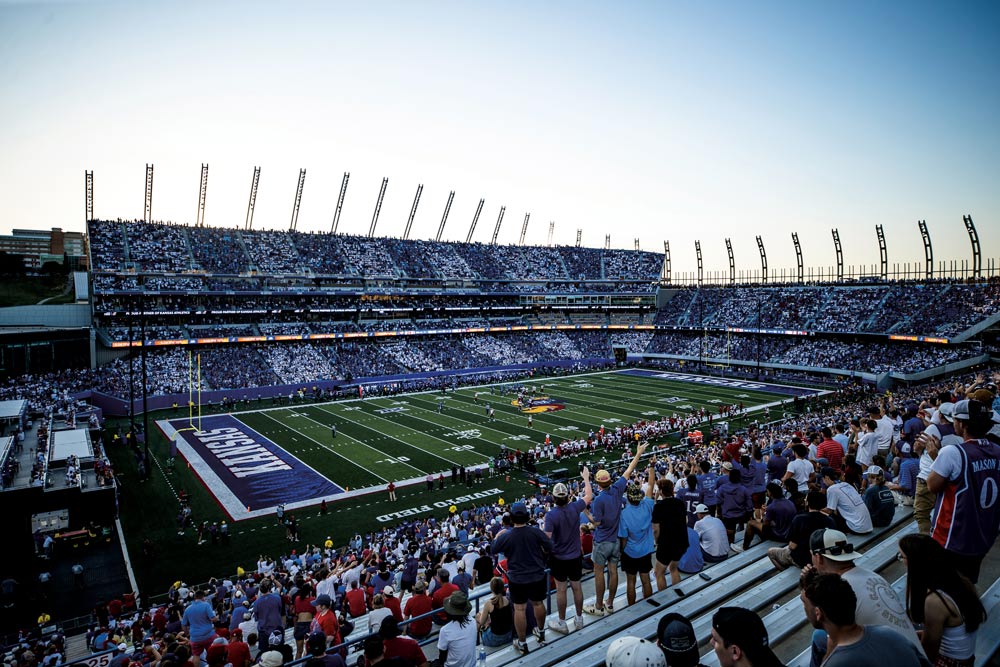
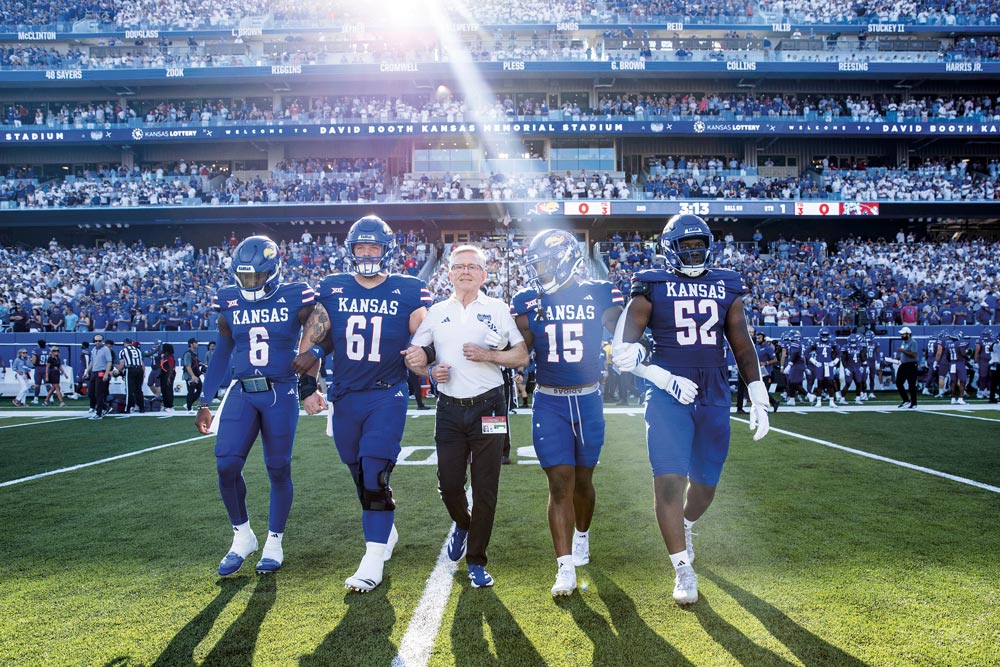
Walk into David Booth Kansas Memorial Stadium today, and you can feel the argument it makes. The renovated west stands opened after a 20-month sprint, with chairbacks and cupholders across the new stadium footprint, world-class concourses, and the kind of ingress and egress that makes families exhale. “No bad seats,” says Director of Athletics Travis Goff, c’03, j’03. University Architect Mark Reiske, a’86, calls it “instantly distinctive”—a place that reads Kansas even without its enormous midfield Jayhawk.
Phase 2 will mirror and extend: new east stands, to start, followed by a hotel, student housing, improved parking, an outdoor event plaza. The project is an engine for both campus and city, designed to hum all week, not just six Saturdays a year. Reiske hopes the lower east stands can be ready for the 2026 season, with the full east side completed by 2027. The hotel is, for now, targeted for 2027, and housing in 2028. It’s not just a stadium; it’s a neighborhood with a scoreboard.
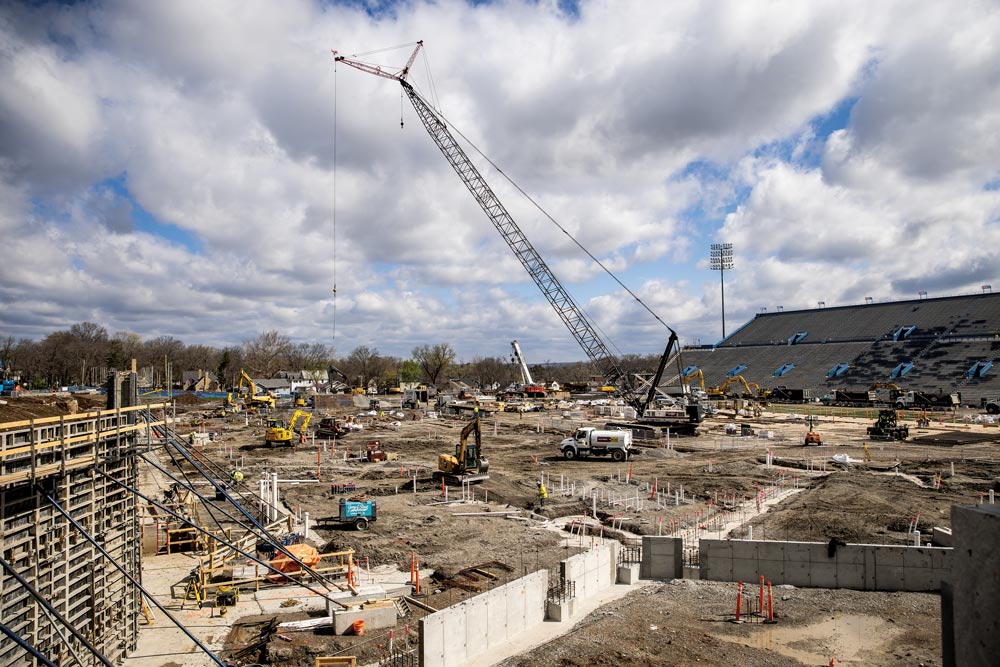
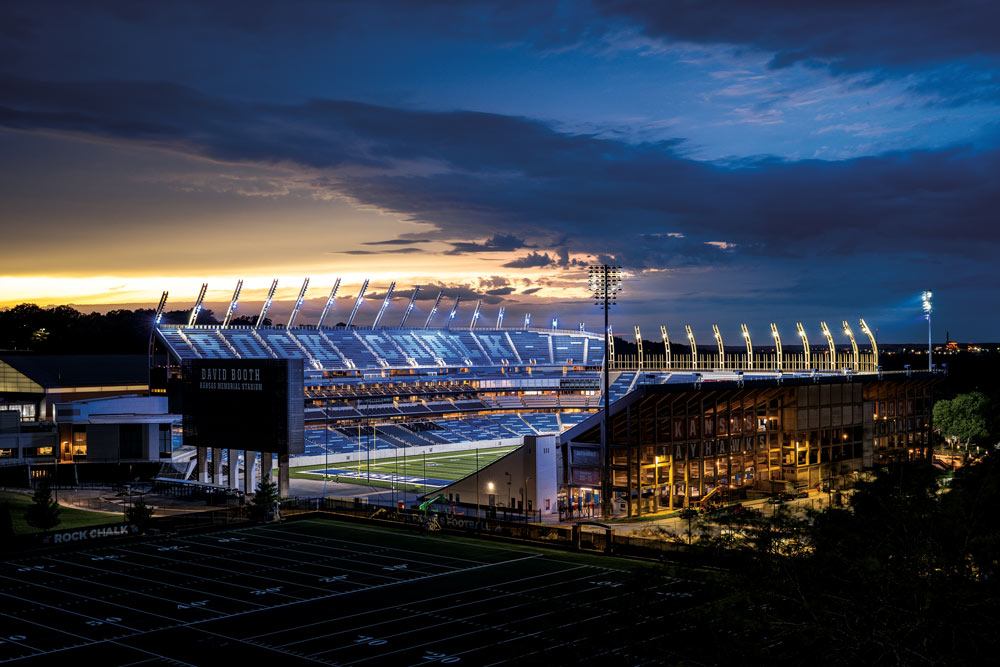
Booth’s gift is built the same way his firm is: a durable core paired with mechanisms that invite fiscal discipline. It includes a $75 million challenge to coax a community into the boat. “Nobody wants to be first,” he says. “Sometimes you have to stand up so others feel comfortable standing up too.”
Coaches see the leverage. “Two years ago we were thinking, ‘How do we get to where we want to go?’” recalls Hall of Fame coach Bill Self, now in his 23rd year leading the men’s basketball program and nearly as long as the unofficial face of Kansas Athletics. “Now there’s a clear path. The responsibility of that gift is to make sure we work as hard as we ever have to bring other people into the mix, to make sure it’s not a one-man, or one-family, gift. It’s the tip of the spear on what should be a lot more, and I think that will be a driving component in how the athletic department looks at it.” Football coach Lance Leipold, who flew to Austin soon after taking the KU job in spring 2021, says of Booth, “He’s a quality man, obviously. Highly successful, very personable, very welcoming.” Leipold appreciates that Booth’s gift arrives with both runway and expectation. “A gift like this gives us the opportunity to stay strong,” Leipold says, “but we have to keep moving.”
A philosophy of uncertainty
As a thoughtful man who has spent a lifetime teaching what he sees as the truth about markets, Booth speaks in sentences that double as coaching points. We have about a century of quality stock market data, he notes—Depression, world wars, financial crises, pandemics—and across long stretches, stocks returned roughly 10% to 11%. The slick pros do not outguess the market with consistency, and it is impossible to predict before the fact who might. The miracle, if you’re looking for one, is that capitalism can perform as such a superb information machine, a tabulator growing exponentially faster and smarter with every computational advance.
So invest the way the world actually works. Build sensible portfolios, capture the dimensions of compound return, be flexible, cut costs, tune out the noise, and judge yourself by the quality of decisions you can live with.
Philanthropy, for Booth, is the same puzzle in a different box. You cannot forecast a campus to the second decimal place. Instead, you can build capacity. Align leadership. Put resources where they compound—in people, in momentum, in places that become magnets. The stadium is a magnet. So is the idea of KU as a shared project.
“Athletics unites people who may not know anything about an academic department but feel deeply connected to KU,” Booth says. He remembers his parents’ season tickets as their annual social budget, and he deeply appreciates the strangers who stop him in Allen Fieldhouse or cheerfully interrupt his hotel breakfast the morning after the stadium’s Aug. 23 debut. Oh my heavens! I think I just had the best fan experience of my life yesterday! Oh my goodness! Thank you for everything, I appreciate you, and here’s to a great season! Community isn’t a metaphor for Booth. It’s a room you can stand in.
“People have so much pride in KU—the students, the alumni community, people like my parents who never went to KU but were really big KU fans, and you can see the impact it has on people’s lives,” he says. “It’s not about the money or anything else. It’s about taking inventory of how we’ve been blessed. My parents, by moving to Lawrence, teed up the opportunity for me to go to KU, and I was proud to be able to do that. I’m still proud that I went to KU, which enabled me to live life the way I wanted to live it. That’s about as cool as it gets.”
The art part
Ask him what has changed over the past decade, and Booth talks less about blueprints than about trust. Projects drift for human reasons. Projects succeed for human reasons, too. With belief in Chancellor Doug Girod, KU Endowment President Dan Martin, g’93, l’93, EdD’98, and Athletics’ Goff, it was Booth who first proposed the $300 million gift, shortly after an April 23 Athletics summit at which he’d agreed to provide a smaller, yet still impressive, gift.
“Five days later or so, I’m driving, and I get a call,” Goff says. “It’s David, and I will never, ever forget this. He says, ‘So, Travis, I’ve been thinking about this, and we can do one of two things.’ He said, ‘We can do what we previously talked about,’ which was a brilliant gift that would have been a game-changer, ‘or, here’s this other concept.’ I pull over, trying to scratch out notes, knowing a lot of this stuff is going to fly over my head. I said, ‘David, I’m not the smartest guy, but I think the second one sounds like the better plan.’ He basically says, ‘Yes.’”
Listening happily as Goff recounts the $300 million gift’s origin story, Booth smiles and nods. Yes, KU chose correctly. “It ties,” Booth says, “into the confidence I have in the team.”
The metaphor he reaches for is compounding: small, disciplined inputs, repeated over time, that turn into a thing bigger than any single deposit. The most famous painting in the world traveled with its maker because Leonardo never declared his Mona Lisa finished; resolute stewardship is the art form behind all the other art forms. Stadiums, too, are carried forward by hands that keep showing up.
At 78, the “ole shoe dog” will tell you the calendar concentrates the mind. Estate planning nudged him to consider the difference between what you can do “above ground” and what you leave to be sorted out when you’re not around to enjoy it. But the bigger reason is strategic. KU is at a fork in the road, he says, and for the first time in a long while, the pieces align. Leadership. Momentum in football. A project that converts big talk into an address you can visit. That’s when you push.
“Ideas are cheap,” Booth says. “Execution is what’s tough.”
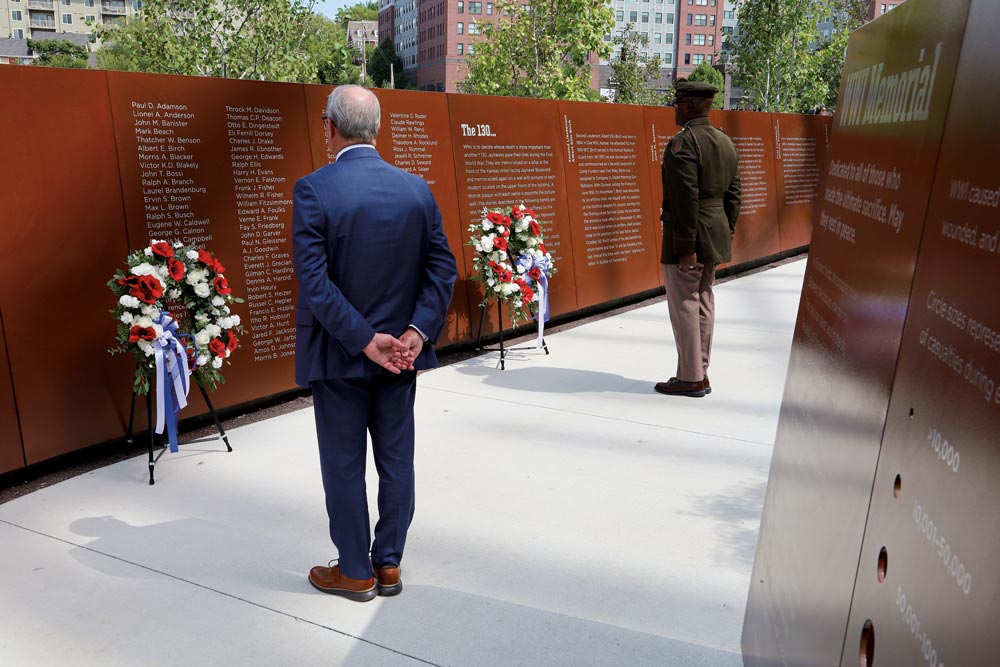
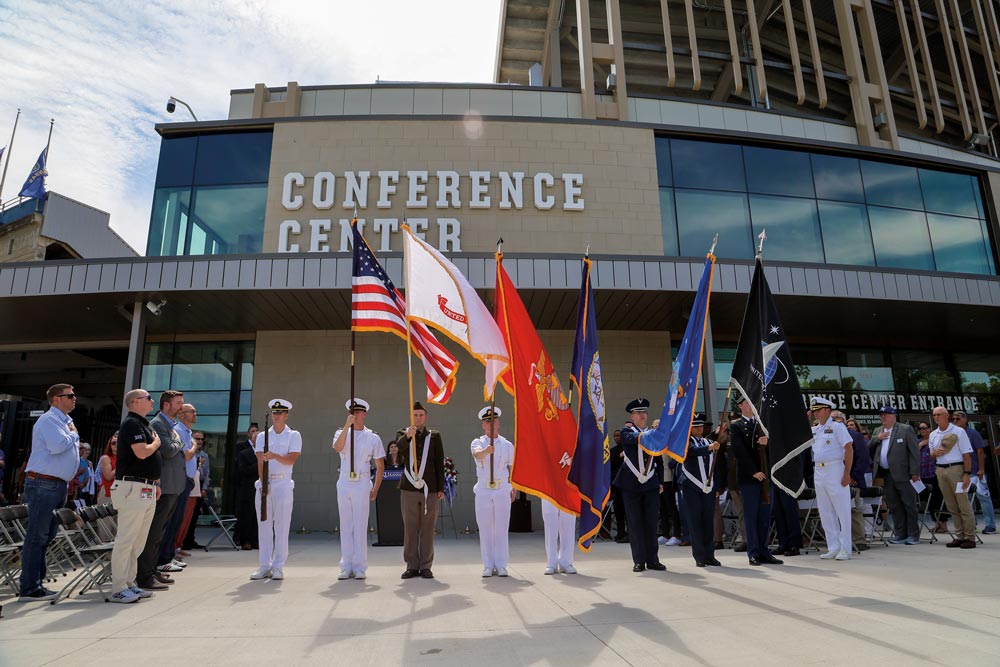
Jason Brown, Turner Construction’s project executive, explains what “tough” looked like on the ground: an active campus; a tight site; just-in-time deliveries; multiple shifts; steel by day and precast by night; a workforce full of fans proud to build the place where their own families will cheer on the ’Hawks. University Architect Reiske proclaims that the stadium “finally gives our fan base what they’ve been longing for, and deserving, for a long time: quality football in an appropriate venue.” Says Booth, “It’s a growth curve.” Start, learn, add, steward, repeat.
Alumni culture isn’t so different from investor behavior; people want to be part of something that works. Booth loves a small number with a big echo: If all alumni each gave $10, that’s $4 million, and $100 is $40 million. But the point is less the amount than the habit. Make the small, disciplined input. Watch it add up. Feel the belonging.
The man behind the name
Here is the other truth about David Booth: Prestige never quite impressed him the way usefulness did. He is the student who loved every course. The kid who at 5-foot-1 was too small for varsity hoops yet found his way into basketball’s orbit by slipping into the fieldhouse to watch the Jayhawks practice. The young teacher who valued helping students want to learn more than making them memorize. The salesman who learned to tell customers the truth even when the commission dangled. The portfolio manager in the spare bedroom who asked clients to test him a little at a time. The donor who says he’s simply paying back the alma mater that launched him and asking others to do the same, at their own scale, for their own reasons.
“My parents gave back a lot,” he says. “They didn’t have money, but they helped people. That’s what philanthropy is.” He still hears them in the voices that stop him to say thanks. He still hears Max on the radio. He still hears the inhale of a crowd ready to roar.
So when he walks into The Booth now, he sees the Boy Scout on the concourse and the grandfather smiling at pies in Bronson, the young man sneaking into the fieldhouse to shoot, the middle-aged founder managing a portfolio in a room too small for his ambitions, and the older man who knows that the long game isn’t glamorous. It is consistent. And it works.
“We’re not finished,” he told a crowd at the stadium in August. “We’re never finished. This is the launchpad.”
Call it a thesis. Call it a method. Call it the long game, the next first step. The life that taught an industry is still teaching his alma mater: Build with discipline, build with heart, and the good will compound.
Chris Lazzarino, j’86, is associate editor of Crimson & Blue.