
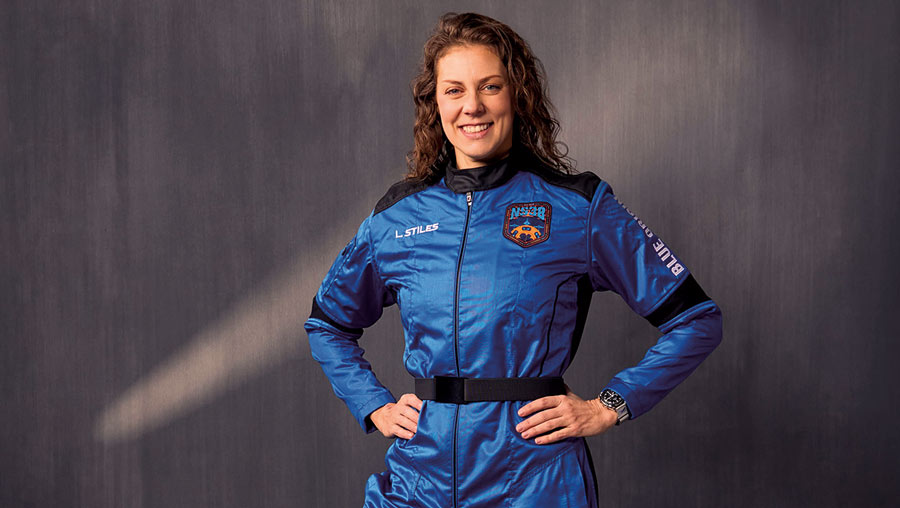
Exactly eight days after flying into space—what she describes as the most thrilling and life-affirming experience imaginable—Laura Stiles weathered sudden deflation from back-to-back traumatic changes to her orbit.
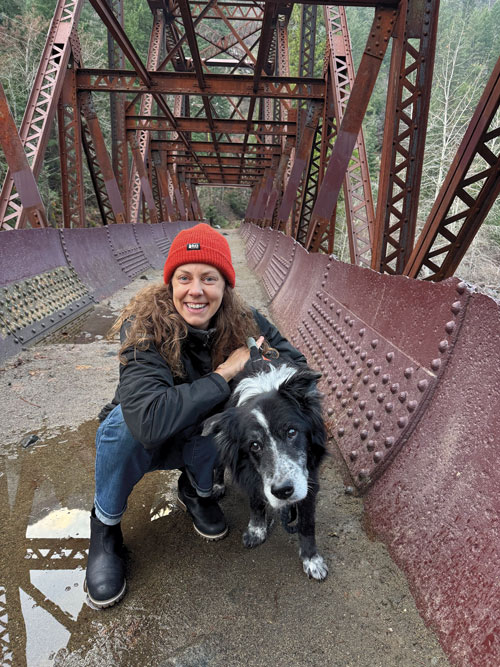
One was expected, at least in the abstract: The private spaceflight company Blue Origin announced it would pause its New Shepard program—the reusable suborbital rocket that Stiles, e’08, had helped build, test and fly for more than a decade. The other was not. That same day, Percy, Stiles’ constant canine companion and a familiar presence around the Blue Origin offices for nearly 13 years, was diagnosed with an incurable disease.
“It almost felt like you couldn’t have one without the other,” Stiles says. “A chapter is closing.”
But before the endings, there were the beginnings—both of which arrived with almost no warning.
Three days before New Shepard’s Jan. 22 launch, one of the six crew members fell ill. The clock was already ticking: Final preparations, supervised by Stiles, were set to begin the next morning at Blue Origin’s launch complex near the West Texas town of Van Horn.
Given constraints related to weight, balance and logistics, there wasn’t time to find another paying customer. There was, however, someone already on-site who checked all the boxes: Stiles, the mission’s director of launch operations.
“Hey, we’ve got a sick customer,” Stiles recalls being told. “We’ve gone through the flowchart. Can you go?”
It was, for Stiles, an immediate yes.
“Oh, God, yeah,” she laughs. “They knew I have always wanted to go. It’s definitely been a dream, especially being in the customer-facing role for so many years and hearing people who come back from this experience and they’re just completely mind-blown.”
Stiles joined Blue Origin in 2013, when the company was still small, with just a few hundred employees. Over the years, she worked across nearly every facet of New Shepard: mechanical systems design, integrated vehicle testing, launch operations. She served as a flight controller, a CapCom (the voice communicating with the ship) and eventually as director of training and launches.
The compressed timeline before launch created a surreal sequence of events. Stiles called her parents—Mark and Brenda, of Prairie Village—to tell them she would be going to space in two days. They and a handful of other family and friends hopped on airplanes and made it to Texas in time for launch, still processing what was about to occur.
“My mom’s first comment was, ‘I’m so glad I only knew for two days,’” Stiles says. “She’s a worrier, and that was the best way, in her opinion.”
The flight itself lasted about 10 minutes. After liftoff, the New Shepard capsule separated from its booster and continued past the Kármán line—the internationally recognized boundary of space, about 62 miles above Earth. There, Stiles and her fellow passengers experienced about four minutes of weightlessness, floating freely before beginning their descent back to the desert.
Watch the webcast of Stiles’ flight to space:
For Stiles—the fifth Jayhawk to fly in space—the moment carried deep resonance.
“It’s hard to find things that put people in that headspace,” she says, “really thinking about who they are and what their role is on Earth.”
Now she understood, and her path to that moment began, fittingly, in Lawrence.
Stiles grew up in Prairie Village and spent much of her childhood visiting her grandmother’s home near the KU campus. She became enamored of KU, and arrived as an astronomy major; when she discovered engineering physics at the department of physics and astronomy’s welcome-to-campus meeting, she switched. Her father, an engineer, approved.
“‘I think you should do this,’” she recalls him saying. “A very dad thing to say.”
The work was intense—long nights in the lab and a social life that mostly consisted of attending KU men’s basketball games, at which her four-year attendance record was, of course, spotless.
Because Stiles excelled under rigorous academic stress, opportunity came her way. She won a NASA internship, during which she was introduced to skydiving; Stiles, an avid outdoors- woman, is now a certified instructor and world record holder in large-formation skydiving. She also worked on a research project with her physics lab professor, Michael Murray, that took her to Switzerland, installing hardware inside the Large Hadron Collider.
“It’s still kind of mind-blowing,” she says. “At 20 years old, being in that tunnel.”
Stiles completed her graduate studies in Boulder, Colorado, then joined Blue Origin through a graduate rotation program. In those early years, the company’s small size meant broad exposure.
“You see the entire life cycle,” she says. “You design a part, you go find a vendor, you pick it up, you help install it, you help refurbish it. It gives you great footing.”
If New Shepard was her professional constant, Percy was her personal one. Colleagues knew Percy well enough that he was mentioned during the Blue Origin webcast of her flight. Smart, emotionally attuned and endlessly present, Percy was part of the Blue Origin culture Stiles helped build—a workplace defined, she says, by close-knit teams and a strong sense of care for one another.
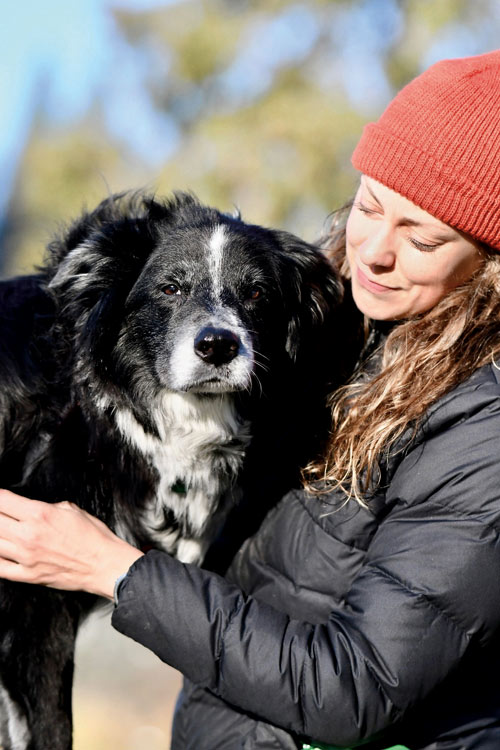
Which is what made the timing of Percy’s diagnosis feel so profound.
The January announcement that New Shepard would pause operations—redirecting resources toward NASA’s unexpectedly redesigned schedule of lunar missions, in which Blue Origin hopes to participate—was significant on its own. The program had flown 38 missions and carried 98 people to space, serving as a proving ground for reusable rocket technology and human spaceflight operations. For Stiles, it represented 13 years of work.
But the same day, Percy’s cancer diagnosis reframed everything.
“In some ways, it feels sort of universal,” she says. “Like they were tied together.”
What comes next is, by her own admission, uncertain. Blue Origin’s focus is shifting toward lunar exploration, part of a broader push to return humans to the moon.
“The exciting part is we don’t even know what all the opportunities are yet,” Stiles says. “There are companies now that couldn’t have existed 10 years ago, so who knows what’s next?”
Chris Lazzarino, j’86, is associate editor of Crimson & Blue.