


KU School of Engineering alumnus Brian McClendon, e’86, a co-founder of Google Earth, and his wife, Beth Ellyn, in November made a $4 million gift to the School of Engineering to strengthen faculty recruitment and expand student success initiatives.
The gift will establish the Brian and Beth Ellyn McClendon Professorships, aimed at helping KU attract and retain top-tier engineering faculty in rapidly evolving fields such as artificial intelligence. It also funds expansion of KUEST, a student support program.
McClendon, now building next-generation mapping technology for robots and augmented reality glasses as chief technology officer at Niantic, said his admiration for exceptional engineering professors inspired the investment.
“My entire career, from Keyhole to Google and now at Niantic, has been built on the foundation of world-class engineering. That foundation was poured at KU,” McClendon said in a news release announcing the gift. “Beth Ellyn and I know that the single most important factor in a student’s education is the quality of the faculty and their ability to teach, mentor and inspire.”
McClendon said competition for elite engineering faculty has intensified as technology advances accelerate, particularly in artificial intelligence. Universities must actively recruit leading experts—often competing directly with industry—and provide competitive compensation packages.
“You actively pursue those people,” McClendon said in an interview with Crimson & Blue, “and when you find somebody in the category, you make a bid for them—as do other schools. And so you have to bid higher, which is why they need this extra money for the package.”
He pointed to his own experience working with prominent academic leaders in industry during his 10 years leading Google’s geospatial division—including professors affiliated with institutions such as Stanford, Oxford and University College London—as examples of the caliber of talent KU should seek to attract.
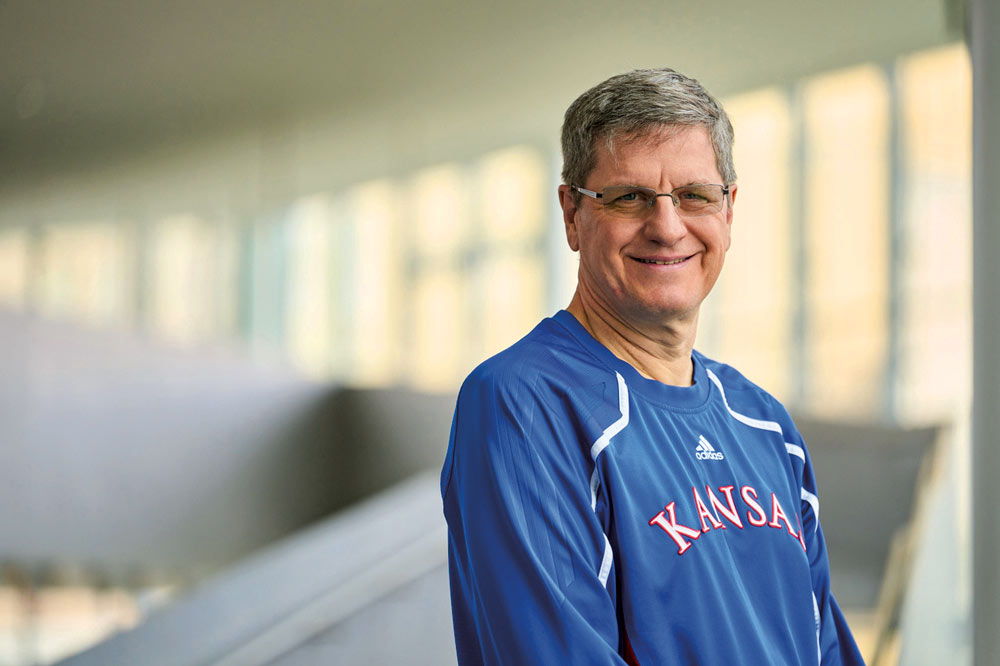
Named professorships are a key tool in that effort, providing long-term funding that helps universities recruit and retain distinguished faculty members. Mary Rezac, dean of the School of Engineering, says McClendon’s gift will help KU remain competitive in a high-demand field.
“Computer science is such a popular field in engineering now, and Brian has been at the frontline of innovation in this space for decades,” Rezac said. “We expect his name will inspire students and faculty, and hopefully encourage others to fund named professorships and strengthen the school.”
In addition to faculty support, a portion of the gift will expand KUEST (KU Engineering, Science and Technology), a summer bridge program that helps incoming freshmen build foundational skills, particularly in mathematics, before beginning their coursework.
The program includes four weeks of precalculus instruction tied to engineering applications, along with faculty and peer mentorship, research exposure, and community-building opportunities. It also covers housing and dining costs during the summer session.
McClendon said his support for KUEST is shaped in part by his experience traveling across Kansas during his 2018 campaign for secretary of state, when he visited dozens of high schools and observed disparities in access to advanced coursework.
“It was clear that there’s a lot of smart kids who wanted to do this,” he reflected, “but who had not had computer science, did not get to take calculus, and needed that extra time.”
University data underscore that challenge: Only about 30% of students who begin in precalculus graduate with engineering degrees, and students starting at lower levels of math rarely complete the program. McClendon described KUEST as a way to close that gap and expand opportunity.
“Talent is evenly distributed, but opportunity is not,” he said. “KUEST is a powerful engine for finding and nurturing exceptional talent that might otherwise be overlooked.”
McClendon has maintained close ties to KU throughout his career. After graduating, he spent eight years at Silicon Graphics before co-founding Keyhole, a company later acquired by Google and developed into Google Earth. He went on to lead Google’s geospatial division, overseeing products such as Google Maps and Street View, and later served as vice president of mapping at Uber.
At KU, he has supported scholarships, contributed to faculty retention efforts, and served on advisory boards for the School of Engineering and the department of electrical engineering and computer science. He also created “Startup School,” a program designed to help students launch technology ventures, and recently invested in a startup founded by one of its participants.
For McClendon, this most recent gift reflects both gratitude and a desire to create opportunities for future students.
“That story about my childhood home being the center point of Google Earth is a fun piece of trivia,” he said. “But to me, it’s a reminder that world-changing ideas can, and do, come from a kid in Kansas.”
Chris Lazzarino, j’86, is associate editor of Crimson & Blue.