

Jayhawks hold leadership positions across diverse industries and professions, and many connect with KU students and fellow alumni through the Jayhawk Career Network. In “Copy the Leader,” KU Alumni, in partnership with SumnerOne, spotlights Jayhawk leaders who are models for others in their fields.
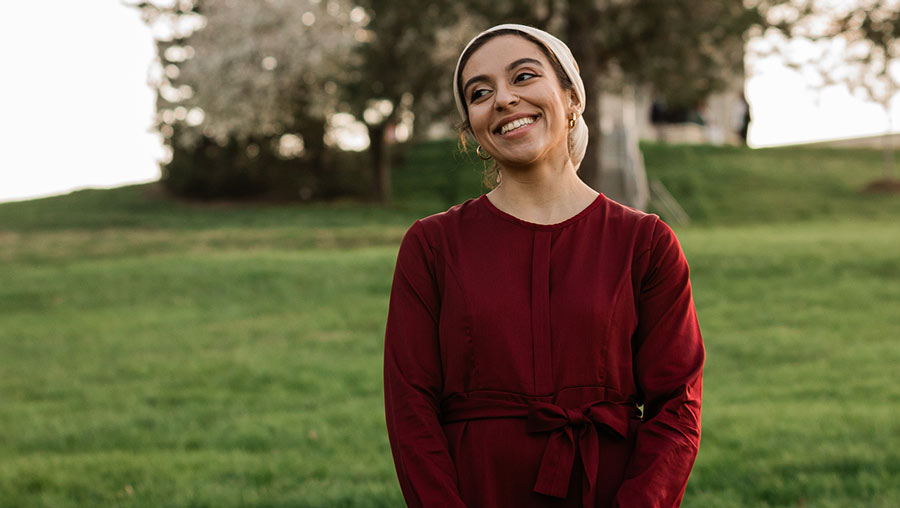
Ceyda Kural-Rendon, PhD’25, is a postdoctoral fellow in the department of biology at Stanford University in Palo Alto, California. Her research focuses on plant-microbe interactions and how they change with environmental stressors, specifically drought. Kural-Rendon, who grew up in Houston and earned undergraduate degrees in ecology and evolutionary biology and English from Rice University, recently chatted with KU Alumni about some of her most formative experiences and valuable takeaways from her time on Mount Oread.
What KU involvement shaped you most?
Kural-Rendon: I was involved in the Graduate Student Organization (ecology and evolutionary biology), which really helped me build community during some of the most demanding years of my career, and I made several lifelong friendships. I also was a teaching assistant, which helped me acquire teaching and mentoring skills both inside the classroom and out.
Did you have any mentors at KU, and what did they teach you?
I had several mentors, from my graduate adviser and other faculty members on my dissertation committee to older graduate students. Aside from teaching me how to be a scientist, my mentors taught me that graduate school—and a lot of life—is a marathon and not a sprint, and that chipping away small wins over time eventually leads to bigger wins.
How do you define leadership today? How has that definition changed since you were a student?
I would define leadership as the ability to step up, make decisions and get everyone on the same page toward a common goal. In the past, I think I probably would have said a leader is someone with a vision, but I think a lot of people have visions. Not everyone has the wherewithal to execute, though.
I would also emphasize the “get everyone on the same page” part. A lot of leadership is practicing empathy and compassion, having good listening skills, and being able to anticipate your team’s needs.
Tell us about a leadership challenge you faced and what you learned.
I was working with a graduate student late last year who was having a hard time showing up to lab on time. He ended up leaving for break without setting up an experiment, which really threw a wrench in our timeline. Before complaining about him to my adviser, I talked to him and tried to figure out what was going on. It turned out he was experiencing a mental health issue, but was in the process of getting treated and getting back on a routine. Once I knew what was going on, I was able to work with him to accommodate his needs, and once he was back on track, he ended up being one of the most reliable students I have ever worked with.
I learned that oftentimes people are scared to tell you about things going on in their life, especially if they work under you, so sometimes the first step is asking the hard questions. And once you know, it’s much easier to come up with a plan where you can meet people where they’re at.
What’s a mistake you made early on in your career, and how did you grow from it?
One mistake I made early on was prioritizing graduate school over sleep and exercise and social activities. It might seem obvious to some, but balance is key. I remember thinking I was “built different” and could “push through” sleep deprivation. But scientific studies show how much performance actually decreases on low sleep, and how exercise and social bonding help emotional stability and mental clarity, which are super important if you’re a student or working on a big project or goal.
This definitely ties back in with, “It’s a marathon, not a sprint,” and that happy (and healthy!) people end up with a more cohesive, well-done end product than people who are stressed out, burnt out and sleep-deprived. Take care of yourself now! It will pay off.
Adapting this mindset during my last three years of grad school made them much happier and relatively low-stress compared to my first three, even though my workload and the pressure of figuring out my next steps had increased quite a bit toward the end.
What qualities should student leaders focus on developing now?
I think people skills in leadership roles are so important and underrated. Learn empathy and compassion and how to be a good listener. A good leader makes team members feel heard and important. A happy, collaborative team is going to make a better product, research article or whatever the end goal may be.
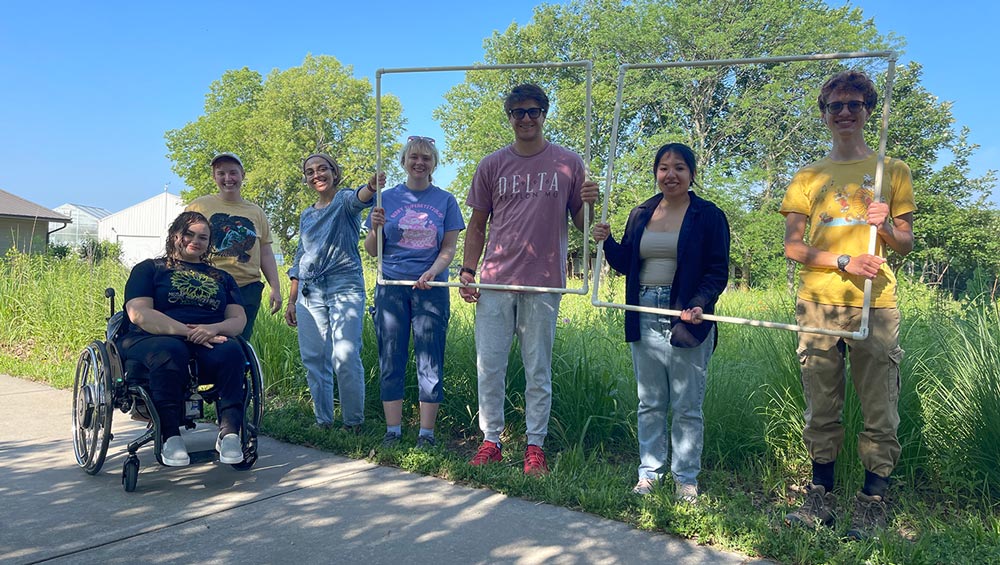
Which KU experiences best prepared you for your career?
I would say my research experiences at KU while doing my dissertation work, as well as my teaching experiences. I think the best way to learn something is to teach it. Teaching is a form of leadership; your shared goal is to learn something and make sure everyone is on the same page about it. I think undergrads especially should try to become teaching assistants or mentor younger students.
For my career specifically, KU has a ton of internal fellowships for students, whether that be for an experiment or to travel to a conference to present your work. I would take advantage of opportunities like that and apply for everything you can—the worst they can say is no, and even then, the experience of applying to a funding opportunity itself is worthwhile. Best case, it looks great on your CV or résumé, and you may get to do a project you wanted to do or travel somewhere new for a conference.
What tips do you have for building strong alumni connections with the University?
I would recommend staying in touch with people you meet at KU, both professors and fellow students. While I am sure lots of people give this advice, I will add that staying in touch does not have to be overwhelming. It can be as simple as a single life update email to a favorite professor every year or two, or finding out a former lab mate is going to be at the same conference you’re going to and asking if they want to grab coffee. You never know when that connection with them might come in handy.
For me, once I left Kansas and the Midwest, meeting anyone from Kansas or Missouri—and especially those who have some tie to KU—builds instant camaraderie, which is really cool, especially given how hard it is to make connections and build community in real life outside the internet. I know that my network of KU friends and acquaintances will always be willing to catch up or let me pick their brain on something that I could use their expertise on. While KU is in my past (for all I know—who knows!), I know I have plenty of connections with fellow Jayhawks in the future that I have yet to make but am excited about.
What changes or trends in leadership do you anticipate in your field?
In the sciences broadly, but especially in fields relating to the natural environment or climate change, funding is becoming increasingly difficult to obtain because of ideological differences with major funding agencies. I think it’s essential for leaders in my field to be able to adapt to a rapid agenda turnover that might require us to shift the focus of our research in ways that may be more palatable to funding agencies. Additionally, the general mistrust in science and academia lately allows for an opportunity for leaders to hone their scientific communication skills and build trust with the public by making their science accessible and transparent.
How should current students prepare for those future challenges?
I think learning to think about your work and communicate it in different ways, for different audiences, is invaluable. If you’re doing research in agriculture, the story you tell in your journal publication vs. what you tell when talking to farmers will be very different. I think science communication skills would be great to have, so volunteer for outreach events, like those put on by the KU Natural History Museum. I think talking about your work to as many different types of audiences—and being receptive to feedback regarding clarity and accessibility—is key.