
KU Alumni’s Jayhawks Give Back program is presented in partnership with Andrew Wymore, senior realtor with ReeceNichols.
Jayhawks Give Back celebrates ’Hawks who are making a difference in ways big and small. Each quarter, we feature a member of the KU family and their story. If you know a Jayhawk who should be featured in Jayhawks Give Back, let us know!
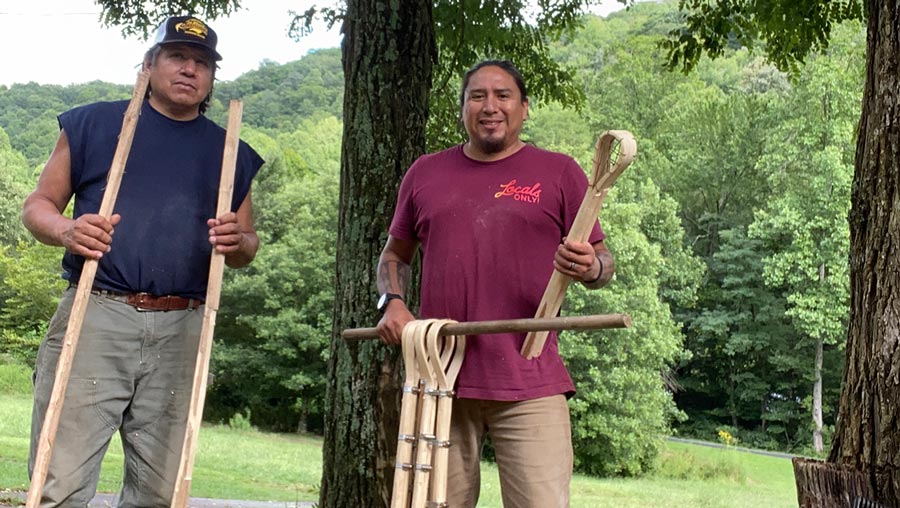
Micah Swimmer knew his relatives were talking about him, but he didn’t know what they were saying. On the porch of Bigmeat House of Pottery, his grandparents’ pottery shop in Cherokee, North Carolina, two generations of his family sat chatting.
“They used to have a little bench out there, and they would sit out there and talk all day,” recalls Swimmer, g’17. “I was this little boy playing, and I went up, and I could just tell they were talking about me, because they’d point at me and smile and laugh. I didn’t know what they were saying, because both of my parents weren’t first-language speakers either.”
The chain of first-language acquisition had been broken in Swimmer’s family. It’s a common situation for many members of the Eastern Band of Cherokee Indians, one of the three federally recognized Cherokee tribes. Now, after decades of studying the language, Swimmer, who serves as the Cherokee language and cultural specialist in the tribal nation’s Human Resources Division, is working against the many forces that have imperiled the language for centuries.
The Eastern Band of Cherokee, who speak their own dialect, are descended from Cherokee who remained in or returned to the tribe’s ancestral homeland in the southeastern U.S. following the Trail of Tears, when the U.S. government forcibly relocated five tribal nations to present-day Oklahoma in the 1830s. Thousands perished, and through assimilation and boarding schools designed to cut Indigenous children off from their families, language and culture, the number of speakers plummeted. One boarding school survivor, who refused to speak Cherokee even as an adult, told Swimmer she had been beaten and starved for speaking it.
“I remember asking her, ‘How come you don’t speak to me in Cherokee? You answer me in English,’” Swimmer says. “And she just shook her head and put her head down and she said, ‘I’ll never speak that way again.’”
Swimmer’s work is, in many ways, a race against time. About a decade ago, Swimmer documented that the Eastern Band of Cherokee had 264 first-language speakers out of approximately 16,000 enrolled members. Today, that number is down to 133, with most of those speakers over 60.
A little notepad
But before Swimmer maintained that slowly dwindling list of names, he had a notepad—and there, the text was multiplying.
Swimmer began receiving formal Cherokee language instruction when he started school, learning basics such as colors, numbers, animals and greetings. Though the vocabulary was limited, Swimmer remembers being “pretty good at it.” And though at first he hadn’t understood his relatives, his grandma, Amanda Swimmer—a renowned potter who passed away in 2018—kept speaking to him in Cherokee. Swimmer says he was about 12 when he started writing down words in a notepad that he carried with him. When he saw Cherokee speakers around, he would practice the phrases.
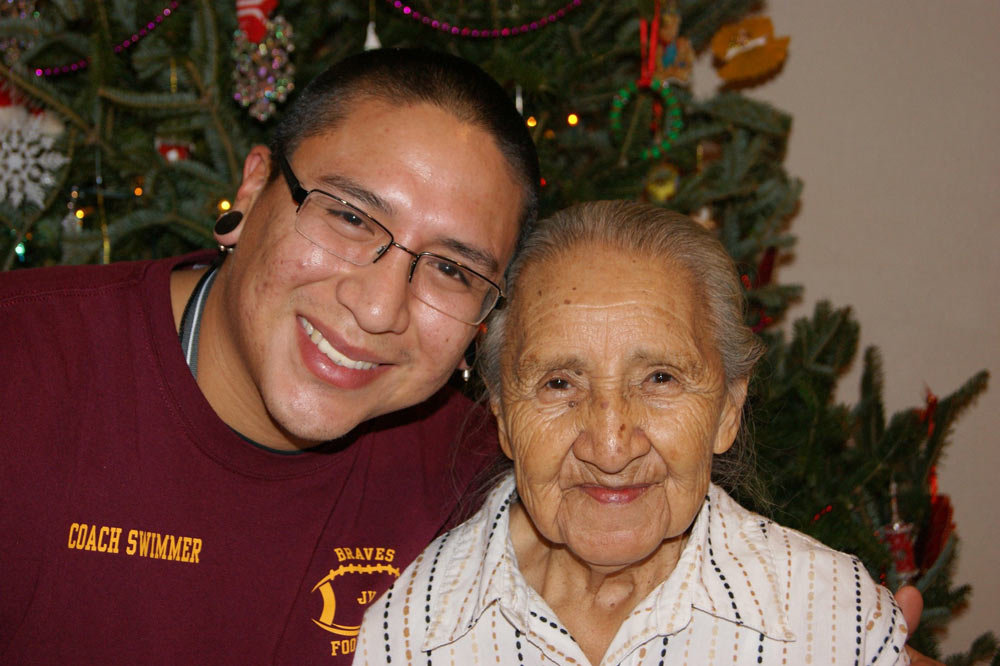
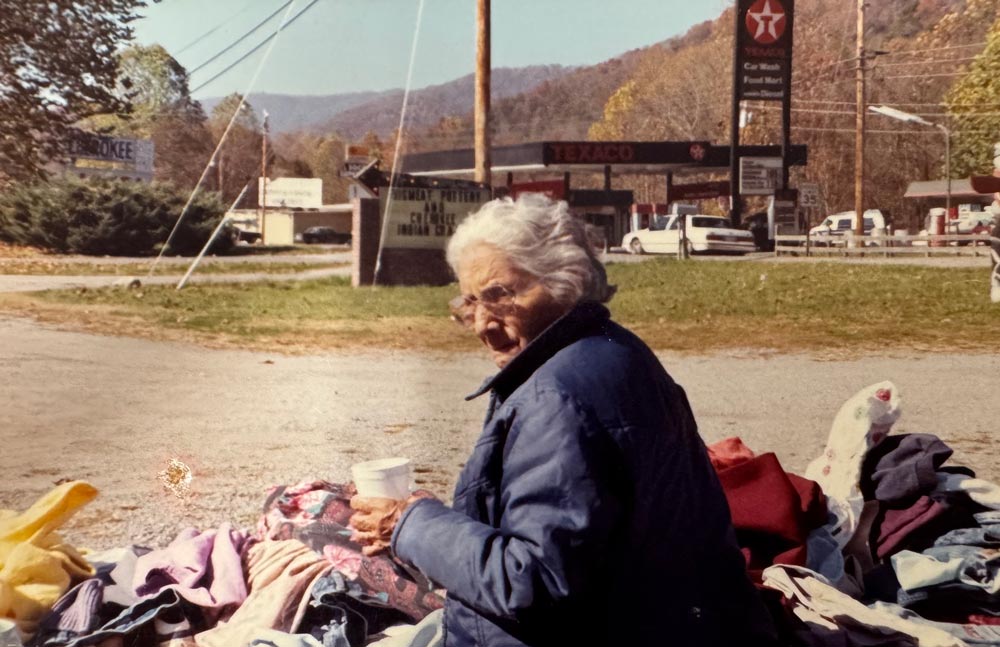
“She was the one who I would really go to and ask questions,” Swimmer says of his grandmother. “And I would take the words she would give me, and I’d write them down in a little notepad I’d carry, and I would study those words.”
That early dedication has bloomed into a lifetime of language learning and teaching. As a teenager, Swimmer was an intern in a Cherokee language immersion program and has since worked in various capacities on the tribe’s Qualla Boundary, a 57,000-acre land trust in western North Carolina, to help the language survive. In his current role as Cherokee language and cultural specialist for the tribal nation’s Human Resources Division, he seeks to restore what’s been lost by teaching Cherokee language and culture classes for tribal employees.
“The goal is cultivating Cherokee language,” Swimmer says. “Because I want these guys to take the language they learn from my classes back to their worksite, back to their jobs, back to their offices and facilities—and then start using the language among each other in their everyday jobs.”
Documentation and revitalization
Swimmer attended Haskell Indian Nations University in Lawrence and graduated with a bachelor’s degree in American Indian studies in 2008. It was at a Haskell career fair that he picked up a brochure for KU’s Indigenous studies graduate program.
A track noted in the brochure grabbed Swimmer’s attention: language documentation and revitalization. He applied and got accepted. But Swimmer, who was also raising a family with his wife, Carrah Swimmer, eventually had to put school on hold and moved his family back home to Cherokee, North Carolina, where he worked as a middle school Cherokee language teacher and coach. All the while, he continued to carry that KU brochure in his bag, intent on finishing. In 2017, clearing what he described as a “cloud over his head,” he completed his last requirements.
At both Haskell and KU, Swimmer learned about documenting and teaching language—as well as empowerment. He visited the Cherokee Nation and Northeastern State University in Oklahoma and observed the methodologies and strategies of their language programs.
“It really opened my eyes up to a lot more, and then I came home ready to go,” he says.
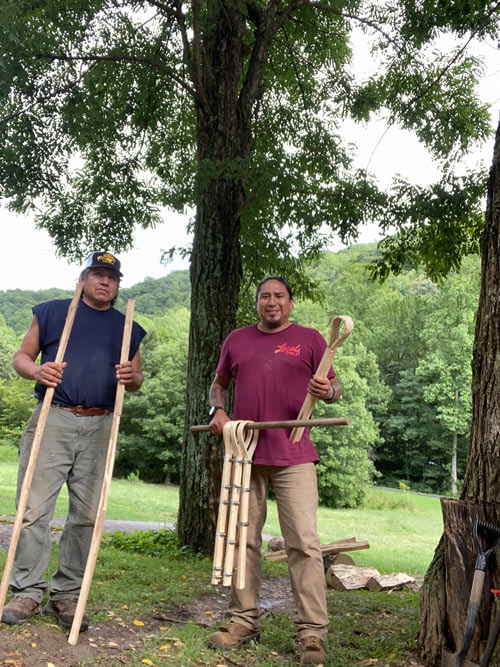
As part of his current position, Swimmer makes videos of first-language speaker Clement Calhoun to demonstrate pronunciation and share cultural knowledge. For example, in one video, Calhoun demonstrates the process of making a stick for the game of stickball, beginning with cutting down a hickory tree. Swimmer says the Cherokee language is interconnected with the tribe’s traditions, including ceremonies, song and dance, and stickball, and he hopes to bring the language back into those spaces.
“Our language is what ties our culture together, our traditions together,” Swimmer says. “It’s embedded in who we are, and it connects us to our land, so all of that together is what we’re doing. We’re reclaiming who we are.”
Three generations
There’s proof it can be done. Swimmer was recently part of a delegation from the Eastern Band of Cherokee Indians that visited New Zealand, where the Māori people have revitalized their language through immersion schools.
“They had their language dying out, and their people decided to make a change,” Swimmer says. “They started their immersion schools, and now they’ve got speakers everywhere, and they’ve got language everywhere.”
Swimmer came back from the trip motivated to do even more. He hopes to see a more concerted effort among U.S. Indigenous nations to preserve their languages, as well as the establishment of a Cherokee language and culture center that would bring together the many knowledgeable people currently volunteering their time.
Swimmer sees funding such a center and joining disconnected efforts as way to combat what time is quickly taking away. He recalls an adage one of the Māori shared with him: “It takes one generation to lose a language, and three generations to restore it.”
While the generations who once sat on the porch chatting in Cherokee are passing on, Swimmer is determined that their words—words that lovingly teased him as child and that underpin immemorial Cherokee culture and tradition—do not disappear with them.
“It’s good that we have this,” Swimmer says of his current position, “But there’s so much more that we could do to save our language.”
Rochelle Valverde, c’08, j’15, is staff writer for Crimson & Blue.