
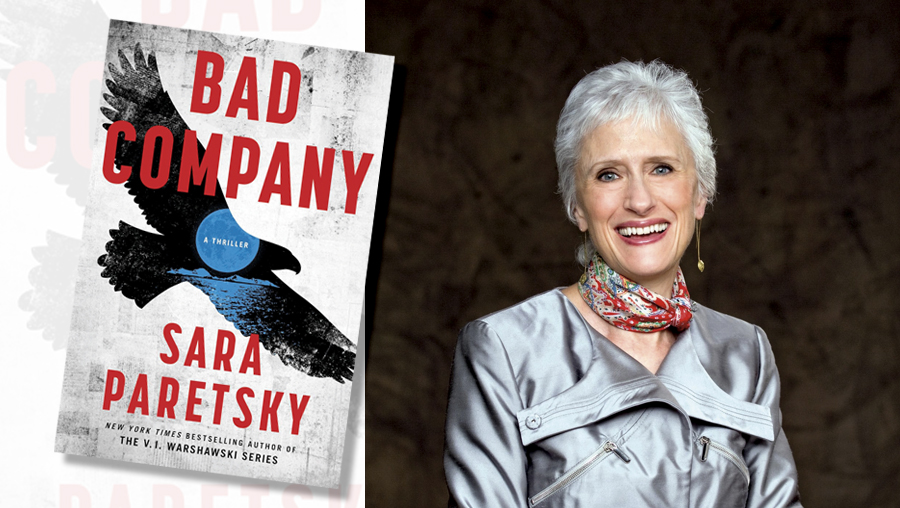
Lily, a retired CIA agent and the protagonist of Bad Company, is in her orthopedist’s waiting room going through her mail when her routine is upended. Inside a padded envelope with no return address, she finds an issue of The New Yorker, its cover stapled with a note saying, “You need to read this.”
Within, Lily finds an article that includes an old, blurry photo of her in Hayalistan, the fictional Central Asian country where she served her longest assignment, and that implicates her in dealings that brought foreign-run lithium mines, pollution and other ills to the nation. Abandoning the interminable wait to see a doctor for her sore shoulder, Lily begins tracking down the provenance of the package and the secretly taken photo. Her increasingly unnerving discoveries eventually bring her back to Hayalistan, where grassroots organizers fight billionaire interests in a conflict where the sides aren’t always clear.
Sara Paretsky, c’67, who at 79 has a few years on her novel’s 75-year-old protagonist, says writing Lily’s story was her way of examining issues she and her friends are facing. These she divides into three broad categories: whining, denial and embracing however many remaining years you’re given. For Paretsky, bestselling author and winner of the Mystery Writers of America Grand Master Award and the British Crime Writers’ Cartier Diamond Dagger for lifetime achievement, that looks like whining about her sometimes faulty hearing aids and still trying to keep the same schedule she did when she was 50. For Lily, it means relying on her wits and scruples more than her body.
“With Lily, I wanted to show that aging can slow you down physically, but it doesn’t change who you are, your core personality, your core values,” Paretsky tells Crimson & Blue.
Lily remains impulsive, empathetic and driven to uncover how the monied and powerful use their influence in ways that harm ordinary people. And like V.I. Warshawski, the groundbreaking female private investigator Paretsky introduced in the 1982 book Indemnity Only, Lily is an empowered character with deeply feminist principles. Forty-four years later, such empowerment is no less important. Both characters reflect Paretsky’s own feminist principles, which were stirred to life during her undergraduate days at KU.
Paretsky started at KU in the fall of 1964, right after the Civil Rights Act had established hard-fought rights for Black Americans and other minorities and equal opportunity for women. However, Paretsky says, those new rights had to be claimed. Though Paretsky, who grew up in the Lawrence area, came from an intellectual family, she wasn’t expected to make her own career. The turning point came during a dinner that Emily Taylor, then the KU dean of women, hosted for Elizabeth Miller Watkins scholarship holders, Paretsky among them. When Taylor asked the women why they were at KU, one student said she hoped her education would make her a better wife and mother.
“She seemed to double in size,” Paretsky says of Taylor. “She’s like, ‘No, you are here to see what kind of contribution you can make as a person to the world.’”
Paretsky says that was the first time anyone had suggested that what she chose to do could matter. And matter it has. Paretsky has published more than 25 books, supported social justice causes in her adopted city of Chicago, and founded Sisters in Crime, a worldwide organization to advocate for women crime writers. But in fiction, as in life, it is no one-woman show.
While Lily exhibits admirable grit, it’s only through the help of old friends, new acquaintances and connections with younger generations that she has a chance of prevailing against corruption. And while there may be disguises, stunts and plot twists, Paretsky says Bad Company is not a spy novel per se.
“It’s really a novel about people, relationships, and navigating some of the terrible things that we all are having to navigate these days, regardless of our age,” she says.
Rochelle Valverde, c’08, j’15, is staff writer for Crimson & Blue.