
Stubborn storms kept plodding across Florida’s Space Coast on the morning Artemis II was scheduled to launch, lingering later than Mark Burger had expected when he first briefed NASA officials. It was not yet a problem for fueling the rocket, but if one of the rainy clouds showed potential for producing lightning, the first crewed lunar flyby in 50 years could not proceed.
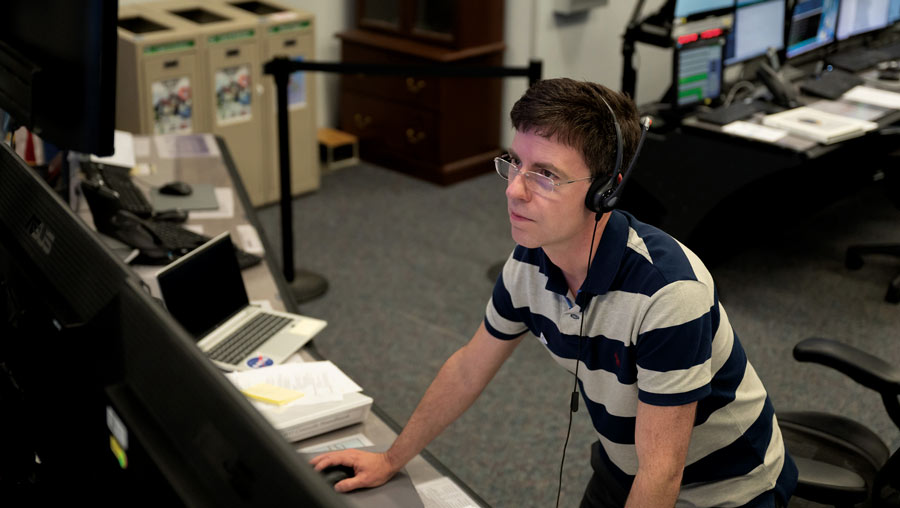
So Burger, c’98, the lead launch weather officer for the April 1 flight of Artemis II and a civilian guardian with the U.S. Space Force at Cape Canaveral Space Force Station, pored through incoming data and looked for an opening. “We kind of had to shoot the gap a little bit,” Burger recalls from his home in Melbourne, Florida.
Sure enough, the showers moved safely inland by early afternoon, and when the launch director called on the dozen or so specialists whose decisions would determine the launch’s fate, Burger spoke the words he’d dreamed of saying since childhood: “Launch weather is a go!”
The moment represented a convergence of Burger’s lifelong fascinations: weather and spaceflight. Burger, a Topeka native, says the volatile weather of northeastern Kansas was a catalyst. “I always wanted to know the why behind what the weather was doing.”
Artemis II was the second flight in NASA’s Artemis lunar exploration program and its first crewed mission. The nine-day lunar flyby with four astronauts aboard marked the first time humans had traveled beyond low-Earth orbit since Apollo 17 in 1972. Artemis II reached 252,756 miles into space, surpassing the previous record for the greatest human distance from Earth.
Watch Artemis II’s launch from NASA’s Kennedy Space Center in Florida on April 1, 2026.
Burger was a fourth grader when he and his classmates witnessed the death of teacher Christa McAuliffe and six other astronauts in the 1986 explosion of the space shuttle Challenger, later attributed to the freezing weather that had impaired fuel tank gaskets. In the tragedy’s aftermath, Burger huddled with a fellow space enthusiast and discussed how it felt as if a family had member had died.
“I remember us talking about how nice it would be, when we grew up, to work in the space program,” Burger recalls, “and help prevent something like that happening.”
Burger monitored CNN’s live coverage during space shuttle launches, and, on one particular day, took note when correspondent John Zarrella reported that the launch had been scrubbed due to forecasts by U.S. Air Force meteorologists. “So why is the Air Force doing weather for NASA?” Burger says he wondered at the time, “and how do I get that job?”
Burger says he was an average student in high school and had to petition the KU math department to allow him to enroll in engineering calculus, a grueling prerequisite for all engineering students. He was intimidated at the time by high-performing students from prestigious school districts who had arrived at KU with calculus confidence—and credits—but when grades were posted for the all-important midterm, it was Burger, an aerospace engineering major at the time, who scored 192 out of 200, outpacing all of his classmates.
“‘I can do this. I can compete with everybody here,’” Burger recalls telling himself. “It was a momentum that fed on itself.” That’s also when Burger changed his major to atmospheric science, hoping he could dovetail his passions for weather and spaceflight.
The weekend after Commencement 1998, Burger began his career as a meteorologist and forecaster in the National Weather Service’s Wichita office. Eager to experience different atmospheres—literally and figuratively—he transferred after one year to central California, where he had to learn weather systems entirely new to him. Even computerized forecasting models struggled with maritime weather, “so I just took myself back to ATMO 105 at KU, thinking about the basics of meteorology.”
Wildfires, influenced by wind and rain, were a constant concern. As astronauts would one day do, firefighters and civilians alike depended on Burger to get it right.
“When you go out with incident management teams for up to two weeks, living in the wilderness in your tent, you can see the meaningfulness of your work in saving property and saving lives every day,” Burger says. “That was something really special.”
Burger left California in 2011 to return home, transferring to the Federal Aviation Administration’s regional air traffic control center in Olathe, where he helped aircraft safely navigate Midwestern weather. In late 2018, he saw a job posting for Cape Canaveral, and by April 2019 he had left his long career with the National Weather Service to join the Air Force as a civilian NASA liaison. It was a time of transition in U.S. spaceflight, with the space shuttle retired and private spaceflight companies yet to become active.
“We went from 17 orbital launches in 2019 to 109 last year,” Burger says. “The growth on this spaceport is absolutely unbelievable. It’s a modern-day boomtown.”
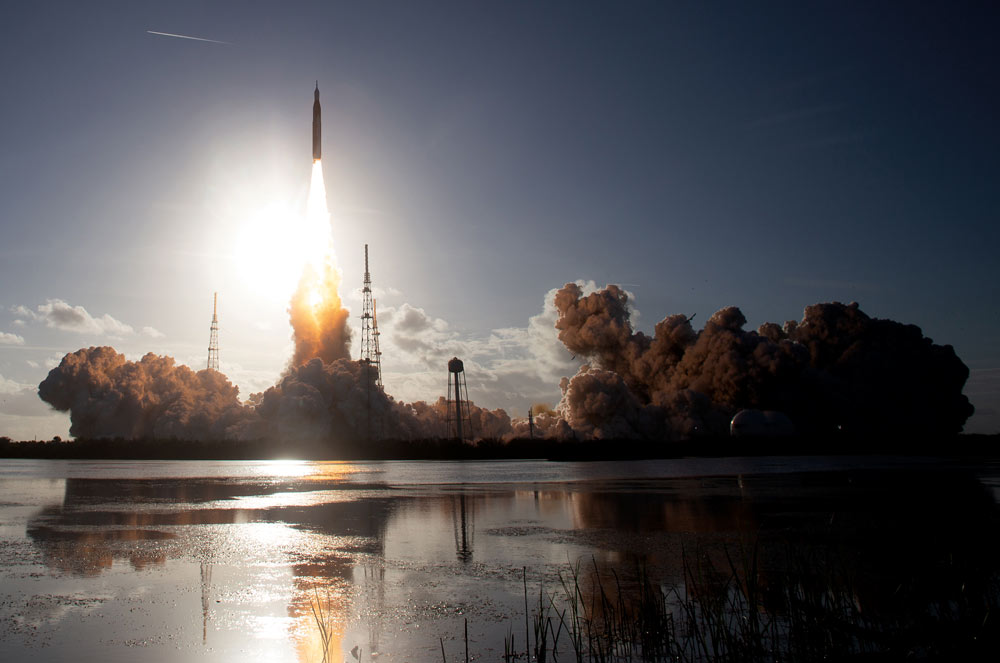
Burger serves as weather officer for launches of the entire fleet of spacecraft, public and private, departing Earth from Florida, and all require equally intense focus. And yet, Artemis II, Burger acknowledges, was the big one. He would be part of history.
Shortly after the successful 6:30 p.m. launch, Burger fought through bumper-to-bumper traffic to unwind at Preacher Bar in Cocoa Beach, a legendary dive that has long been a post-launch gathering spot. Navigating the packed bar, Burger found his way to the Space Force and NASA crowd and raised a glass in good cheer.
“There’s nothing like being high-fived by astronauts who know what you had done to help them get safely into orbit and on their way to the moon,” Burger says. “It’s something that could never be replicated. Am I dreaming all of this? But it really was real.”
Chris Lazzarino, j’86, is associate editor of Crimson & Blue.