



Jayhawks hold leadership positions across diverse industries and professions, and many connect with KU students and fellow alumni through the Jayhawk Career Network. In “Copy the Leader,” KU Alumni, in partnership with SumnerOne, spotlights Jayhawk leaders who are models for others in their fields.
Andrew Moore b’22, is a law student at the University of Virginia. Based in Charlottesville, Moore draws on his experience as a KU student leader in the Business Leadership Program, Undergraduate Business Council and Student Senate.
What do you do in your work, and how do you practice leadership in your role?
Moore: I currently study law at the University of Virginia School of Law which includes a steady diet of classes and extracurriculars. In class, I practice leadership by organizing study groups with my peers and by being willing to answer the professors’ questions when the classroom is otherwise quiet. In my extracurriculars from Managing Editor of the Virginia Law Weekly to Co-President of the run club, I lead by keeping the finances on track (as an accountant I am easily typecast into treasurer-esque roles) and by collaborating with my colleagues to ensure everything is organized and people know what they are doing. Beyond grounds, I also practice leadership informally by planning and hosting game nights to mix people from different classes and groups while having a fun time.
How did your KU education and involvement shape you as a leader?
My time in the Business Leadership Program under Professors Hedeman and Harrison, the Undergraduate Business Council with Professor Crabb, being a teaching assistant with Professor Haug, and Student Senate with Mr. Mucci all taught me how to lead in and out of the classroom. The BLP taught me the importance of “energy, optimism, and enthusiasm,” in every setting. The BLP-SELF study abroad in Slovenia also reinforced the importance of being curious about the world and being able to learn something from anyone. In the UBC, Professor Crabb taught us how to work together as a board, including how to make sure everyone is heard.
Professor Haug, Charly Edmonds, and the other teaching assistants helped me learn how to work with students and how to adjust my working and teaching style depending on what worked best for the students. Student Senate taught me a bit of everything from financial acumen to politics to the importance of networking, but most importantly I learned both how to prioritize and to be able to vigorously disagree with someone in one moment and work closely with them in the next.
What qualities do you most admire in the leaders you have worked with?
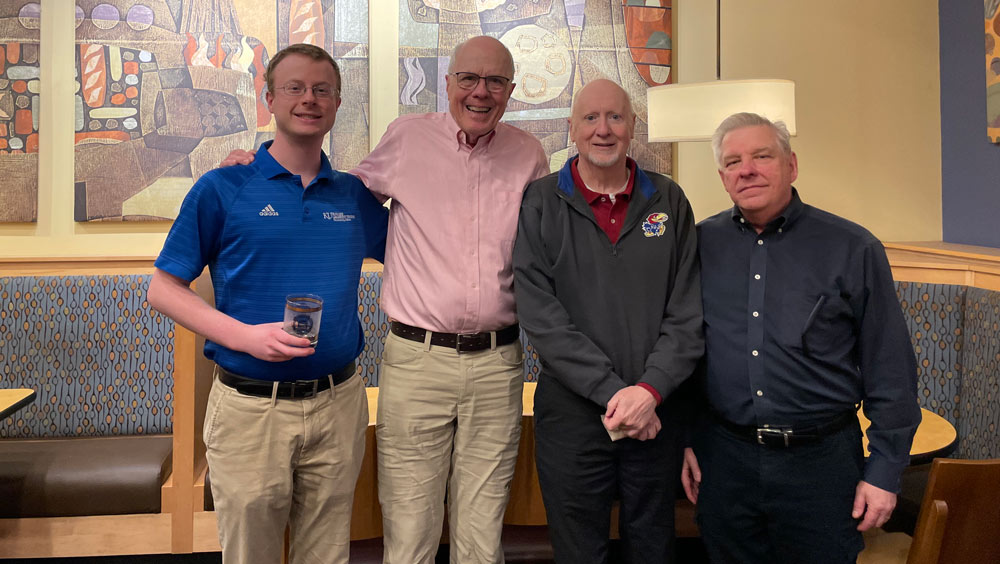
Beyond the mentors I mentioned earlier, Jeff DeWitt at KU, Jess Davis and David Hilton at KPMG, and David Rubenstein, among others, continually model how to lead. Mr. DeWitt’s ability to continuously learn about the world and be curious about innovative trends while tying them all back to the bottom line as CFO of KU continually impresses me. Jess and David both modeled an indefatigability through prioritization to which I always aspire. Both of them were so organized, prepared, and practical that nothing could faze them.
While I did not work with Mr. Rubenstein very closely, I had the opportunity to interact and collaborate with him at an event for the Economic Club of Washington, DC and at the National Book Festival and he is one of my ultimate role models due to his ability to ask insightful questions clothed in a dry sense of humor, his curiosity and near-continuous reading, and his continued drive to serve the public through his philanthropy and service on countless boards and organizations.
How has leadership contributed to the success of teams you have been a part of?
Nicky Demitry, Kelly Wu, and Bradley Berklich’s combined leadership of the Virginia Law Weekly in recent years (I cannot speak to the rest of the 75+ year history) has made it arguably the most successful extracurricular group or publication at the law school. They do a better job than nearly anyone else when it comes to keeping things organized enough to stay on track but otherwise letting a truly fun and hilarious culture thrive among the cohort. While fun is impossible to measure directly, the fact that the Law Weekly continually has people joining and leading in their own ways while other organizations are starved for leaders, all despite the Law Weekly not being as directly career focused as the other organizations is strong evidence that they are doing something (in fact many things) right.
What can students or young professionals do to develop leadership competencies within your industry?
While hard work, knowledge, and staying organized are the baseline, people can set themselves apart from the crowd in a variety of ways and focusing on what you already enjoy will ultimately be most successful. I am very curious, so the reading and networking I have pursued as a result have taught me a lot and connected me with amazing mentors who help me nearly every day. Joining interdisciplinary groups is another good way for students and young people to learn how to work with different people with unique working styles. Regardless of what a person’s strengths are, I would encourage them to be efficient and intentional with their time–there are too many ways to waste time so as long as you know what are doing, why you are doing it, and are having fun or getting something out of the experience that is really all you can do.
How has serving as a mentor benefited you and the work you do?
Mentoring other people is one of my favorite things to do because it both helps me connect with interesting people and practice techniques that I then can apply when I have my own questions. Helping and mentoring those younger than me is incredibly rewarding because the mentees are amazing people at the end of the day. It is always inspirational when a mentee avoids a trap that befell me and Is able to surpass me as a result. Additionally, I can be a chronic overthinker so helping other people when they have big questions forces me to be analytical and curious–which I then can also use when I encounter my own big life questions. I like to joke that I make all my big life decisions by committee and that would certainly not be possible with both my mentors and mentees (who can at times be the same people) indulging my questions and asking me insightful ones in return.