
KU Alumni’s Jayhawks Give Back program is presented in partnership with Andrew Wymore, senior realtor with ReeceNichols.
Jayhawks Give Back celebrates ’Hawks who are making a difference in ways big and small. Each quarter, we feature a member of the KU family and their story. If you know a Jayhawk who should be featured in Jayhawks Give Back, let us know!

When she first set out as a large-format photographer, Courtney Masterson began with scenes she found visually arresting: an old wooden house being swallowed up by vines, the awakening of spring, the intricate patterns in leaves. Eventually, her photos took a dark turn.
“My work started to get really heavily focused on the harder parts (of nature) to observe,” says Masterson, g’16. “I did a series focused on air pollution and soil pollution, the broken human relationships with nature.”
Masterson admits these images were sadder and less palatable—not the type of art people would want to purchase to hang on a living room wall. But if her photography was steering her toward a new path, she couldn’t yet see where it might lead. It wouldn’t be a zoom lens that brought things into focus, but a human guide, pointing out what she’d been missing with the naked eye.
Seeing landscapes anew
It was 2007, and Masterson, who was studying photography and multimedia art at Johnson County Community College, needed a science elective. Since her photography drew her outside, she decided botany would complement her work. When the professor urged the class to volunteer in the community, Masterson met the mentor who would change her course.
Though Masterson had lived in the Kansas City area since she was a teenager, she’d never knowingly set foot on what’s known as a remnant landscape—land that has never been tilled for crops or built upon.
It was a cool day in early spring, and Rocky Point Glade, an old-growth grassland in Swope Park, still seemed gripped by the dormancy of winter. But Masterson’s guide, Linda Lehrbaum, who at the time was the program manager for the conservation nonprofit Kansas City WildLands, started directing Masterson’s attention to the undergrowth.
“As we walked around what looked like dead leaves, sleeping trees and brown landscape, she started to point out these little plants, these beautiful flowers that my eyes had just skimmed over,” Masterson says. “And it just blew my mind.”
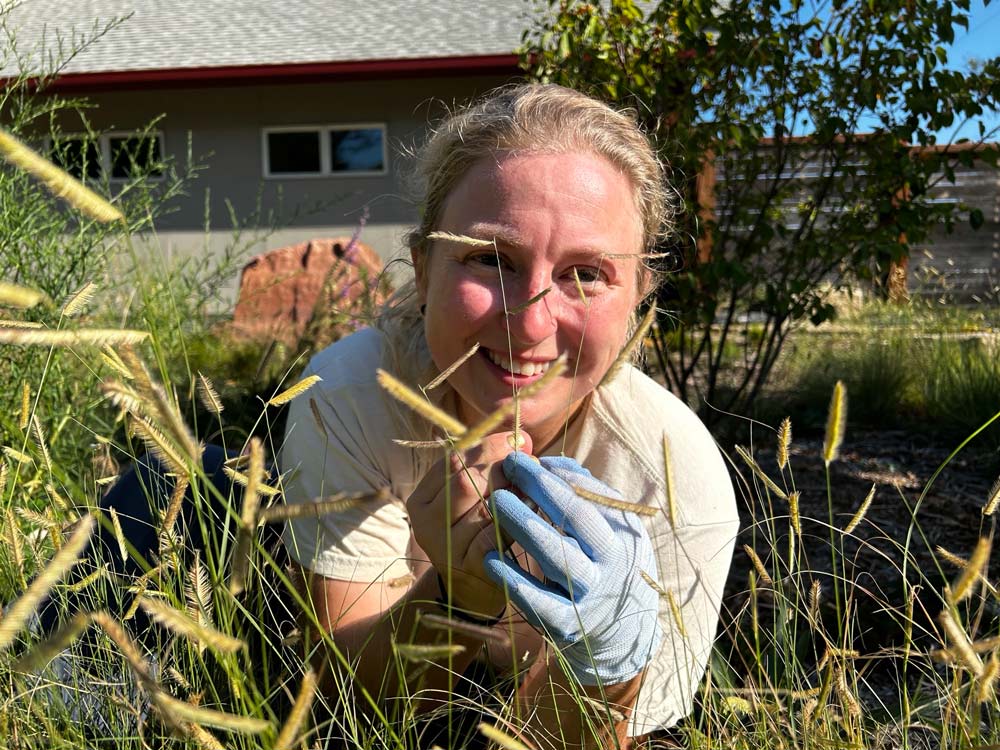
Among the ephemeral species that Lehrbaum identified were nodding trout lilies, translucent-white ghost pipe and the light pink petals of spring beauties. Masterson, even with her artist’s eye for composition, light and detail, had been blind to these species’ fleeting appearances.
Such remnant landscapes are not only exceedingly rare, but are under perpetual threat by development and environmental degradation. Only 6% of the original forests in the U.S. and less than half of the wetlands remain. Tallgrass prairie covers less than 4% of its original area, making it among the world’s rarest and most endangered ecosystems. Masterson would learn that preserving these landscapes not only protects plant and animal species, but improves soil health, water quality and the land’s natural ability to capture carbon.
Suddenly, the bleak images in her photographs had a counterweight. She became a regular volunteer with Kansas City WildLands, which works to protect and restore native ecosystems. She went on to earn undergraduate degrees in biological sciences and chemistry from the University of Missouri-Kansas City before making her way to KU for graduate studies.
‘The power of many hands in the soil’
Masterson moved to Lawrence in 2012 to study ecology and evolutionary biology at KU. Once settled, she and her husband, Ryan Riedel, looked for something like Kansas City WildLands to “scratch the itch” of getting out on the land, but found there wasn’t a Lawrence organization with a similar mission. Masterson decided to meet the need.
She started Native Lands Restoration Collaborative in 2015 and graduated with her master’s degree the following year. Projects led by Native Lands have included riverbank, prairie and wetland restoration in Kansas and Missouri, all buoyed by community partners and volunteers.
“As an ecologist and a botanist, I was out in the field all the time by myself,” Masterson says. “It can feel immense and heartbreaking to see how much work needs to be done, and we can’t do it alone. So we started to build community around this work and felt the power of many hands in the soil beside us.”
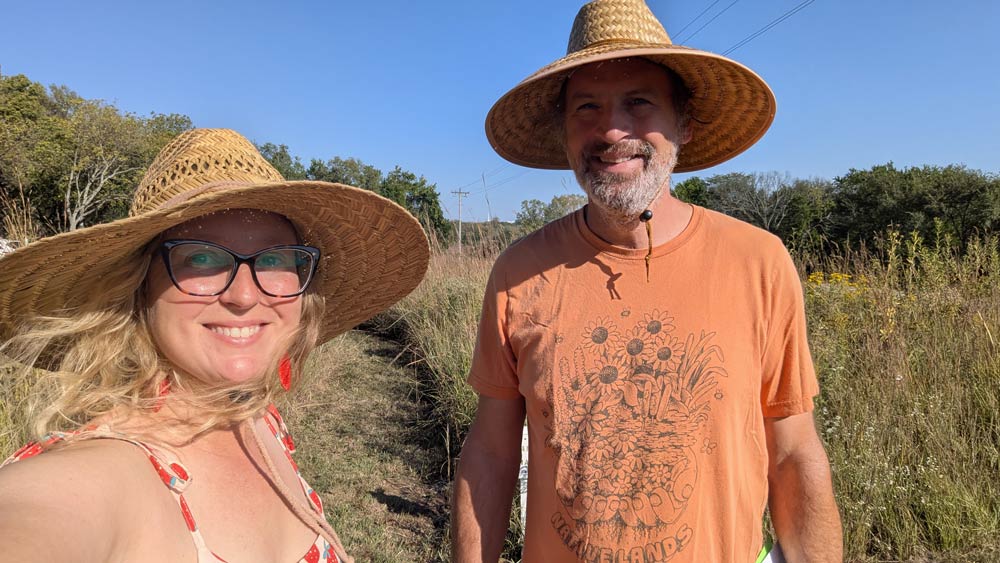
One project in the works, along Burroughs Creek Trail in East Lawrence, will remove invasive plants and replace them with native species. Masterson says the project, which is partially funded by the Douglas County Heritage Conservation Council, will improve stormwater infiltration, slow and trap trash and pollutants prior to entering the Kansas River, and provide invaluable habitat to native animals and an educational landscape for visitors.
“This restoration project provides care to a vital wildlife corridor through busy East Lawrence, a landscape that has changed dramatically over the last 200 years,” Masterson says. “While little of the historic landscape remains along Burroughs Creek, we know what is left is vital to the health of our community.”
Masterson says the restoration, which begins this fall, will continue at least through spring 2028, though she hopes Native Lands can continue caring for the area indefinitely with community support. Like other Native Lands initiatives, the project calls on the help of volunteers and local partners. Surrounding residents wrote letters of support for the grant application, and Masterson says volunteers are already showing up regularly in large numbers to pick up trash and remove invasive species. Partners include Sparks on the Creek, the organization that hosts the Firefly Festival at Burroughs Creek; Friends of Lawrence Area Trails; Haskell Greenhouse; and the Lawrence Parks and Recreation Department.
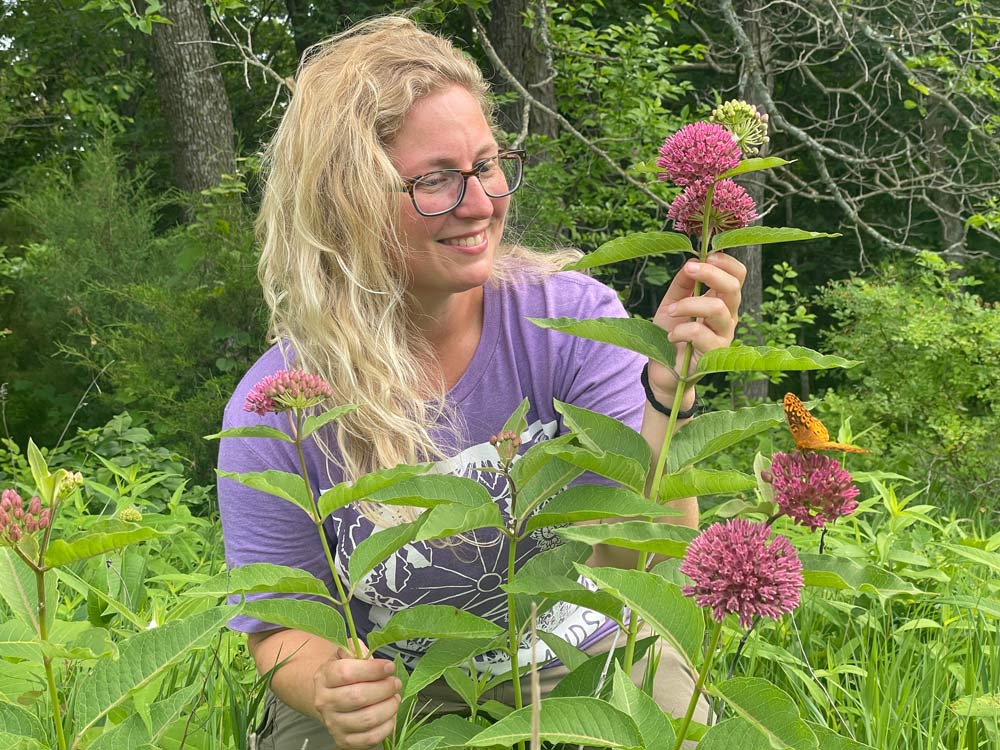
The exact collaborative formula took time to establish. Masterson originally organized Native Lands as an LLC and wrote grants in collaboration with nonprofit partners, but she eventually realized Native Lands could be more effective as a nonprofit and reorganized as Native Lands Restoration Collaborative in November 2022. She says the change has allowed Native Lands to take on a bigger leadership role, organizing its own volunteers and directly applying for grants. While her years in the field readied her to manage those responsibilities, her time at KU—which included mentoring from Helen Alexander, professor emerita of ecology and evolutionary biology—sharpened essential statistical skills.
“Being able to back what we do with science, interpret new research and be involved in new research, which we still strive to do every day, is key to being respected as a conservationist,” Masterson says. “Because there’s a fine line between being a ‘tree hugger’ and being an effective land steward.”
A place to gather and learn
Another focus of Native Lands is community education. The organization offers internships and skills training to the community, and Masterson and Riedel, Native Lands operations manager, use restoration sites as well as their own property to host dozens of annual educational events.
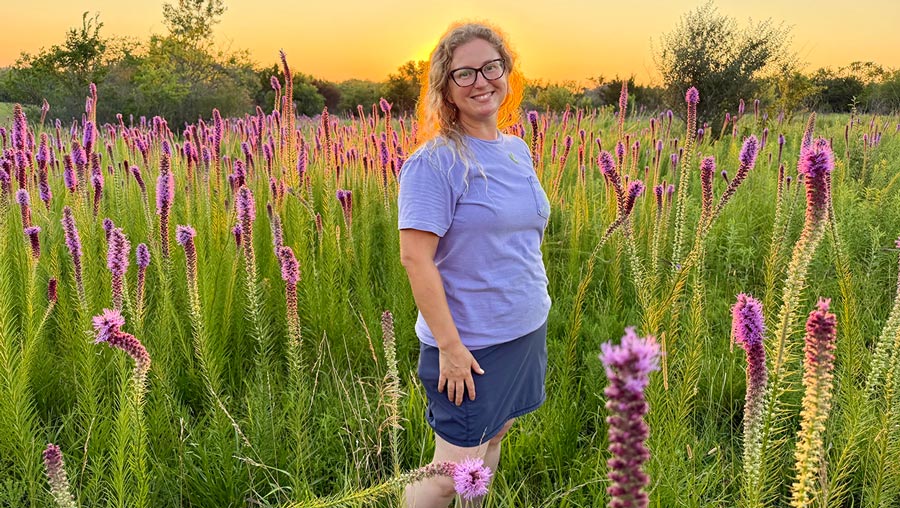
In 2020, they purchased land near the KU Field Station that includes 15 acres of remnant prairie. Named Blazing Star Prairie for the hot pink blooms that dominate the landscape in summer, the land, which also includes woodlands and wetlands, serves as the nonprofit’s headquarters. Since grant-funded work can mean gaps between projects, Masterson says the land provides an outdoor classroom that’s always accessible.
“Blazing Star represents a space that will always be there for us to gather community,” she says. “People can come and immerse themselves every day of the year in everything from sustainably gathering white sage with Haskell students to going out foraging on the land.”
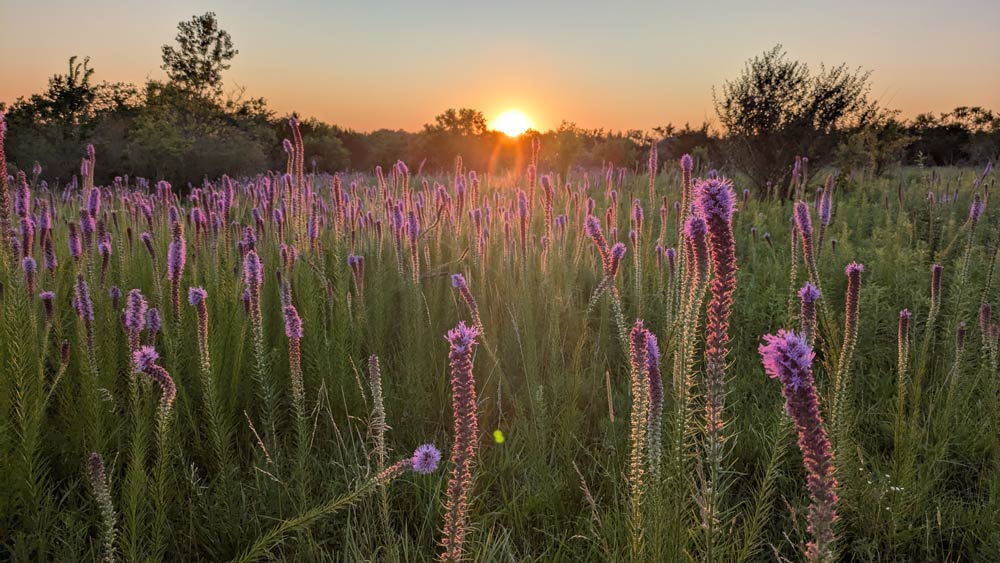
One such event is Native Land’s annual Blazing Star Celebration in July. The hot pink flowers live up to their name, drawing attention to a cause that Masterson says demands greater awareness: that these native landscapes still exist, and that it will take the concerted efforts of many to ensure they endure and grow. But first, they must be truly seen.
Masterson hopes to bring others the awareness she first felt nearly 20 years ago that cool spring day on the remnant grassland, when a knowing guide opened her eyes to the beauty and purpose of the native plants at her feet.
“I couldn’t see them until she showed me,” Masterson says. “And that’s what our work is. That’s what I wake up every day to do: shepherd people into these relationships again.”
Rochelle Valverde, c’08, j’15, is staff writer for Crimson & Blue.