


en·tre·pre·neur·ship
“You’ll actually find a lot of different definitions around the world, but here is how we define it: ‘Can you solve a meaningful problem in a meaningful way that allows for the creation and capture of economic value?’ When we think about entrepreneurship this way, entrepreneurship happens everywhere. It happens in universities. It happens in AI startups. It happens in hospitals. It happens in nonprofits.
“At KU, we focus a lot on building an entrepreneurial competency. No matter where your professional career takes you, an entrepreneurial competency will make you better. Whether you’re a physician, attorney, cancer researcher, musician or accountant, this skill set, this competency, will help you do your job better.”
—Brian Anderson, professor of entrepreneurship in the KU School of Business
1. Establish the framework
On a given day in Lawrence, the future of the University doesn’t announce itself. It sails along on a rising tide of curiosity and discovery—the same forces that have powered KU’s academic experience from its earliest days.
Now, however, that experience unfurls in innovative ways, and the University’s new way of doing business can be found in focused conversations, in whiteboard sketches, in introductions that begin with a handshake and sometimes result, months or years later, in a company that has achieved the unlikely: converting academic brainpower into fiscal expansion.
“It’s hard to build things that are new. It’s hard to take an opportunity that is ill-formed and ill-defined and convert that into something where your solution actually makes somebody want to pay you to solve that problem,” says Brian Anderson, professor of entrepreneurship in the School of Business. “We tell students this is not rocket science, but it is hard work. Resiliency, grit, hustle—all of these things are so critical to learn in the process of becoming an entrepreneur and building entrepreneurial competency.”
For years, these ambitions happened in pockets, scattered across campuses and academic fields. A KU graduate would leave, build something meaningful, and add to a growing but largely invisible ledger of Jayhawk success. Another would follow. And another. The numbers created by those siloed stories, when they finally came into focus, were striking: Companies founded by Jayhawks have generated more than $118 billion in exit value—placing KU among the top 15 universities nationwide for entrepreneurial success among its alumni and faculty, despite being positioned far from the deep investor pockets on both coasts.
For John Fein, a Kansas City-based investor who uncovered that exit value figure while tinkering with the idea of creating a second-stage investment fund limited to KU-connected companies, it was both mind-boggling and instantly clarifying.
“We didn’t have the infrastructure around all this entrepreneurship,” says Fein, co-founder and managing partner of Firebrand Ventures and its KU-focused offshoot, The Hill Fund, “but the success was already there. In a very big way.”
KU is no longer relying on isolated success stories. It is instead building a system—intentionally, collaboratively, and across every layer of the Jayhawk community, from incoming freshmen to graduates long established in their careers—to turn ideas into companies and companies into lasting payoff.
KU Innovation Park, Oread Angel Investors, The Hill Fund, a campus entrepreneurship hub set to open in 2027, mentoring programs for students and recent graduates administered by KU Alumni—these and other initiatives across KU’s extended platforms form the core of an entrepreneurship ecosystem that has become a top priority for the University. The ambitious effort boils down to a simple goal: shorten the distance between discovery and deployment.
“How do we facilitate getting discoveries and ideas out of the University and into the commercial space,” Chancellor Doug Girod says of the thinking that’s fueling KU’s burgeoning entrepreneurial initiatives, “and how do you build a pathway for that?”
That pathway, now under full construction, runs through classrooms and across disciplines. It extends into new physical spaces designed to bring ideas and people together. It reaches beyond campus boundaries and into places where companies are built and scaled. And it’s powered by a growing network of investors, mentors, alumni and friends committed to helping the next generation succeed.
“Entrepreneurship at KU is a long game,” says KU Alumni President Heath Peterson, d’04, g’09. “It’s Jayhawks investing in Jayhawks through sharing experience and expertise, deploying capital, and backing one another to build a stronger network and culture of entrepreneurship benefiting all stakeholders.”
In a time of decreasing state support and seismic shifts in federal grant allocations that are putting new pressures on higher education funding and resources, the financial impact of a wholly new emphasis on entrepreneurship will likely be critical to KU’s long-term success. And yet its effects will reach far beyond any bottom line.
In spring 2025, Chancellor Girod greeted hyped-up hopefuls at the dawn of their careers and curious alumni with personal portfolios of investment resources, all of whom had gathered at the Jayhawk Welcome Center for what has since evolved into seasonal Oread Angel Investors events. While mingling with the crowd before delivering his official welcoming remarks, Girod explained his enthusiasm for the concept driving such interactions: “The networks that investors bring to the table are huge, not just from a financial perspective, but also business connection and sales perspectives. That’s a big part of the conversation we need to be having around this. Everybody wins. The investors win, the companies win, the Jayhawks win.”
2. Teach the mindset
That cultural shift begins in the classroom. If KU’s entrepreneurial momentum is visible in companies and capital, it is first cultivated in how students are taught to think.
For Anderson, executive director of entrepreneurship initiatives in the KU School of Business and Frank T. Stockton Professor of management and entrepreneurship, the goal isn’t simply to teach students how to start companies. It’s to help them understand how opportunities emerge—how to recognize and evaluate them and act in the face of uncertainty.
Entrepreneurship, in this sense, is a rigorous academic enterprise that can’t be confined to one major or school. “The majority of our students come from outside the School of Business,” Anderson says of the entrepreneurship studies program he directs. “We have students from every academic unit on campus.”

Increasingly, this enterprising mindset is one KU is working to make available to every student on campus. Students from across disciplines—engineering, education, health sciences, the humanities—are engaging with entrepreneurial thinking, sometimes with specific ideas in mind, sometimes simply exploring how, in an era of rapidly evolving career norms, entrepreneurship might fit into their future.
Both paths are intentional, informed in part by yet another revelatory figure to emerge in recent years: Today, Anderson says, 70% of all incoming freshmen, across the University, list entrepreneurship as an interest area. And what was that percentage 10 years ago? “Oh, I don’t know,” he says. “We probably never even asked the question 10 years ago.”
At its heart, entrepreneurship is about problem-solving. It is about creativity, adaptability, and the ability to move forward without a clear map and despite inevitable setbacks. Cultivating that approach begins early and extends beyond the classroom. Hands-on experiences, mentorship and real-world exposure have become central to how students engage with entrepreneurship at KU. They are encouraged to test ideas, challenge assumptions and learn through iteration.
“We are in the dream-building business, not the dream-crushing business,” Anderson says of how entrepreneurship students are guided and mentored in creation of their early concepts. “Our job is not to tell a student whether an idea is good or is not good. That’s not what we do. A great day for us is when a student who has gone through a class or a co-curricular or some other experience comes in and says, ‘Wow, that idea was not very good, and it did not work out the way I wanted it to,’ followed very closely by, ‘and I can’t wait to try something new.’”
Relationships that students begin forming during this stage—with peers, mentors, advisers—often become the foundation for what comes next. Beyond individual preparation, entrepreneurship education is about building networks that continue to blossom long after Commencement, creating the thriving ecosystem that KU is now actively shaping.
That ecosystem will soon have a new physical center. At the top of the Hill, on the site of the former Jayhawk Bookstore and McLain’s Bakery, KU’s planned Entrepreneurship Hub will provide a space where ideas, people and resources can converge.
Scheduled to open in fall 2027 and launched with a $10 million gift from an anonymous alumni donor, the Hub reflects the simple and powerful idea that entrepreneurship should be accessible, visible and integrated into everyday life at the University.



“This dedicated space represents a major step forward,” says School of Business Dean Jide Wintoki, “in equipping all KU students with the tools and experience to drive innovation.” As Wintoki notes, the Hub is envisioned as being of the School of Business, but existing for the University, and the building itself has been designed to mirror the entrepreneurial journey.
A first-floor coffee shop, open to the public, will serve as an invitation to step inside. From there, the space unfolds in stages: areas for ideation and collaboration, classrooms and meeting spaces for development, advanced environments for execution and presentation, and a rooftop terrace for reflection. As with the evolution of a young business, each step builds on that which came before.
“The Hub is entirely privately financed, all being done by Jayhawk alumni,” Anderson says, “and the importance of alumni being supporters and champions of the program, being excited about it, talking about it, is just so critical. This Jayhawk entrepreneurship story is not defined by any one school or experience. It is very much cross-disciplinary, interdisciplinary, and really tells the rich tapestry of KU’s story.”
Ashton Barker, an Overland Park junior, is a marketing major with minors in entrepreneurship and professional selling. He’s also president of KU’s entrepreneurship club, which has about 50 active members. He says KU’s entrepreneurship curriculum emphasizes “that this isn’t an easy road. You’ve got to learn your accounting, your finance, and all the aspects of business to figure out how to execute them in a very real world.”
He sees the academic rigor as a key aspect of an exciting journey that could one day help him realize his own entrepreneurial dreams. As he works through KU’s existing opportunities, Barker also predicts that entrepreneurship studies at KU will “grow exponentially as soon as we have a building of our own that isn’t isolated within the business school.”
KU’s soon-to-be-real Entrepreneurship Hub is a statement—a visible commitment to the idea that innovation belongs at the center of the KU experience, not at its edges.
3. Turn concept into company
If the Hub represents the front door, KU Innovation Park is where ideas move into the real world. Headquartered in two glistening West Campus buildings that boast a combined 55,000 square feet—with expansion planned for West Campus and specialized wet lab space available on Wakarusa Drive—Innovation Park operates as a bridge, connecting research, industry and entrepreneurship in a shared environment built for growth.
Its mission: Create, recruit and grow high-impact technology and bioscience companies while strengthening the regional economy. Inside its labs and offices, startups work alongside established companies and research teams—a proximity that would be difficult to replicate elsewhere—gaining access to resources and expertise.
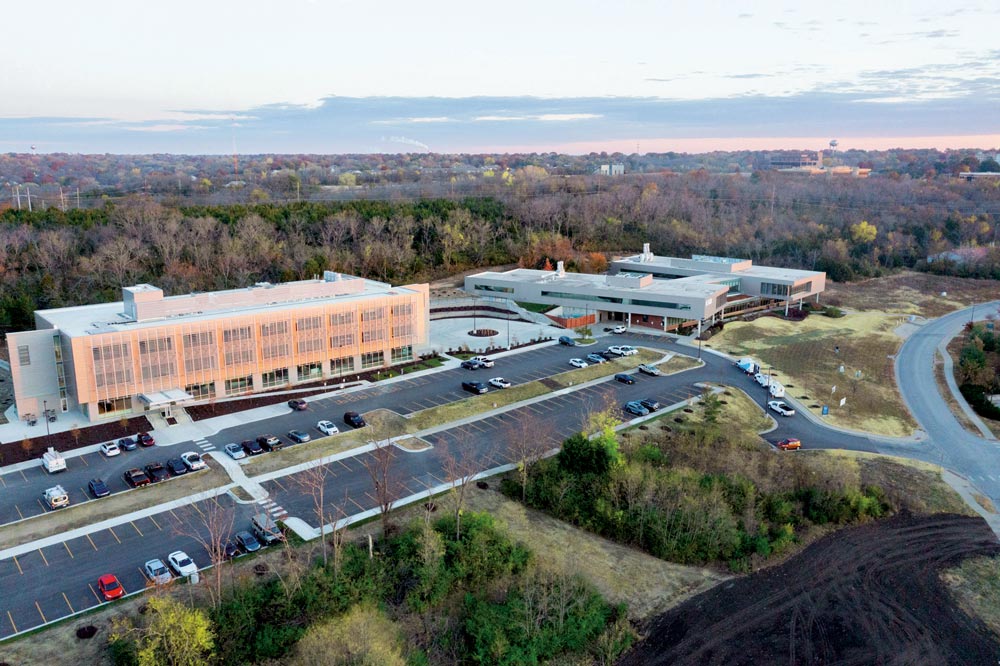


But what makes KU Innovation Park distinctive is not just its infrastructure—it’s the structure, built on a public-private partnership that brings together the City of Lawrence, Douglas County, the Lawrence chamber of commerce and the University. That alignment reflects a broader truth about entrepreneurship at this scale: It doesn’t happen alone.
“This center is more than a building,” the late LaVerne Epp, Innovation Park’s longtime leader, said at its 2009 groundbreaking. “It is people, who will transform ideas into commerce.”
Today, that vision continues as KU Innovation Park grows, serving as both a launch point for startups and a destination for companies looking to expand. It also plays a central role in addressing one of entrepreneurship’s most persistent challenges: access to capital.
One of KU Innovation Park’s latest and most consequential programs is Oread Angel Investors, which invites alumni and friends of the University to consider providing critical funding to business plans proposed by students and recent graduates. The network was launched in 2024 with a $500,000 grant from the Kansas Department of Commerce. It works tongue-in-groove with The Hill Fund, which is focused on financial support for established businesses ready to take a critical next step in their growth. With those combined efforts, KU helps support a capital pipeline designed to fuel companies at multiple stages, from early ideas to scaling ventures.
“Obviously capital in the Midwest is a little bit harder to find than someplace like Silicon Valley or Austin, so we were hoping that this would fill that gap, and we’ve had good success,” says KU Innovation Park CEO Adam Courtney, who notes that about 115 alumni “angels” have so far invested more than $1 million. “We’re just trying to keep the momentum of Jayhawks investing in Jayhawks, and so far it’s been positive.”

KU Alumni is a partner of Oread Angel Investors and helps facilitate connections between the network and Jayhawks who want to get involved in angel investing.
The Hill Fund’s John Fein was already a mid-career success by the time he joined the Jayhawk family. A Boston native who moved to San Diego in 1991, Fein joined his first startup in 1997. By the time of his fifth such enterprise, he and his wife were having their first child, and he was directed to “get a normal job.” That’s what Fein thought he was doing when he agreed to help a San Diego company make its first outreach into Overland Park, which sounded like an idyllic spot to slow down and raise a family. Instead, Fein helped push that new operation—then called Prescription Solutions, now Optum Rx—into business overdrive. It sold to United Health Group for $8.1 billion about a year after Fein’s 2005 arrival in Kansas City.
“I worked there a few years,” Fein says, “but the catch was, that wasn’t my crowd. So by 2012 I just started showing up at startup events in Kansas City on nights and weekends, just meeting people, building relationships one by one, and through that I got connected to a company called Techstars, a global startup accelerator company.”
In 2014 Fein organized Techstars’ first foray into the Kansas City market, hosting one of its globally renowned three-month boot camps in Kansas City’s Crossroads district. Participating in 30 investments out of the Techstars investment fund and learning from “the most accomplished investors in the industry,” Fein identified his own opportunity to tap the Kansas City investment market. Launching Firebrand Ventures with an $18 million fund, Fein and his partners then created a $40 million fund, and, pondering ideas for a third fund, Fein hit upon the notion of focusing not on Kansas City, but on KU, where he had already spent years as a guest speaker in various business classes and investor conferences.
An initial pitch to KU Endowment, he says, led to the research that uncovered the vast pool of billions of dollars in value generated by Jayhawk-affiliated companies, and from there The Hill Fund was born.
“I concluded after speaking with other university-focused funds for other university systems that there had to be a really strong partnership with KU to make this work, and that’s exactly what has happened,” Fein says. “We had the support of all different areas, from the chancellor on down, and that meant we could collaborate. What makes this work is the relationships. We feel like we’re part of the community and that provides us opportunity to add value back into that community.”
4. Build something real
Gorkem Sevinc, e’08, is a Fulbright scholar from Cyprus who completed his computer science master’s degree at Johns Hopkins University and later co-founded Hopkins’ Technology Innovation Center. Eager to create his own company and generate his own income, Sevinc devoted his downtime during the COVID-19 pandemic to addressing a critical issue facing business computing: the accuracy of input data.
“As a data leader, what I saw was, I have all these really cool machine learning and AI models that I’m building, and I cannot trust the data that I’m acting on,” says Sevinc, who would go on to co-found the data quality company Qualytics. “So how can we actually use machine learning and AI models to help us make this data governance problem easier to solve, easier to manage and easier to scale?”

Now in its sixth year, his Atlanta-based company grew threefold, year over year, from 2023 through 2025, and boasts a customer base that includes Blackstone, Brookfield, Georgia-Pacific and Wells Fargo. Eager to keep building momentum now that the rest of the business world is, even in just the past six months, finally grasping the scale of the data-quality problem he’s been wrestling with for years, Sevinc opened a second stage of investor funding.
He says he chose to include The Hill Fund among his investors based on—you guessed it—Jayhawk relationships that he can trust.
“John and his team are absolutely fantastic. I saw that they really want to not only put money to work, but they actually want to help the company, make introductions and get our name out there, and that’s been absolutely great,” Sevinc says. “It’s interesting how sometimes you know an investor is going to put in a lot of money and then completely forget you, and then sometimes an investor puts in a little money but then is always picking up the phone and saying, ‘What can I do for you this week? How can I help you?’ Those are the investors I like working with.
“We’re building a business. We’re slaying the dragon here. It’s hard. Going from having an idea to convincing a company like Wells Fargo to become my customer—that’s not for the faint of heart. A lot of things are going to go wrong during that time. It takes a village for something like this to become a real thing, and you want your investors to be on the journey with you.”
5. Use volatility as motivator
Sevinc says that when he studied computer science at KU, “entrepreneurship was not a thing. Having the ecosystem to support that now is huge.” Huge, and necessary. As Professor Anderson observes, students arrive at KU intrigued by entrepreneurship education because “barriers to being an entrepreneur have never been lower,” including culture, support, and dissolution of the once-traditional stigma around failure, all of which nudge young adults toward considering entrepreneurship as their career or preparing now for possible entry somewhere along their uncertain real-life journeys.
“These are typically students who have insane drive,” Ashton Barker says of his fellow Jayhawks who are active in the entrepreneurship club. “You’re not talking about someone who is satisfied with 9 to 5 in an office. You’re talking about people who want to be involved in all different aspects of their business and see it built from the ground up.”
Today’s college students, Anderson notes, nurtured their entrepreneurial drive while admiring cultural icons in sports, music, movies and social media who, unlike celebrities of previous generations, are active in merchandising and generate vast wealth by owning their own narratives and messages. “Taylor Swift is an unbelievably successful entrepreneur,” Anderson says, “and she is rightly known and celebrated for that.”
The third aspect of entrepreneurial attraction, as Anderson sees it, is that young people today “have known a fair amount of economic volatility, as a generation,” and volatility—for good or ill—is certain to remain part of their lives. “Think about students graduating in May 2026,” he says. “They started at KU before the ChatGPT moment even began. If we think about the change they have seen in a very short period of time, you can see the draw toward, ‘Maybe I should consider betting on myself and creating and owning my own pathway.’ We certainly see that in the technology entrepreneurial space, but we’re also seeing that across the board.”
From classroom to marketplace, from alumni networks to venture capital, the pieces necessary to support those dreams are coming together at KU—not as separate initiatives, but as parts of a coordinated whole, all designed to meet career needs for students, help fulfill economic goals for KU and the state, and offer engagement opportunities for alumni.
While the work is still unfolding, the direction is clear. At KU, entrepreneurship is no longer an outlier. It is core to the culture, and it points forward. The work of building something new will always be difficult, but at KU, it no longer has to be done alone.
Entrepreneurship at KU, by the numbers

$118 billion+
Exit value generated by Jayhawk-founded companies.

70%
Incoming KU freshmen who list entrepreneurship as an interest area.

115
KU alumni who have so far collectively invested more than $1 million in Oread Angel Investors.

Fall 2027
Slated opening for KU’s Entrepreneurship Hub at 1420 Crescent Road, a new, physical headquarters for the University’s interdisciplinary entrepreneurship programs.
Connect to KU’s entrepreneurship ecosystem
Learn more about Oread Angel Investors.
Contact The Hill Fund by Firebrand Ventures.
Join the more than 16,000 KU alumni, students, faculty and staff on KU Mentoring+, the University’s platform for mentoring and networking.
Read more Crimson & Blue stories of Jayhawks who’ve started their own businesses.
Listen to “The KU Hustle,” KU Alumni’s new podcast that spotlights alumni entrepreneurs and business owners, on your favorite podcast platform.
Chris Lazzarino, j’86, is associate editor of Crimson & Blue.