
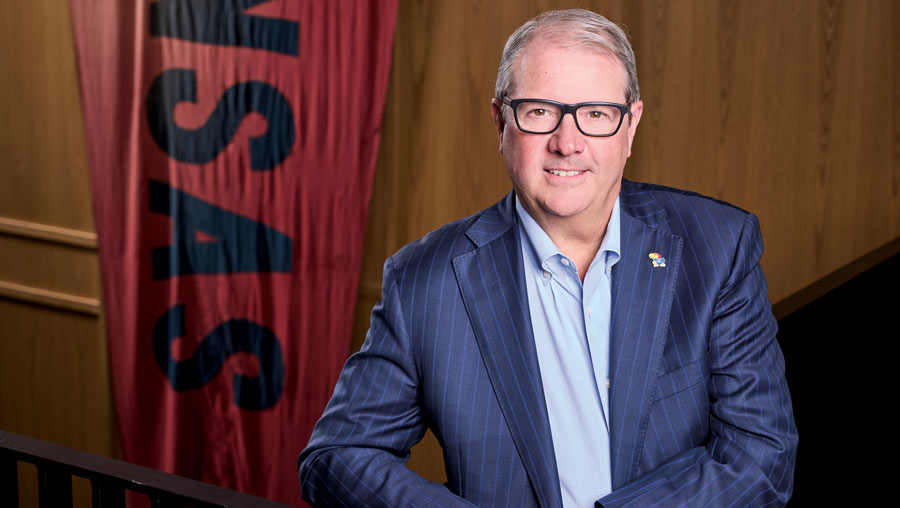
When Douglas A. Girod was announced as KU’s 18th chancellor, at a July 2017 news conference in the Lied Center lobby, he arrived as a known quantity.
That had not been true of his recent predecessors, accomplished leaders who had come to KU from elsewhere. No, Girod had already spent 23 years at KU Medical Center, where he had been a nationally prominent head and neck surgeon, a popular teacher, chair of otolaryngology and executive vice chancellor. Readers of Kansas Alumni magazine—Crimson & Blue’s predecessor—had followed him into operating rooms in Guatemala and met him again when he assumed the medical center’s top job.
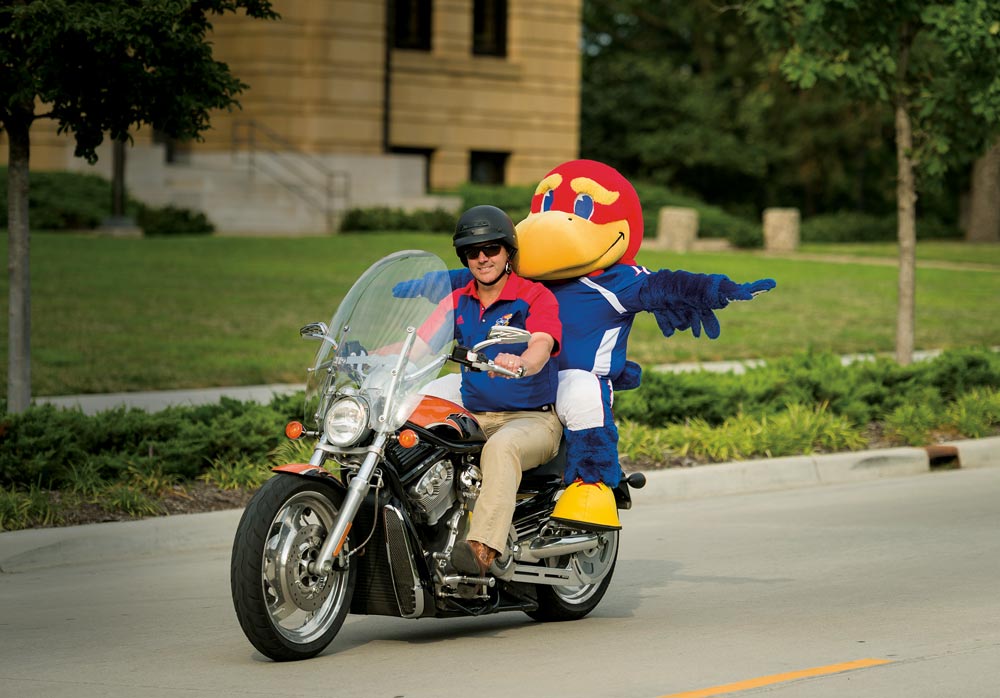
He was the nationally prominent surgeon who had helped revolutionize microvascular facial reconstruction; the administrator whose pager interrupted his public audition for the executive vice chancellorship; the motorcycle rider, fly fisherman and amateur race car driver whose family joined him on medical missions around the world.
Now, nine years into his chancellorship, much of that life has receded. Girod has not undertaken a medical mission since moving to Strong Hall. He stopped performing operations when he became chancellor and recently closed his clinic, after continuing to follow his cancer patients for years. He has found time for only two out-of-town motorcycle rides this year.
The University remains Girod’s vantage point. But, increasingly, his perspective is national.
At a moment when foundations underpinning American higher education seem to be shifting, Girod chairs the boards of both the prestigious Association of American Universities and the Big 12 Conference. His Big 12 role puts him on the NCAA Board of Governors and the newly reorganized NCAA Division I Board of Directors, and he also serves on the board of the College Sports Commission, the independent organization created in 2025 to implement and enforce provisions of the U.S. House settlement governing revenue sharing and name, image and likeness compensation.
The posts place Girod inside consequential national discussions about the future of scientific research and college sports—enterprises that can appear unrelated until one considers their immense influence on KU’s enrollment, finances, reputation and ability to serve the state.
“Being in the weeds on a daily basis,” Girod says, “certainly makes me a better-informed chancellor in terms of figuring out how to best position the University of Kansas in this environment.”
The environment is unlike any he has encountered, Girod says, comparable only with the pandemic’s forced restructuring of all University operations. A smaller-than-usual demographic of 18-year-olds—the result of the reduced birth rate in the wake of the Great Recession—places heavy pressure on enrollment numbers across the country. Public trust in higher education has declined. State support remains a perennial concern. The federal research enterprise is being remade in ways that remain uncertain. College athletics is adjusting to revenue sharing; name, image and likeness (NIL) oversight; toothless transfer rules; and an unrelenting succession of legal challenges.
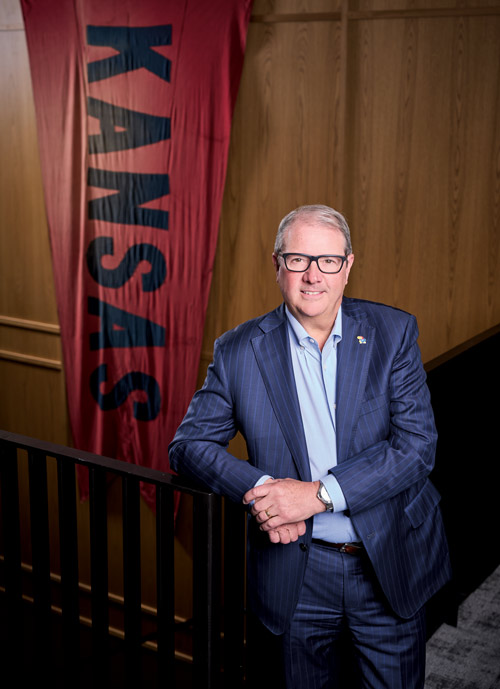
Girod describes it as “collisions of tectonic shifts at the same time,” with every branch of KU’s varied missions under pressure at once. His response owes something to the work by which Kansans first knew him.
“You often are operating in an environment of chaos,” Girod says of performing surgery. “You do have to have a plan, but you better have two or three backup plans, and you better be willing to pivot midstream.”
All while remaining calm, he explains, and helping everyone around you do the same.
“You need to save your energy and your time,” Girod says, “for the things you can control.”
There may be no better mindset for the present: remaining cool and confident in the face of wildly uncertain outcomes.
The research compact
At the Association of American Universities, Girod’s peers elected him to lead an association of 71 preeminent research universities in the United States and Canada, split almost evenly between public and private institutions. Although his term as AAU chair ended in October, Girod remains on the board for another year as past chair.
At its heart, Girod says, the AAU is a research-advocacy organization: a collective voice for the universities that conduct much of the nation’s most ambitious research and educate its next generations of scientists.
“Historically, these used to be fairly honorific,” Girod says of his national leadership roles. “They are not these days. They’re very busy roles, and that comes with an obligation. If you’re going to lead the nation’s leading research organization of institutions, then your voice is the one that has to be the voice of that organization.”
In May, he and AAU Vice Chair Ronald Daniels, president of Johns Hopkins University, carried that voice to the opinion pages of The Wall Street Journal. Congress had recently appropriated, and the president had approved, money for federal agencies that support university research, but, Girod and Daniels wrote, the customary flow of new grants had slowed dramatically.
More than halfway through the 2026 fiscal year, they noted, the National Institutes of Health had allocated only 33% of the $26 billion it ordinarily awards to universities. New NIH awards were down nationally, with an especially steep decline in awards supporting scientists in training. In Kansas, new awards were down $182 million from the previous year at that point.
The numbers can sound like institutional-scale budget problems, but the consequences are human. Researchers whose work might lead to novel cancer treatments, advances in agriculture or dazzling new technologies can be stymied. Graduate students and postdoctoral researchers might not advance their careers past the starting line. Patients and families awaiting discoveries meant to ease pain and extend lives would never know what could have been.
Federal research grants generally operate as reimbursements, Girod explains. Universities receive an award, conduct the work, incur expenses and bill the government against the grant. When payments stall, universities are left financing federal commitments.
“We don’t have the balance sheet to float the government,” he says. “If this continues very long, you’ve got to start making some hard decisions.”
The concern is not merely that money has slowed, but that the model itself may be changing without a clear national discussion. The National Science Foundation has signaled interest in directing fewer grants for artificial intelligence research through universities in favor of increased support of industry-led research.
Industry research has long been an essential partner to university efforts, Girod says, yet it occupies a different place in the research ecosystem. Businesses answer to quarterly returns and avoid unprofitable investments. University researchers pursue advancements in knowledge and understanding that may not have immediately apparent financial returns.
“If you want to change the paradigm, let’s have a conversation,” Girod says. “What are you trying to accomplish, and let us help you accomplish that. But doing it behind the curtain and leaving us trying to figure it out is not a very functional way to get to a different place.”
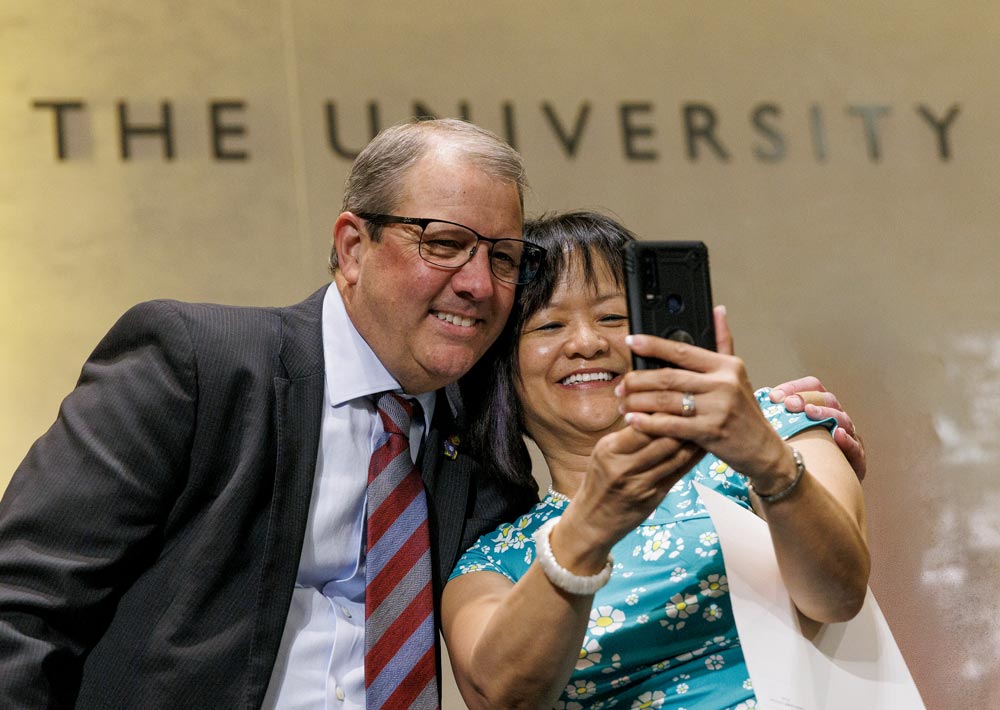
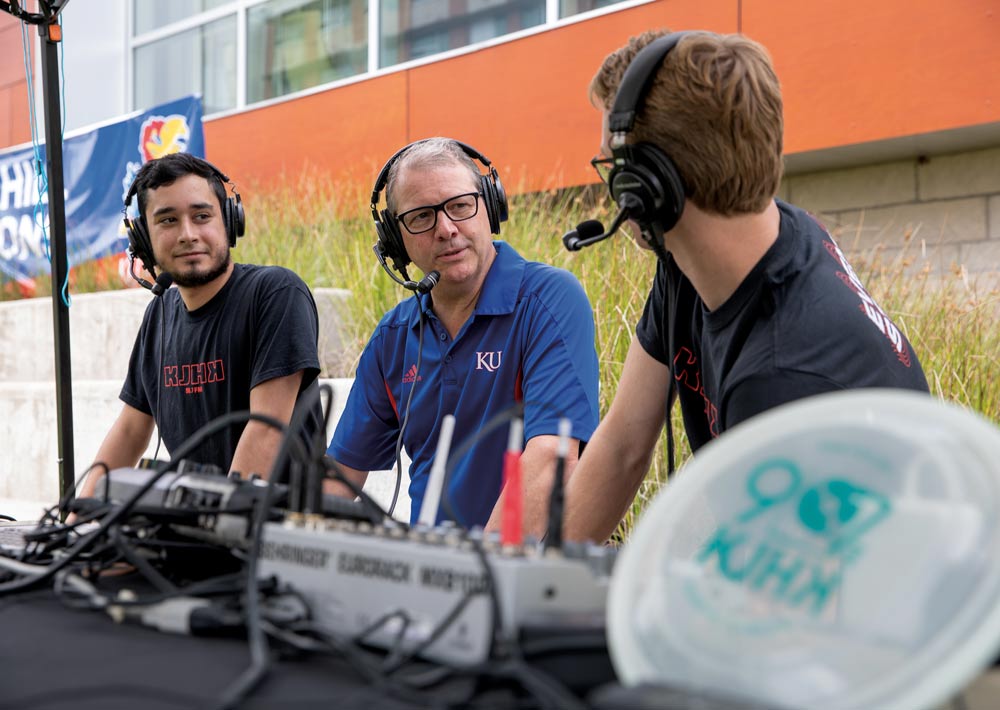
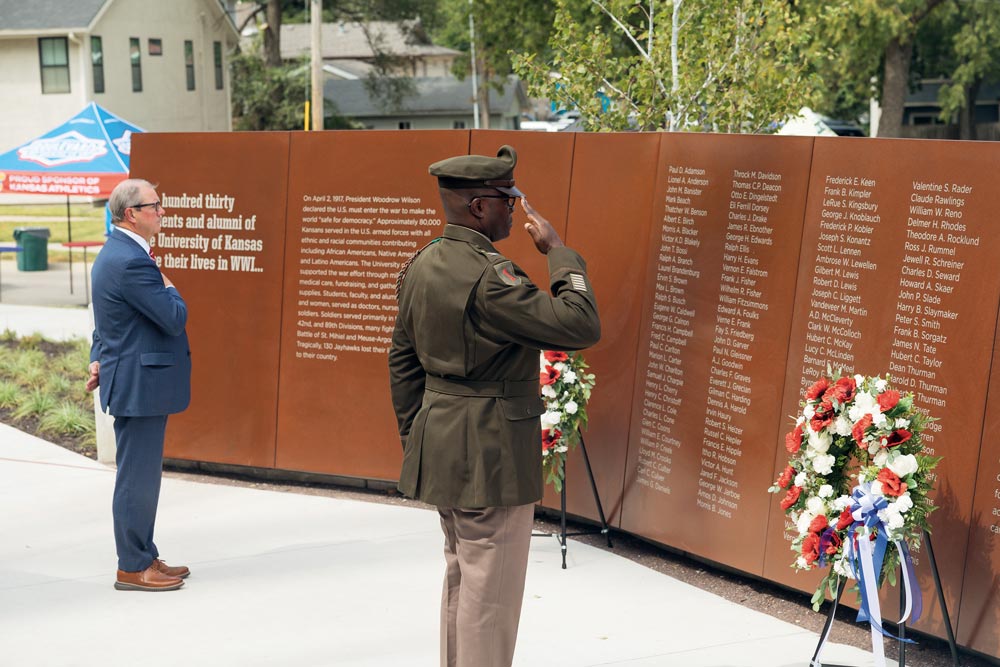
His national post with the AAU puts KU in that conversation and gives the University a clearer view of changes as they unfold. It also gives a public university in a relatively modestly populated Midwestern state a prominent voice in an arena assumed to belong to elite institutions on the coasts. Girod and Daniels emphasized that point in their essay: One of them leads a private university in Maryland, a reliably Democratic state; the other, a public university in Kansas, a reliably Republican one. Their researchers serve the same public good.
For Kansas, that work is anything but abstract. Girod says KU’s research enterprise supports more than 5,000 jobs and has generated about 50 companies based on University technologies. Collaborations with KU also help attract major employers to the state, including the Panasonic battery plant in De Soto.
Research is only one part of the economic equation. KU awards more than 5,000 degrees and certificates annually. About 70% of graduates from Kansas remain in the state for work, as do roughly one-quarter to one-third of graduates who came from elsewhere. When companies evaluate a state for possible expansion, Girod says, their primary concern is not taxes but talent: Are the workers there? After that come schools, healthcare and quality of life. KU contributes to all of them.
“We’re a pretty attractive place as a result of our ability to meet a lot of those needs,” Girod says, “and when you figure we’re only 3 million people in the state of Kansas, we’re punching above our weight.”
Stability in a time of chaos
College athletics offers a more visible example of national instability. The broad outlines are familiar to fans: conference realignment, the transfer portal, revenue sharing and NIL payments. Less apparent is the legal and administrative machinery required to hold it all together.
As with the leaders of all conference schools, Girod has served on the Big 12 board since becoming chancellor. Before beginning his current two-year term as chair in 2025, he served two years as vice chair and one as secretary-treasurer. He has helped lead the conference through a period in which its survival was by no means assured.
One year after Texas and Oklahoma announced in summer 2021 that they intended to leave the Big 12 for the Southeastern Conference in 2025, the Big 12 hired sports and entertainment business executive Brett Yormark as its commissioner. Yormark promptly convinced Texas and Oklahoma to leave a year early and negotiated a media agreement ahead of schedule. Had those moves not been made, Girod says, the Big 12 might have suffered the fate of the shell-shocked Pac-12, the now-humbled conference Girod grew up following in Oregon.
The Big 12 instead swelled to 16 universities across 10 states. Girod strongly supported the addition of Colorado, Utah, Arizona and Arizona State, all members of the AAU. When Texas left, KU had become the conference’s only AAU school; the four additions strengthened not only the conference’s geography and athletic profile, but also its academic standing.
Girod, Yormark says, played “a critical role” in that transformation. The two men found a personal connection during Yormark’s job interview, when Girod learned that Yormark had spent eight years as a NASCAR executive; Yormark, in turn, discovered that the chancellor had been an amateur race car driver (and is still the KU Car Club’s faculty adviser). Yormark says he now speaks with Girod nearly every other day and often communicates with him daily.
“He’s been an incredible sounding board for me, and he’s a fantastic leader,” Yormark says. “There are so many leaders who want to stay in the gray. Doug’s a great listener, and he facilitates incredible conversations among the board, but he is not afraid to take a point of view and support it with great conviction.”
That quality matters as college sports attempts to build a smooth-running machine from truckloads of unlabeled, unordered parts. The U.S. House settlement that permits schools to share revenue directly with athletes also created the College Sports Commission to oversee revenue-sharing and NIL rules. Meanwhile, disputes over athlete eligibility and NCAA authority continue to move through courts across the country.
The NCAA’s unanimous loss in a 2021 U.S. Supreme Court case, which ruled that limits on student-athlete benefits violated federal antitrust law, was a turning point. “We didn’t just lose it,” Girod says, “we got pummeled.” The court’s resounding takedown of the NCAA’s long-held amateurism standards opened the door to further antitrust challenges, and Girod says national legislation is now necessary to give college sports enforceable, uniform rules comparable to those governing professional leagues, and to thwart the growing tide of cases being heard in state and district courts. In exchange, proposed legislation would include student protections involving scholarships, healthcare and other benefits.
“The goal of all the work that we’re doing right now, particularly in Washington, is to create a stable new model that we can all operate in for the next decade or so,” Girod says. Without it, the alternative is continued chaos—an outcome that benefits no one.
Chancellor Girod fast facts
Hometown: Salem, Oregon
Family: Wife, Susan, and children, Katelyn, l’23; Jimmy, c’13, g’19; and Callie
Chancellor since: July 2017
KU Medical Center top job: Executive vice chancellor, 2013-17
Education: University of California at Davis, chemistry; UC San Francisco, medicine, U.S. Navy scholarship; University of Washington, postgraduate residency and NIH research fellowship
Military service: U.S. Navy Reserves; retired in 1997 as lieutenant commander
Medical career before KU: U.S. Naval Medical Center in Oakland, California
Career at KU: Joined School of Medicine faculty in 1994; leadership roles included department chair, interim executive dean, senior associate dean for clinical affairs and KU Cancer Center physician in chief
Hobbies: Grew up racing dirt bikes in Oregon backcountry and now rides big cruisers with Jimmy; Porsche rally car enthusiast; skiing and fly fishing
Why should Kansans who never attend a KU game care whether the NCAA and Big 12 are healthy? Because athletics provides exposure that no university could otherwise replicate. Girod says KU has repeatedly seen direct relationships between football bowl games or basketball titles and enrollment. More than 40% of KU students come from outside Kansas, and many first encounter the University when Jayhawk athletes compete on the national stage.
That stage is increasingly international. Yormark points out that 14% of Big 12 athletes come from outside the United States, and six conference universities operate international campuses. Games and other conference activity abroad—including KU’s Sept. 19 conference game against Arizona State, in London’s historic Wembley Stadium—introduce those institutions to prospective students far beyond U.S. borders.
“A healthy conference,” Yormark says, “is critically important to our 16 institutions.”
KU’s place in a Power Four conference ensures that it remains at the table—competing against prominent institutions, participating in decisions that will shape college sports, and carrying the University’s name and famous mascot into millions of homes. Visibility supports enrollment. Enrollment supplies Kansas with educated workers. Conference stability, like research advocacy, eventually reaches far beyond campus.
Eyes on the patient
His national appointments consume time, but Girod rejects any notion that they distract from KU. If he can help stabilize federal research support, KU benefits. If college athletics can reach a sustainable model, KU benefits. If those systems fail, KU absorbs the consequences.
“As those enterprises go,” Girod says, “so do we.”
He is quick to add that none of the work is solitary. It depends on strong teams at KU, the AAU and the Big 12, and on boards capable of remaining productive under pressure.
“There’s nothing to create cohesion like adversity,” Girod says. “If you’re holding a foxhole together, you’d better be nice to each other.”
At KU, that team is advancing projects intended to outlast any one chancellor: the Gateway District and transformed David Booth Kansas Memorial Stadium; the KU Cancer Center, a milestone achievement that Girod traces across two decades; a $2.5 billion fundraising campaign that exceeded its goal; and the “One KU” initiative to align and modernize the University’s dispersed campuses and administrative routines.
Girod’s measure of leadership is not whether those projects remain identified with him, but whether they prove durable enough to withstand transition. A well-built organization, he says, should be able to “rotate out players without major hiccups. I’m just one more player on that team. When the time comes, you rotate out my role, as well, and nobody breaks stride.”
For now, thankfully, that time has not come. The surgeon remains in the middle of the operation, facing a convergence of challenges with a plan, backup plans and his instinct to preserve energy for what can be controlled.
Girod and his wife, Susan, recently marked their 45th anniversary by taking their three adult children to Croatia—a rare trip, he notes, undertaken not for work but as an actual vacation. One day, he hopes, there will again be more time for family, travel and his eclectic interests.
For now, KU’s familiar chancellor is carrying the University’s interests into discussions whose outcomes will reach communities across Kansas via laboratories, classrooms, playing fields and payrolls.
For now, the country may have a considerable claim on his time. But Doug Girod’s eyes remain on the patient he was summoned to heal.
Chris Lazzarino, j’86, is associate editor of Crimson & Blue.